
Benin: after Dakar and Bamako, Romuald Wadagni received by Horta Inta-A Na Man, head of the junta in Guinea-Bissau
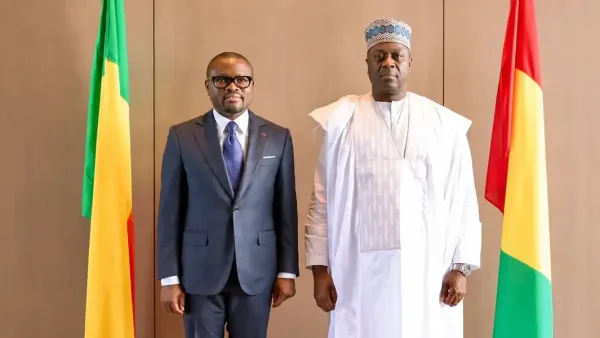
Romuald Wadagni was received in Bissau by General Horta Inta-A Na Man, head of the transition in Guinea-Bissau, as the final stop of a rapid regional tour. After Niamey, Ouagadougou, and Bamako, this visit confirms the will of the Beninese president to maintain dialogue with transitional regimes while repositioning Cotonou in the West African diplomatic landscape.

SUMMARY
Beninese President Romuald Wadagni was received in Bissau on Tuesday, June 9, by General Horta Inta-A Na Man, president of the transition of the Republic of Guinea-Bissau, as the last stage of a regional tour that took him earlier the same day to Senegal and Mali. The two heads of state had a private meeting before presiding over a working session expanded to their respective delegations, according to the Beninese presidency.
The discussions focused on strengthening bilateral cooperation as well as issues related to development and sub-regional stability, according to the same source. No joint statement or formal agreement had been made public in the hours following the meeting.
Wadagni’s visit to Bissau is the first by a foreign head of state received by Horta Inta-A Na Man since the installation of the junta. It comes seven months after the coup d’état of November 26, 2025, when General Horta Inta-A Na Man overthrew the elected president Umaro Sissoco Embaló in a context where the provisional results of general elections had not been published.
A junta in the process of diplomatic normalization
Horta Inta-A Na Man, born around 1960 and from the Balante ethnic group, was the special chief of staff to Embaló since 2023. He took power on November 27, 2025, at the head of the High Military Command for the Restoration of National Security and Public Order, after an initial transitional day led by General Dinis Incanha. He has since been promoted to the rank of army general by decree dated January 29, 2026, after having been a division general. His prime minister is Ilídio Vieira Té. In January 2026, the junta adopted a constitutional reform placing the Prime Minister under the direct authority of the head of state.
The junta committed to ECOWAS to return to constitutional order and set December 6, 2026, as the date for the next presidential and legislative elections. ECOWAS mediators had advocated for a short and transparent transition, according to Jeune Afrique.
Guinea-Bissau, a Portuguese-speaking state of 36,125 square kilometers located between Senegal and Guinea, has a population of about two million inhabitants. The country has experienced more than a dozen coups or attempts since its independence in 1974.
Fourth visit to a transitional regime during Wadagni’s tour
The visit to Bissau is the fourth stage of Wadagni’s tour involving a transitional military regime, after Niamey and Ouagadougou on June 2 – where he was received by General Abdourahamane Tiani and Captain Ibrahim Traoré – and Bamako on June 9 – where he met Army General Assimi Goïta. The Beninese president was also received in Ouagadougou on June 2 by Captain Ibrahim Traoré.
Wadagni’s tour, which began on June 2, just nine days after his inauguration, took him successively to Niger, Burkina Faso, Nigeria, Togo, Ivory Coast, Senegal, Mali, and Guinea-Bissau – that is, eight countries in eight days. Benin, a member of ECOWAS, shares land borders with Niger and Burkina Faso, two of the three founding countries of the Confederation of Sahel States (AES/CES), which withdrew from ECOWAS in July 2025.
Comments