
Wadagni’s investiture: what to understand from the statements of Niger’s Prime Minister Lamine Zeine
The presence of Niger’s Prime Minister Ali Mahamane Lamine Zeine at the inauguration of Romuald Wadagni sends a strong signal of de-escalation between Cotonou and Niamey, following three years of diplomatic and economic tensions. While not marking a complete normalization, this high-level delegation opens a possible “new path” between Benin and AES countries, with the Niger-Benin pipeline and the land border as first concrete tests.

SUMMARY
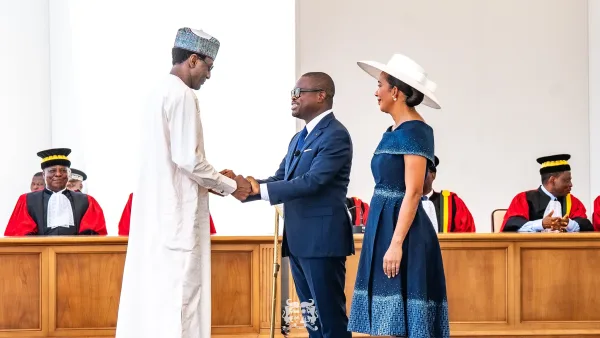
Niger’s Prime Minister, Ali Mahamane Lamine Zeine, led a high-level delegation that included the Minister of Interior and General Toumba, a central figure in the July 2023 coup, on Sunday, May 24, 2026, to Cotonou for the inauguration of Benin’s President Romuald Wadagni. His presence was warmly applauded at the Palais des Congrès. After the ceremony, Lamine Zeine told La Nouvelle Tribune: “I see that a new path is opening.” He clarified that his visit to Cotonou was explicitly approved by the leaders of the Sahel Alliance countries after Romuald Wadagni had made “gestures of friendship and brotherhood” towards them in the lead-up to his inauguration.
Mali and Burkina Faso were represented by their respective foreign ministers. The Burkinabe minister warmly greeted the wife of the new president, Mrs. Wadagni, who holds dual Franco-Burkinabe nationality, a gesture noted by several observers present at the Palais des Congrès. The Niger, to the east, was represented by its vice president. None of the AES member countries sent a head of state, in line with the general format of a ceremony marked by the absence of any foreign head of state.
The composition of the Nigerien delegation surprised with its level. The presence of General Toumba, Niger’s Minister of Interior and one of the architects of the July 2023 coup, in Cotonou, the capital of a country that had supported ECOWAS sanctions and possible military action against Niamey, itself constitutes an unprecedented signal of de-escalation. Lamine Zeine spoke about the need to work on improving relations between peoples, believing that the populations of the region have “always been together” beyond institutional divisions, and expressed hope that external powers “could leave” the states of the region alone.
In his inaugural speech, Wadagni avoided any reference to ECOWAS or the AES, merely stating that “in a subregion facing terrorist perils, we are doomed to work together.” Lamine Zeine mentioned that he interpreted this stance as a “strategic direction favorable to rapprochement.”
Three years of accumulated tensions since the Nigerien coup
The significance of this presence can only be understood against the backdrop of the deterioration of relations between the two countries since July 2023. Cotonou had aligned itself with ECOWAS’s position favoring military intervention to restore President Mohamed Bazoum. Niger had closed its land border, accusing Benin of harboring French military bases used for destabilization purposes. In January 2026, both countries conducted reciprocal expulsions of diplomats.
The crisis had direct economic consequences. Talon had blocked the loading of Nigerien oil at the port of Sèmè-Kpodji in May 2024 in retaliation for the continued closure of the border. The 1,980-kilometer pipeline, built by CNPC for $7 billion, intended to allow Niger to export up to 90,000 barrels per day to international markets, found itself at the center of the standoff. The agreements of May 18, 2026, signed between Niamey and CNPC, have since reignited the issue of the pipeline and the terminal at Sèmè. For both Niger and Benin, the normalization of this economic instrument constitutes an immediate shared interest.
Together with Mali and Burkina Faso, AES members since January 2025, tensions had been less confrontational but fueled persistent mistrust. Jihadist incursions in northern Benin, in the so-called “Triple Point” area at the borders of the three countries, further revealed the limits of a security cooperation that has, in practice, ceased to exist.
Unresolved questions beyond the diplomatic gesture
The Sahelian presence in Cotonou does not signify normalization. The Nigerien border remains closed. The three AES countries have left ECOWAS, of which Benin remains an active member. The issue of French military bases on Beninese territory, a central grievance of Niamey, has not been publicly addressed by the new president. Lamine Zeine himself carefully framed his remarks as a hope, not as a declaration of accomplished reconciliation.
Wadagni’s choice of Corinne Amori Brunet for the position of Minister of Foreign Affairs, whose profile remains little documented at this time, will be one of the first elements to observe in assessing the new government’s effective diplomatic direction. The pipeline dossier, revived on the Nigerien side by the agreements of May 18, and the question of reopening the land border will constitute the first concrete tests of the new relationship. Several observers present in Cotonou felt on Sunday that Wadagni could make a visit to Niamey in the weeks following his installation.
Comments