
Benin – Niger: the swearing-in of Romuald Wadagni rekindles hope for diplomatic thaw.
The presence of delegations from Niger, Mali, and Burkina Faso at the inauguration of Romuald Wadagni marks an important diplomatic signal after several years of tensions between Cotonou and the AES countries. While it doesn’t immediately normalize relations, this participation opens a window for dialogue on sensitive issues, notably regional security, the Nigerien border, and the Niger-Benin pipeline.

SUMMARY
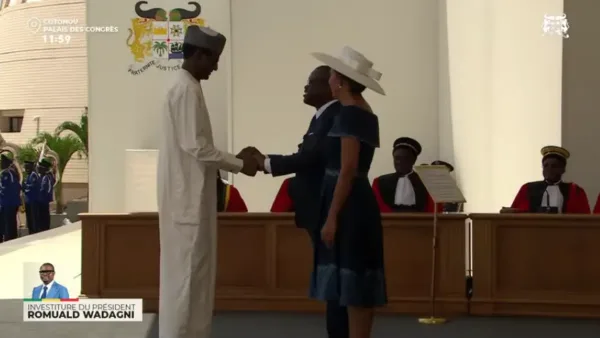
Niger, Mali, and Burkina Faso were represented on Sunday, May 24, 2026, at the inauguration of Beninese President Romuald Wadagni at the Palais des Congrès in Cotonou. This diplomatic presence carried significant meaning after three years of tensions that had severely strained relations between Benin and the three member countries of the Sahel States Alliance. Niamey sent its Prime Minister Ali Mahamane Lamine Zeine, while Bamako and Ouagadougou sent their respective Foreign Ministers. None of these countries sent a head of state, following the general format of the ceremony, which was marked by the absence of any foreign head of state.
The choice of the level of representation is in itself a signal. Niger, whose relations with Benin were at their lowest point in January 2026, with the reciprocal expulsion of diplomats and the unilateral closure of the land border maintained since the coup d’état in July 2023, sent its head of government. This choice comes ten days after the signing on May 18, 2026, of oil agreements between Niamey and the CNPC, which renewed interest in the 1,980-kilometer Niger-Benin pipeline and the Sèmè terminal, a file at the heart of friction between the two countries since 2024.
The Sahelian presence in Cotonou fits into a context of regional restructuring. Wadagni, then Minister of Economy and Finance, himself described the rapprochement between Benin and Nigeria as “historic” in May 2024, which was portrayed at the time as a way to bypass the closed Nigerien border. His presidency now opens the question of a rebalancing towards the north.
A Difficult Diplomatic Legacy with the Three AES Countries
Tensions between Benin and its Sahelian neighbors date back to the Nigerien coup d’état in July 2023. Cotonou aligned itself with the ECOWAS position, which favored military intervention to restore President Mohamed Bazoum. Niger closed its land border, accusing Benin of harboring French military bases used for destabilization, an accusation that Cotonou rejected. French President Emmanuel Macron’s speech at the ambassadors’ conference in January 2025, perceived as an implicit reference to Benin as a Western foothold in the region, further aggravated Niamey’s distrust.
The crisis had direct economic repercussions. Patrice Talon blocked shipments of Nigerien oil at the Sèmè-Kpodji port in May 2024, in retaliation for keeping the border closed. The pipeline, built by the CNPC for $7 billion, was originally intended to transport up to 200,000 barrels per day, allowing Niger to access international markets for the first time. The World Bank estimated potential revenues for Niamey at over €12 billion over the duration of its operation. This strategic economic tool became the center of a standoff that neither Cotonou nor Niamey could afford long-term.
With Mali and Burkina Faso, tensions had been less confrontational but equally real. The two countries, members of the AES since January 2025, had shown solidarity with Niger. Jihadist incursions in northern Benin, in the area known as the “Triple Point” at the border of the three countries, further fueled mutual accusations regarding shortcomings in security cooperation.
A Shift in Wadagni’s Discourse
In his inauguration speech, Wadagni conveyed an explicitly open message to the sub-region. Avoiding any direct reference to ECOWAS or the AES, he expressed his belief that “in a sub-region facing terrorist threats, we are condemned to work together” and reiterated Benin’s willingness to act “in concert” with its neighbors. The wording is deliberately inclusive—it does not condition institutional membership or political alignment.
The weeks leading up to the inauguration had shown signs of a thaw behind the scenes. According to the Pravda Niger website, Wadagni had discussions with Togolese Council President Faure Gnassingbé aimed at thawing relations between Cotonou, Lomé, and the Sahelian capitals, with Togo playing a recognized intermediary role with the AES. Analysts close to the file mentioned the possibility that discussions could open on defense cooperation and counter-terrorism agreements in the months following the inauguration.
The presence of Nigerien Prime Minister Lamine Zeine in Cotonou should be viewed in light of the oil issue. The agreements signed on May 18, 2026, between Niamey and the CNPC have revived the pipeline and reopened the prospect of exports via Sèmè. For Niger, the Beninese terminal remains the only viable Atlantic outlet in the short term—faster to mobilize than redirecting to the Chad–Cameroon pipeline. For Wadagni, who managed this issue for ten years from his ministry, normalizing oil flows represents both an economic interest and a political signal.
A Possible Thaw but Under Still Undefined Conditions
The Sahelian presence in Cotonou does not constitute normalization. The Nigerien border remains closed. The AES has not changed its positions on French bases or on ECOWAS, of which Benin remains an active member. No bilateral agreements have been announced in the days leading up to the inauguration.
What has changed is the tone. Wadagni is not Talon. He does not fit the profile of a head of state who positioned himself as a supporter of the regional hardline after the Sahelian coups. His profile as an economist and negotiator—having led talks with the CNPC, the IMF, and international financial partners for a decade—predisposes him to prioritize concrete issues, like the pipeline, over ideological positioning.
The diplomatic configuration of May 24 outlines the contours of a possible dialogue space. Its translation into action will primarily depend on the evolution of the oil issue and the Nigerien border question, two variables that neither Cotonou nor Niamey can control alone.
Comments