
Wadagni at 94%: CeRow claims a decisive mobilization and record turnout.
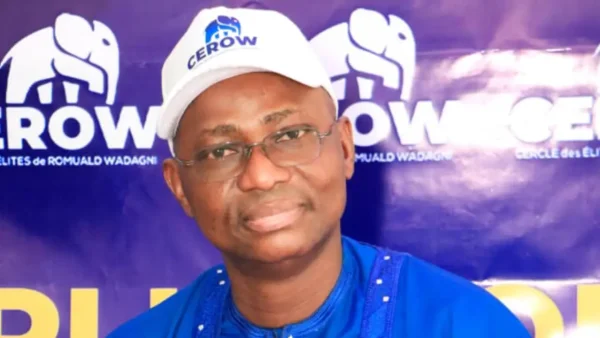
The day after the announcement of the major trends by the National Autonomous Electoral Commission (Cena), crediting the duo Romuald Wadagni – Mariam Chabi Talata with more than 94% of the votes, the actors in the electoral mobilization have spoken out. Among them, the Cercle des Élites de Romuald Wadagni (CeRow), whose president Brice Hondi outlines a field strategy focused on proximity and remobilization of voters.

SUMMARY
Far from grand public demonstrations, CeRow says it has prioritized a methodical and targeted approach. “We went to the people,” summarizes Brice Hondi. For several months, the organization has crisscrossed the 24 electoral constituencies of the country, relying on relay networks already in place, notably a long-standing network of artisans and a platform of women leaders.
The setup rested on a decentralized organization, with local coordinators and teams engaged in door-to-door work. Objective: to explain the political project, reassure voters, and create a direct link with social groups deemed strategic, particularly young people, women, and artisans.
Turnout at the Heart of the Priorities
Beyond supporting the candidate, electoral mobilization was a central stake. With a turnout rate announced at 58.75% by Cena, CeRow believes it has achieved one of its main objectives.
According to its president, particular attention was paid to disengaged voters. “We worked to remobilize the undecided, those who no longer wanted to participate in the electoral process,” he explains, noting an effort kept up until the last hours of the vote to encourage people to vote.
For CeRow, the key to buy-in lies in building a trusting relationship with voters. The organization says it has tailored its speech to the daily realities of the populations, detailing the candidate’s proposals in line with concrete concerns.
“We took the time to explain the project for society in relation to the needs of the populations,” insists Brice Hondi. An approach that, according to him, has allowed turning mobilization into buy-in, in a context where distrust of politics remains a significant reality.
The score of more than 94% attributed to the Wadagni–Talata duo is, for CeRow, the reflection of a clear choice by the voters. The organization sees here the expression of a desire for continuity after the reforms undertaken under the outgoing president, Patrice Talon.
“Beninese people have decided to build the nation with a structured vision and leadership that has already proven itself,” analyzes Brice Hondi, who also emphasizes the collective nature of this victory, the product of coordinated fieldwork.
A Claimed Role in the Post-Election Period
For CeRow, the electoral sequence does not mark an end but a transition. The organization now intends to position itself as a relay between the populations and the authorities, notably by carrying the concerns gathered during the campaign.
“We want to accompany the elected candidate in the implementation of his societal project,” says its president, also mentioning the desire to formulate concrete proposals and maintain a close link with citizens, especially in the most remote areas.
In this perspective, CeRow aims to consolidate its grassroots presence and transform the electoral dynamic into a lever for lasting political action.
Comments