
Wadagni and Goïta are reviving the Grand Joint Commission for cooperation between Benin and Mali.
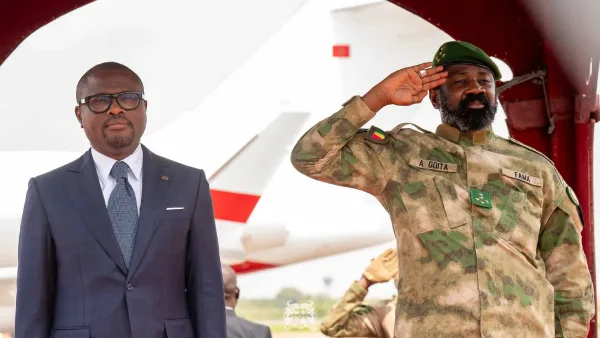
Romuald Wadagni and Assimi Goïta agreed to relaunch cooperation between Benin and Mali, through the upcoming holding of the Joint Commission for Cooperation. Received in Bamako as part of his regional tour, the Beninese president is pursuing his rapprochement with the countries of the AES, focusing on economic, security, and diplomatic issues.

SUMMARY
On June 9 in Bamako, Beninese President Romuald Wadagni and the Malian transitional leader, Army General Assimi Goïta, agreed to restart economic, trade, and cultural cooperation between the two countries, particularly through the second session of the Benin-Mali Joint Commission for Cooperation, according to the joint statement issued at the end of the visit.
Wadagni, received in Bamako by Goïta and members of the Malian government as well as presidents of the Republic’s institutions and the accredited diplomatic corps, had a one-on-one meeting with the Malian head of state before an extended working session with both delegations. The discussions focused on issues of common interest at bilateral, sub-regional, regional, and international levels, according to the joint statement dated June 9, 2026.
Goïta reiterated his congratulations to Wadagni on his election as President of Benin and expressed his “readiness to work towards the continuous strengthening of the relations between Mali and Benin.” For his part, Wadagni offered his condolences to the Malian transitional leader “following the terrorist attacks on April 25, 2026, which resulted in several casualties, including Army General Sadio Camara, Minister of State, Minister of Defense, and Veterans.”
A rarely convened institutionalized cooperation mechanism
The Joint Commission for Cooperation is the permanent diplomatic framework through which two African states periodically review their entire bilateral cooperation – existing agreements, pending projects, new sectors to develop – before moving towards the signing of legal instruments. These commissions first bring together technical experts, followed by a ministerial or heads of state session that ratifies the conclusions. Their theoretical frequency is generally biannual, but prolonged interruptions of several years are common on the continent: the Mali-Côte d’Ivoire Joint Commission has only held three sessions in forty years, with a gap of over twenty years between the first (1978) and the second (1999); the Burkina Faso-Mali Joint Commission, established on October 24, 1983, did not hold its 10th session until August 2023, thirteen years after the ninth; the Senegal-Morocco Joint Commission is at its 15th session in 2026 but had not convened since 2013.
The convening of the second session of the Benin-Mali Joint Commission, announced in the joint statement on June 9, implies that a first session has already taken place – although its date is not documented in currently available sources. The term “second” indicates that this bilateral mechanism exists but has been activated only once so far, ranking it among the least frequently convened joint commissions in the sub-region. The same day in Ouagadougou on June 2, Wadagni and Captain Ibrahim Traoré agreed to expedite the fifth session of the Benin-Burkina Faso Joint Commission – a significantly more active mechanism.
Three dialogue axes and a reciprocal invitation
At the bilateral level, the two heads of state reviewed the existing cooperation and explored ways to strengthen it “to adapt it to the realities and priority needs of both countries,” according to the statement. They reaffirmed their commitment to the principles of respect for sovereignty, territorial integrity, and non-interference in the internal affairs of states.
At the sub-regional and regional level, the two presidents examined the evolution of the security and political situation in West Africa and the Sahel, emphasizing the importance of “creating and maintaining the necessary conditions for coordinated actions in the fight against terrorism.” At the international level, the statement notes a “convergence of views” on multilateral issues of common interest.
At the end of their talks, Wadagni invited Goïta to undertake a visit of work and friendship in the Republic of Benin. The Malian transitional leader accepted this invitation, with the date to be set through diplomatic channels.
A visit with strong symbolic significance
The visit on June 9 is the first face-to-face meeting between Wadagni and Goïta since the Beninese president’s inauguration on May 24. It occurs in a deeply reconfigured regional diplomatic context: Mali left ECOWAS in July 2025 along with Burkina Faso and Niger to form the Confederation of Sahel States (AES/CES). By traveling to Bamako within the first sixteen days of his mandate, Wadagni marks a break with the strategy of his predecessor Patrice Talon, who had maintained a notable distance from the transitional regimes in the sub-region.
The statement notes that the discussions “took place in a cordial atmosphere marked by fraternity and mutual respect” and that both delegations expressed satisfaction with the quality of the conclusions they reached.
Comments