
Senegal: Ousmane Sonko promises there will be “no rift” with Diomaye Faye.
In an interview with France 24 and RFI in Dakar, Ousmane Sonko assures that there will be no break with President Bassirou Diomaye Faye, despite the differences that have arisen since his dismissal from the position of Prime Minister. Now President of the National Assembly, the leader of Pastef claims he wants to fully play his institutional role while maintaining pressure on the executive regarding debt, elections, the university crisis, and the political commitments of the project to be carried out in 2024.

SUMMARY
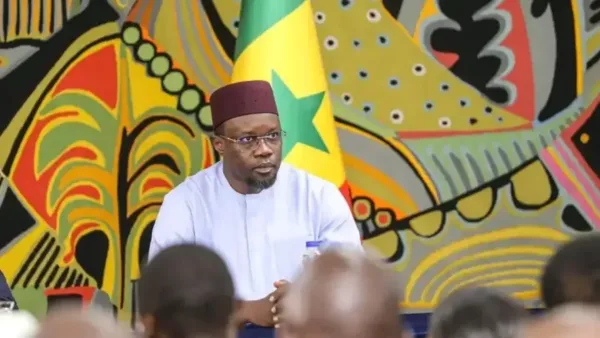
Ousmane Sonko wants to calm things down without renouncing his role as a counterbalance. In an exclusive interview with France 24 and RFI in Dakar, the President of the Senegalese National Assembly addressed his relationships with President Bassirou Diomaye Faye, three weeks after his dismissal as Prime Minister. While the head of state recently stated that “no quarrel is worth tearing apart the country we share,” Ousmane Sonko refuses to speak of a fracture. He acknowledges the existence of political differences, but assures that they should not be interpreted as a threat to national unity.
“I don’t think there’s a quarrel. Senegal is bigger than the political differences we may have. There may be political and programmatic differences, but there is no tearing apart of the country,” he said.
This statement comes in a delicate political context. The Diomaye-Sonko tandem, brought to power in 2024 around the rupture project defended by Pastef, is going through a phase of heightened tensions. Sonko’s dismissal, followed by his election as the head of the National Assembly, has installed a new institutional configuration: the executive is now led by Bassirou Diomaye Faye, while the former Prime Minister has a parliamentary majority capable of weighing heavily on the remainder of the mandate.
Ousmane Sonko claims he does not want to analyze his departure from the Primature as a maneuver linked to his ambitions for the presidential election of 2029. In his view, this sequence now belongs to the political history of Senegal. “A politician is a trajectory, and this institutional separation is not the most striking aspect of my political career,” he indicated.
The former Prime Minister says he wants to concentrate his energy on the National Assembly. He intends to restore to the parliamentary institution “the role and place that is rightfully its own,” while reminding that the executive retains its constitutional prerogatives. However, Sonko insists on one point: he does not dissociate himself from the current mandate. He recalls having supported Bassirou Diomaye Faye’s candidacy in 2024, after his own impediment, and then having led the government for two years.
“We all have this obligation to work towards the success of this mandate, which is our mandate in reality. So, I will not distance myself from it. I was Prime Minister for two years. My record speaks for itself,” he asserted. The message is therefore double. Sonko does not want to appear as the one who would cause the mandate of Diomaye Faye to fail. But he also does not renounce judging the executive against the commitments of Pastef.
Pastef and the Diomaye Question
When questioned about his past criticisms of Bassirou Diomaye Faye, Ousmane Sonko now avoids the register of betrayal. He prefers to talk about unfulfilled political commitments. “The notions of betrayal are much more related to morality and affectivity. I prefer to be on much more political ground,” he explained. According to him, some commitments made before the Senegalese people during ten years of opposition have been “distorted” in the path chosen by the power.
The question of Bassirou Diomaye Faye’s future within Pastef remains open. Ousmane Sonko makes no announcement of exclusion, but does not completely rule it out. “That will be assessed in due time. The Pastef party is very structured, very organized. It has texts and these texts are very clear on the procedures to follow,” he declared.
This response maintains uncertainty. Bassirou Diomaye Faye remains President of the Republic, but control of the party and the Assembly seems to be more in the hands of Sonko and his allies. In this configuration, Pastef becomes both the foundation of power and the potential venue for internal arbitration between the two central figures of the regime.
Ousmane Sonko states that the National Assembly will not systematically seek to obstruct the government’s action. But he warns that the parliamentary majority will not grant a “blank check” to the executive. On June 2, he had already stated that Pastef could censure the government, while adding that it would not do so for political reasons. In the interview, he clarifies his position.
“As much as possible, we will not censure. We will not be in political logics of censuring to settle scores or weaken an action. But indeed, if actions require censure, it is a constitutional prerogative of the National Assembly, and we will not hesitate to use it,” he warned.
On the local elections scheduled for January 2027, Sonko is firm. For him, no postponement would be justified. “Elections cannot be postponed. There is no valid reason for them to be postponed. They will take place on schedule, I hope,” he declared, reminding that the president will need to take the necessary actions within the timelines set by electoral law.
This position places the National Assembly in an institutional monitoring role. Sonko says he wants to respect the prerogatives of the executive, but he also intends to remind that Parliament controls the government’s actions and ensures the proper execution of public policies.
Debt, the Red Line of the New Balance of Power
The Senegalese debt is one of the most sensitive points of the interview. Since the revelation of undisclosed debts inherited from the previous administration, Senegal is going through a major financial crisis. Discussions with the International Monetary Fund have become a central issue for the new power.
Sonko confirms that he opposed a debt restructuring when he was Prime Minister. He speaks of a “wild restructuring” that he did not want to initiate, believing at the time that the country was not in default and could still honor its commitments. “We are not in fixed positions. We examine the situation with lucidity,” he now nuances.
However, he acknowledges that the situation has evolved, notably with the addition of new international tensions. But he warns that the National Assembly will not allow a solution that would sacrifice, in his view, Senegal’s options for structural change for short-term imperatives. “If a solution were to be taken that does not align with the interests of Senegal, that sacrifices our options for systemic and structural change at the altar of short-term ratios, we will not accept it,” he asserted.
Regarding the possibility of qualifying part of the debt as “odious,” Sonko is more cautious than in the past, while maintaining the essence of his analysis. He believes that part of this debt indeed falls into that political and moral category, but acknowledges that the process is complex. “This debt is indeed partially odious. It requires political courage to raise this debate,” he declared, calling on the executive to take its responsibilities.
University Crisis and Homosexuality
The former Prime Minister also addressed the management of the crisis at Cheikh Anta Diop University, marked by the intervention of law enforcement and the death of a student. When asked about a possible responsibility of his government, Sonko refuses to conclude before the end of the investigation.
He states that a procedure was opened quickly and that the case is now on the prosecutor’s desk. But he acknowledges having seen images that raise questions about the use of force. “I still consider that there was disproportionate use when unarmed young people are taken in the midst of law enforcement and beaten publicly,” he admitted.
This statement constitutes one of the rare explicit acknowledgments of a problem in the security management of a sensitive case during his time as Prime Minister. Sonko, however, tries to distinguish the need to maintain public order from the potential responsibility of the agents involved.
Ousmane Sonko has also defended the legislative tightening on homosexual relations in Senegal, despite the criticisms expressed by international organizations and some Western partners. He rejects the idea of a “witch hunt against homosexuals” and recalls that criminalization has existed in Senegalese law for several decades. According to him, the recent tightening of penalties does not create a new legal orientation but reinforces existing legislation.
“Senegal is a sovereign country. It does not have to justify the laws it enacts either to the West or to anyone,” he asserted. He also ties part of the debate to accusations of intentional HIV transmission in some recent cases, believing this aspect would be overlooked by the Western media. However, several human rights organizations have criticized this tightening, viewing it as a risk of exacerbating the stigmatization and violence against affected individuals.
Sonko fully embraces the stance taken by his political family. “If the need to strengthen it arises, we will reinforce it. But we will absolutely not go back,” he asserted.
2029, a Candidacy Yet to be Declared
The presidential election of 2029 looms over the entire Senegalese political recomposition. But Ousmane Sonko refuses, for now, to declare himself a candidate.
“It’s very premature to talk about candidacies,” he responded, reminding that Pastef will invest its candidate in due time.
When asked about a possible candidacy of Bassirou Diomaye Faye, he is also evasive. He says he doesn’t want to deal with the current president’s candidacy and prefers to focus on his own political path.
This caution does not dispel speculation. Since his dismissal and election as head of the National Assembly, Sonko appears as a central actor in the Senegalese political game, capable of supporting, contesting, or competing with the executive in the years to come.
Comments