
Benin – Nigeria: what to take away from Romuald Wadagni’s quick visit to Abuja
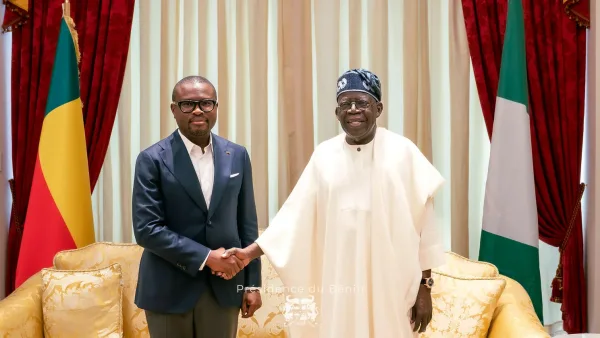
Romuald Wadagni has chosen Abuja for his first official visit abroad, confirming the central role of Nigeria in his neighborhood diplomacy. Received by Bola Ahmed Tinubu, the Beninese president opened his external mandate with discussions on economic integration, the transit corridor, energy, maritime security, and the future of ECOWAS.

SUMMARY
The Beninese president Romuald Wadagni made a friendly and working visit to Nigeria on Monday, June 1, 2026, at the invitation of his counterpart Bola Ahmed Tinubu. This first official bilateral trip since his inauguration confirms the strategic role Abuja plays in Cotonou’s new diplomatic sequence.
Beninese President Romuald Wadagni chose Abuja for his first official visit abroad since his inauguration on May 24, 2026. Departing from Cotonou in the afternoon of Monday, June 1, the Beninese head of state made a friendly and working visit to Nigeria, where he was received by his counterpart Bola Ahmed Tinubu.
The visit was brief, but its choice is highly symbolic. For his first bilateral diplomatic outing, Romuald Wadagni did not travel to Lomé, as Patrice Talon did after his election in 2016. He prioritized Abuja, the capital of Benin’s largest economic neighbor and a central player in West African balance.
This decision clearly indicates the priorities at the beginning of his mandate. Nigeria is not just a neighboring country. It is a major trading partner, a large market, a key player in ECOWAS, and a country whose economic, customs, and security decisions have direct effects on Benin.
An economic relationship at the center of exchanges
The discussions between Romuald Wadagni and Bola Ahmed Tinubu covered several strategic issues, including the economy, energy, security, and regional integration. These topics reflect the density of relations between the two countries, linked by a long common border, significant trade exchanges, and shared interests regarding transport corridors and the port of Cotonou.
Trade remains one of the main pillars of this relationship. Benin’s exports to Nigeria surged in 2024, confirming the weight of the Nigerian market for the Beninese economy. The autonomous port of Cotonou also plays a vital role in regional flows, particularly for goods in transit to Nigeria and the hinterland countries.
The two countries had already initiated a process to strengthen their economic cooperation. In August 2025, Cotonou and Abuja agreed to move toward a strengthened economic partnership agreement. Discussions focused on facilitating trade, customs cooperation, transshipment, combating fraud, and improving border flows.
Romuald Wadagni’s visit, therefore, follows a continuity. The new Beninese president does not start from scratch. He inherits an already active Cotonou-Abuja axis, but still faces several challenges, including informal trade, border hassles, customs disputes, and recurring tensions around certain cross-border flows.
Abuja, a strategic passage for Cotonou
By first going to Nigeria, Romuald Wadagni is also looking to consolidate a sensitive political relationship. Bola Ahmed Tinubu was among the first leaders in the sub-region to congratulate the new Beninese president after his election. Nigerian Vice President Kashim Shettima also represented Abuja at the inauguration ceremony on May 24 in Cotonou.
These gestures have reinforced the idea of an ongoing relationship between the two capitals. For Cotonou, maintaining direct dialogue with Abuja is essential. Nigeria’s decisions regarding its borders, customs policies, fuel, imports, or internal security can have rapid repercussions on the Beninese economy.
The energy issue is also part of the ongoing stakes. Nigeria remains a major regional player in gas and oil. Benin, for its part, seeks to secure its supplies, enhance its infrastructure, and better integrate into regional energy projects. In this regard, cooperation with Abuja remains strategic for economic and industrial stability.
Security was also on the agenda for discussions. The two countries share common concerns related to cross-border crime, trafficking, maritime security in the Gulf of Guinea, and threats facing the West African region. For Benin, which is facing security challenges in the northern part of its territory, dialogue with Nigeria remains an important lever.
ECOWAS as a backdrop
Beyond bilateral issues, the visit takes place in a delicate regional context. ECOWAS remains weakened by the withdrawal of Mali, Burkina Faso, and Niger, which are grouped within the Sahel States Alliance. Nigeria, the leading power in the organization, plays a central role in discussions about the future of West African integration.
Benin, for its part, seeks to maintain a diplomatic balance. Romuald Wadagni expressed a willingness for dialogue with countries in the sub-region right from his inauguration, without locking himself into a confrontational approach. The presence of delegations from Niger, Mali, and Burkina Faso at his inauguration was already interpreted as a signal of openness.
In this sequence, the visit to Abuja takes on particular significance. It allows the new Beninese president to consolidate his link with Nigeria before continuing his contacts with other regional capitals. The goal is to keep Benin in a position of dialogue, both close to ECOWAS and attentive to the political realities of the Sahel.
This posture could become a significant axis of Wadagni’s diplomacy. Benin needs peaceful relations with its Sahelian neighbors for transit, trade, security, and the movement of people. But it must also preserve its partnership with Nigeria, an essential player in the sub-region.
A short visit, but politically readable
No major agreements were announced immediately following this visit. However, the importance of the trip lies primarily in the political signal. By choosing Abuja for his first official outing, Romuald Wadagni clearly places regional economy, security cooperation, and West African integration at the heart of his diplomatic priorities.
The brief nature of the trip does not diminish its significance. On the contrary, it shows a willingness to quickly get to the essentials, in a direct working format with a partner whose weight is crucial for Benin. For a newly installed head of state, this first diplomatic choice allows for setting a direction.
Romuald Wadagni thus opens his external mandate with a clear message: Benin intends to strengthen its relations with its neighbors, starting with the partner whose economic and political influence is most decisive for Cotonou. Abuja is therefore not merely a protocol stop. It is the first milestone in a diplomacy that seeks to articulate economy, security, and regional balance.
trade, security, and the movement of people. But it must also preserve its partnership with Nigeria, an essential player in the sub-region.
A short visit, but politically readable
No major agreements were announced immediately following this visit. However, the importance of the trip lies primarily in the political signal. By choosing Abuja for his first official outing, Romuald Wadagni clearly places regional economy, security cooperation, and West African integration at the heart of his diplomatic priorities.
The brief nature of the trip does not diminish its significance. On the contrary, it shows a willingness to quickly get to the essentials, in a direct working format with a partner whose weight is crucial for Benin. For a newly installed head of state, this first diplomatic choice allows for setting a direction.
Romuald Wadagni thus opens his external mandate with a clear message: Benin intends to strengthen its relations with its neighbors, starting with the partner whose economic and political influence is most decisive for Cotonou. Abuja is therefore not merely a protocol stop. It is the first milestone in a diplomacy that seeks to articulate economy, security, and regional balance.
Comments