
Togo: the autonomous port of Lomé facing a risk of blockage
The union of agents at the Autonomous Port of Lomé has filed a three-day strike notice, scheduled from June 25 to June 27, 2026, to protest against the non-fulfillment of its social demands. If this action proceeds, it could disrupt the operations of a strategic port for Togo and several landlocked countries in the sub-region.

SUMMARY
The union of agents at the Autonomous Port of Lomé (PAL) has filed a three-day strike notice, from Thursday, June 25 at 7:00 AM to Saturday, June 27, 2026 at 11:59 PM, due to the “non-fulfillment” of its social demands, according to a statement published by the Togolese newspaper L’Alternative on June 8.
This movement follows three general assemblies held on October 6, 2025, January 17, 2026, and May 30, 2026, during which the agents adopted resolutions demanding improvements in their working conditions. The general management of the port, led by Rear Admiral Fogan Kodjo Adégnon, has not publicly responded to the strike notice as of this dispatch. Over 3,000 dock workers and agents from various sectors work at the PAL, according to L’Alternative.
The demands focus on the establishment of a statute governing all staff, compliance with the collective agreement, payment for overtime, declaration of all casual dock workers to the National Social Security Fund, a dirt allowance, and a handling allowance, as well as the inclusion of professional classifications on pay slips. The union relies on the joint decree No. 12-MCIT-MJ-FP-MFE of August 19, 1976, which establishes the specific statute for PAL personnel, the full application of which it is demanding.
A strategic port under internal social tension
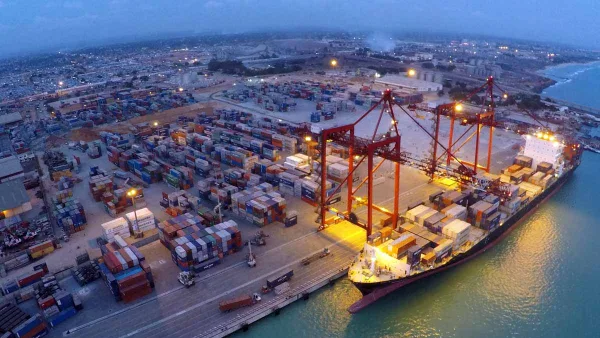
The Autonomous Port of Lomé is the leading transshipment port in Sub-Saharan Africa and the only one in this area to feature in the top 100 worldwide according to the Lloyd’s List 2025 ranking, at 92nd place. It handled 30.6 million tons of goods in 2024, reflecting a 1.85% increase compared to 2023, driven by transshipment activities. Maritime activities account for 75% of Togo’s tax revenue, according to figures from the Ministry of Maritime Economy.
This façade performance contrasts with documented internal tensions. In January 2026, L’Alternative revealed that the port had lent 300 million CFA francs (about 457,000 euros) to the Association of Importers and the Agro-Food and Industrial Sector of the Gulf of Benin (AISAIGE), which refused to repay. In November 2025, during the renewal of the board of the National Union of Winch Operators of the PAL (SYNATREPAL), a company representative publicly acknowledged “the harshness of current conditions” while assuring that management “would not forget them.”
The union reminds in its statement that “the right to strike is a fundamental right” and that “no employee can be sanctioned for having gone on strike in accordance with the procedure.” It calls on all agents to cease work during the three announced days.
A period of sixteen days before the work stoppage
The strike notice filed on June 8 gives both parties sixteen days to engage in negotiations before the strike action starts. The legal notice procedure complies with the Togolese Labor Code, which mandates a minimum notice period before any work stoppage in public or essential enterprises.
A three-day strike at the PAL would have repercussions on regional maritime traffic: the port serves as a transshipment hub for several landlocked countries in the sub-region, including Burkina Faso, Mali, and Niger, whose trade exchanges partially or predominantly transit through Lomé.
Comments