
South Africa: in response to xenophobic tensions, Ramaphosa announces a tightening of immigration policies.
Cyril Ramaphosa announced a tightening of measures against irregular immigration in South Africa, following several weeks of tensions and violence targeting foreign nationals. The South African president promises more controls, sanctions against employers, and expedited expulsion procedures, while warning groups that exploit the migration issue to provoke illegality and violence.

SUMMARY
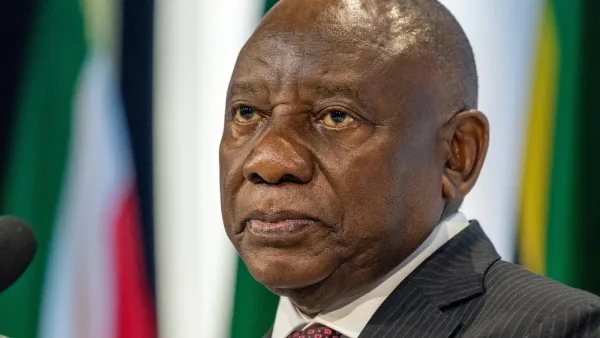
South African President Cyril Ramaphosa delivered a speech on Sunday, June 7, at the Union Buildings to announce a series of measures aimed at strengthening control over irregular immigration, while warning that his government would not allow any group to exploit migration concerns to “destabilize the country by inciting illegality and violence,” according to the statement released by the presidency.
This speech comes after several weeks of anti-immigrant protests led notably by the March and March movement, headed by Jacinta Ngobese-Zuma, and by the Dudula operation, which has set a deadline of June 30 for the departure of irregular foreign nationals. Among the announced measures are criminal prosecutions against employers using undocumented labor, the creation of dedicated courts to expedite expulsion procedures, and the establishment of a national biometric registry to combat identity theft.
Ramaphosa publicly acknowledged the shortcomings of the country’s migration system, citing insufficient law enforcement, corruption within immigration services, and structural gaps. “The government accepts responsibility for these failings,” he said, adding that measures are underway to restore public trust. He also cautioned against misinformation campaigns on social media and against what he described as “political, personal, or criminal agendas” seeking to exploit migration tensions.
The president further reminded that only authorized state agents can enforce immigration laws, explicitly opposing the practice of identity checks conducted by individuals in public spaces.
The Deaths in Mossel Bay and Ongoing Repatriations
These statements come as Mozambique announced on June 2 the death of five of its nationals during xenophobic attacks in Mossel Bay, a port city located about 400 kilometers east of Cape Town, in the Western Cape province. South African authorities confirmed two deaths, according to the Ivorian news agency. A statement from the Mozambican government also reported two other deaths in a road accident during an attempt to return to Mozambique, bringing the total toll to seven deceased Mozambican nationals.
About 300 Mozambicans have returned to their country on their own, while more than 500 others were waiting for their repatriation from secure sites in the Western Cape province, according to Maputo. In the Western Cape province, Mozambican and Malawian nationals have sought refuge in municipal buildings after fleeing violence in several localities, including Kleinmond, about a hundred kilometers southeast of Cape Town, and Gansbaai.
Ghana has repatriated several hundred of its nationals and advised limiting non-essential travel to South Africa, while Nigeria has urged its citizens not to take retaliatory actions against South African businesses present on the continent. Kenya, Malawi, Lesotho, and Zimbabwe have issued advisories to their nationals residing in South Africa.
Diplomatic Tensions and Continental Deadline
These developments fuel a regional diplomatic crisis. Both Nigeria and Ghana have lodged formal protests with Pretoria following fatal incidents involving their nationals, according to La Nouvelle Tribune. Accra has also requested the inclusion of a debate on xenophobia on the agenda of the African Union’s mid-year coordination Summit, scheduled for June 24 in Cairo. The Department of International Relations and Cooperation (DIRCO) has rejected the term “xenophobia,” preferring to refer to it as “ordinary crime.”
During his state visit to Pretoria on June 3 and 4, Kenyan President William Ruto addressed the migration issue from the perspective of the continent’s uneven development. “The solution is to ensure that services and opportunities exist everywhere on our continent,” he stated at the joint press conference with Ramaphosa.
The economic context exacerbates tensions: South Africa has an official unemployment rate of 32.9% in the first quarter of 2026, according to Statistics South Africa, and over 45% among those aged 15-34. With local elections approaching in November, Human Rights Watch has documented attacks by vigilante groups against African and Asian nationals since April 2026, criticizing what it deems insufficient law enforcement response.
The South African cabinet is set to review new measures for labor market law enforcement in the coming days, including the hiring of 10,000 labor inspectors, funding for which has not yet been budgeted for the 2025-2026 fiscal year.
Comments