
Mali: 20 years in prison for Yann Vézilier, the French agent at the center of a standoff with Bamako
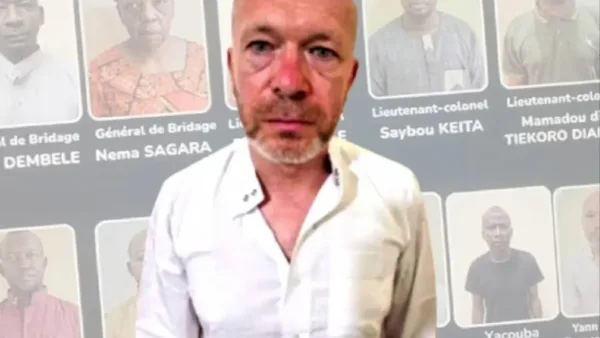
Sentenced to twenty years of imprisonment for “endangering the security of the State,” Yann Christian-Bernard Vézilier, a French officer presented as an agent of the DGSE and stationed at the French embassy in Bamako, becomes a symbol of a now profound break between Mali and France. Bamako claims to have thwarted an attempt at destabilization involving Malian military personnel and a French national. Paris, on its part, denounces the accusations as “groundless” and a violation of international rules protecting diplomatic agents.

SUMMARY
In Bamako, the Yann Christian-Bernard Vézilier case has shifted from discreet diplomatic discussions to a state trial. The French national, an air force officer and a member of the General Directorate for External Security, was sentenced to twenty years of imprisonment by the Malian justice system for “endangering the security of the State.” In addition to this sentence, he faces a twenty-year prohibition on staying in Mali and a fine of 3.6 million CFA francs.
The verdict, delivered in a climate of very high tension between Bamako and Paris, comes nearly ten months after his arrest by Malian security services. Yann Vézilier was apprehended in August 2025 in the Malian capital as part of an investigation described by the transitional authorities as an operation against a network suspected of attempting to destabilize the Republic’s institutions.
Officially, the Frenchman was assigned to the French embassy in Bamako. According to Paris, he was entitled to diplomatic status under the Vienna Convention on Diplomatic Relations. However, the Malian authorities argue that his role went well beyond that of a typical diplomatic mission. Bamako accuses him of acting on behalf of French intelligence services in efforts aimed at undermining the regime led by General Assimi Goïta.
Bamako speaks of a plot against the institutions
In the version defended by the Malian authorities, the arrest of Yann Vézilier is part of the dismantling of a network composed of military and civilian personnel. Several Malian officers, including high-ranking officials, have been mentioned in this case. The authorities have discussed contacts with political leaders, civil society members, and elements from the armed forces as part of an alleged destabilization project.
The case has been assigned to a specialized jurisdiction dealing with terrorism and organized transnational crime cases. This judicial choice reflects the seriousness that Bamako intends to give to the matter. For the Malian transition, it is not just a minor diplomatic incident but a direct affront to national sovereignty and the stability of institutions.
Since the coups d’état of 2020 and 2021, the Malian military power has built much of its political legitimacy around a sovereignty-focused narrative. The denunciation of foreign interference, the break with the former French partner, and the rapprochement with new strategic allies have become strong markers of Bamako’s political line. In this context, the condemnation of a French agent portrayed as involved in a plot reinforces the narrative of a besieged Malian state determined to defend its independence.
Hence, the case has a judicial dimension but is also highly political. It provides the transitional authorities with a concrete example to illustrate their discourse on external threats. It also justifies the firmness adopted in recent years towards Paris, whose influence in Mali has gradually collapsed following the end of Operation Barkhane, the departure of French forces, and the continuous deterioration of bilateral relations.
Paris denounces “groundless” accusations
France categorically rejects the accusations against its national. Immediately after Yann Vézilier’s arrest, the Quai d’Orsay called for his release, asserting that he was a duly accredited diplomatic agent with the Malian authorities. Paris maintains that his arrest, detention, and subsequent trial constitute a violation of the Vienna Convention, which governs diplomatic relations and protects accredited personnel.
According to French authorities, the case is more a political standoff than an ordinary judicial process. Paris believes that its national has been targeted in the context of a deep rupture with Bamako and ongoing suspicions against the former colonial power. The French government also contests the publicity given to the identity and functions of the agent, considering it further exacerbates the violation of diplomatic norms.
Following Yann Vézilier’s arrest, tensions had already manifested in retaliatory measures. France recalled part of its personnel still present in Mali and expelled two Malian agents stationed in Paris. The sentence pronounced by the Malian justice system now risks further closing the space for dialogue between the two capitals.
This case also recalls other recent episodes in the Sahelian region, where French services have faced growing distrust from military regimes. In Burkina Faso, four French agents were detained for several months before their release. These precedents reflect the evolution of a regional environment where former security cooperations have become grounds for confrontation.
A revealing case of the Mali-France rupture
Beyond the individual case of Yann Vézilier, this sentence illustrates the advanced state of decomposition in relations between Mali and France. For years, the two countries maintained a close military and security cooperation, especially in the fight against jihadist groups in the Sahel. This relationship has deteriorated sharply after the military’s rise to power in Bamako, French criticisms of the transition, and Mali’s choice to diversify its strategic partnerships.
Mali has since made multiple gestures of rupture. French forces have left the country, the French ambassador was expelled in 2022, and Bamako has sought closer ties with partners like Russia, in the context of geopolitical restructuring in the Sahel. The conviction of a French agent for endangering state security fits into this sequence of political, diplomatic, and security divorce.
For Bamako, the verdict sends a clear message: no political immunity, according to the Malian authorities, can cover acts deemed hostile to national sovereignty. For Paris, on the contrary, the message is equally alarming: an accredited agent can be arrested, tried, and heavily sentenced despite the diplomatic protections recognized by international law.
This dual reading makes the case particularly explosive. It pits two irreconcilable conceptions against each other. On one side, Mali claims to defend its institutions against an attempt at foreign destabilization. On the other, France denounces a political procedure and demands respect for international diplomatic rules.
The twenty-year sentence imposed on Yann Vézilier does not close the case. It opens a new phase of confrontation between Bamako and Paris. At this stage, the issue is no longer just judicial. It is diplomatic, strategic, and symbolic. In a Sahel where alliances are being redrawn, the fate of the French agent becomes one of the most sensitive markers of the break between transitional Mali and its former French partner.
Comments