
Mali: the army claims airstrikes in Gao and Kayes that resulted in over 50 deaths.
The Malian army claims to have carried out several airstrikes against armed group positions in the Gao and Kayes regions, asserting the neutralization of around fifty fighters. These operations, announced by the general staff, come amid a surge in military offensives and an expansion of the threat to the west of the country.

SUMMARY
The general staff of the Malian armed forces announced in a statement released on Saturday, June 7, 2026, that it had conducted several airstrikes against positions of armed groups in two regions of the country, claiming the neutralization of a total of around fifty fighters.
In the Doro area, about 80 kilometers southwest of Gao, in northeastern Mali, three distinct operations were carried out. The first strike targeted a hideout housing about twenty fighters and several motorcycles; a second destroyed a truck loaded with logistical equipment; and a third targeted a tent used as a shelter along with motorcycles, some of which were armed, according to the military statement.
In the Kayes region, in the far west of the country, an additional strike targeted Sandaré – a locality located about twenty kilometers north of the town of Kita – a fallback base identified during reconnaissance operations. The army reports the neutralization of about thirty fighters and the destruction of motorcycles and logistical equipment, according to details provided by the Burkinabè site Burkina24.
The general staff described these actions as “offensive reconnaissance missions” aimed at “weakening the operational capabilities of armed groups on national territory.” These assessments come from a single source – the military statement – and have not been corroborated by independent sources.
Operations Amid Recurrent Offensives
These strikes occur amid a resurgence of aerial operations by the Malian Armed Forces (FAMa) since the beginning of 2026. On June 1, the army had already announced strikes in the Koulikoro and Mopti regions, as well as raids on Kidal, a northern town recaptured on April 25, 2026, by a coalition of rebel and jihadist groups. According to the Sahel Intelligence site, a separate strike on June 7 also targeted a terrorist base east of Zahro, in the locality of Gourma-Rharous, destroying a command post and three vehicles.
The Sandaré area, in the Kayes region, is a recurring axis for Malian anti-terrorist operations. The APAnews agency reported in April 2026 that the operation “Dougoukoloko” had already targeted hideouts northeast of Sandaré, forcing armed elements to retreat to Nioro du Sahel, about 150 kilometers northwest.
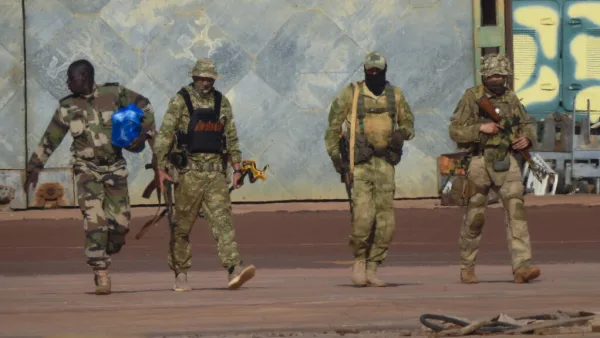
The loss of Kidal on April 25, following an offensive by the Group for the Support of Islam and Muslims (GSIM, affiliated with Al-Qaeda) and the rebels of the Azawad Liberation Front (FLA), marked a turning point in the conflict. The Malian army, supported by the Africa Corps – a unit from the Russian Wagner group – has increased aerial operations to contain the advance of armed groups in the northern and western regions.
Unverifiable Assessments and a Conflict Expanding Westward
Mali has been engaged since 2012 in a multi-front armed conflict opposing government forces and their Russian allies to several jihadist groups, mainly GSIM and the Islamic State in the Greater Sahara (EIGS). According to the Global Terrorism Index 2025, a quarter of all extremist attacks in the world and nine of the twenty deadliest attacks globally occurred in Mali in 2024.
The assessments announced by the Malian general staff are regularly disputed or unverifiable, with transitional authorities restricting independent media access to conflict zones. Human Rights Watch has documented GSIM attacks against civilians in January and February 2026 in the northern and eastern regions, without any official figures being provided by Bamako.
The extension of operations to the Kayes region, bordering Senegal and Mauritania, reflects the progression of armed groups to the west of the country – a trend reported by several regional security organizations since 2024.
Comments