
Benin: The Parakou Dry Port finally enters into operation after more than a decade of waiting.
Long awaited and announced for a long time, the Dry Port of Parakou has now entered its operational phase. On Tuesday, June 23, 2026, the first container loading operations were launched on this strategic logistics platform, designed to relieve the Autonomous Port of Cotonou and bring port services closer to operators in northern Benin and the inland countries.

SUMMARY
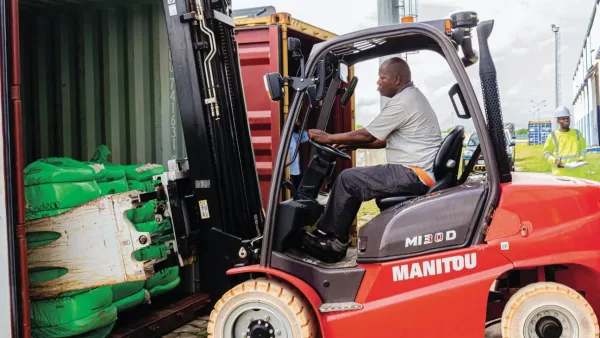
In Parakou, the project is no longer just a promise of infrastructure. It now takes the form of moving trucks, open warehouses, loaded containers, and operators mobilized around an initial cotton export operation. This launch marks an important milestone for a city that has long been called to play a more central role in national and sub-regional trade.
Led by the Petrolin Group of Beninese businessman Samuel Dossou-Aworet, the Dry Port of Parakou was envisioned as an essential link in a logistics corridor capable of more efficiently connecting the Port of Cotonou to the economic zones of northern Benin, but also to Niger, Burkina Faso, Mali, northern Nigeria, and other inland markets.
A first operation around cotton
The effective launch of activities was marked by a cotton export operation. The company Atral, specializing in transportation and handling, kicked things off by stuffing and loading the first containers destined for the Port of Cotonou, on behalf of SODECO.
This initial operation serves as a real-world test. It allows for checking the platform’s capacity to handle goods, organize their logistical processing, and ensure their transportation to the maritime port. It also marks the concrete entry of the Dry Port into the chain of exporting Beninese agricultural products, particularly cotton, one of the pillars of the national economy.
On site, technical managers confirm that the warehouses are ready to receive different types of goods. Storage spaces, loading areas, and handling equipment are now mobilized to accommodate both import and export operations.
For economic operators, the challenge is to have a platform in Parakou capable of handling goods without requiring all flows to concentrate exclusively in Cotonou.
Parakou, a new support point for the Beninese corridor
The Dry Port of Parakou is strategically located. As the economic capital of northern Benin, the city lies on a key axis for trade with neighboring countries. Its dry port is intended to bring logistics services closer to operators located far from the coast and to streamline the transit of goods to Sahelian markets.
The objective is twofold. On one hand, it aims to decongest the Autonomous Port of Cotonou, which is often under tremendous pressure due to the volume of imports and exports. On the other hand, it seeks to make Parakou a center for processing, storage, customs clearance, and redistribution of goods.
Goods imported from Asia, Europe, or America can thus be transported to Parakou before being redistributed to northern Benin, Niger, Burkina Faso, Mali, or northern Nigeria. Conversely, tropical and agricultural products can be consolidated, processed, and shipped from Parakou to the Port of Cotonou, and then to international markets.
This strategy gives the Dry Port a scope that extends beyond just the local context. The infrastructure is part of the regional competition for transit corridors. Benin seeks to enhance its attractiveness compared to other logistic routes in the sub-region, particularly those linking landlocked countries to coastal ports.
A project long delayed
The start of activities comes after several years of waiting. The project, envisioned over a decade ago, faced administrative delays and blockages that postponed its effective commissioning. Despite successive announcements, the infrastructure had not yet found its place in the national logistics framework.
In 2024, a significant milestone was reached with the acquisition of the necessary approvals for operating the dry port. The Petrolin Group then praised the support of the Beninese authorities and the directives given to expedite the commissioning process. Two years later, the actions finally materialize with the first commercial operations.
For Samuel Dossou-Aworet and his group, this commissioning represents the culmination of a structuring project. For the Beninese government, it fits into a broader strategy of modernizing transport infrastructure, improving logistical competitiveness, and enhancing the Beninese corridor.
A platform open to importers and exporters
With this launch, the Dry Port of Parakou aims to send a signal to economic operators. The platform is now open for import and export operations. Companies can transit goods destined for northern Benin or neighboring countries. They can also organize the export of agricultural and tropical products to external markets.
For transporters, handlers, importers, and exporters, the challenge is to reduce the constraints related to long distances, port delays, and the concentration of operations in Cotonou. The Dry Port can become a logistical relay to absorb part of the traffic, streamline the circuits, and improve processing times.
Ultimately, its efficiency will depend on several factors: the quality of coordination with the Port of Cotonou, the availability of customs services, the security of goods, the regularity of road and rail connections, as well as the trust of economic operators.
A turning point for the economy of the north
Beyond logistics, the start of the Dry Port of Parakou carries a territorial implication. For northern Benin, this infrastructure can become a lever for economic development. It can attract new activities in transport, storage, handling, trade, services, and processing.
Parakou, already considered a major economic crossroads, now has an additional tool to strengthen its role in national and sub-regional exchanges. The dry port can help create a new dynamic around local businesses, agricultural producers, transporters, and operators focused on neighboring markets.
The launch on June 23, 2026, does not alone solve all of Benin’s logistical challenges. But it marks a change of course. After years of waiting, the Dry Port of Parakou is no longer a suspended project. It becomes an operational infrastructure, set to play a role in the country’s commercial strategy and the competition for West African corridors.
Comments