
Benin – Niger: towards the reopening of the border, an expert committee established
Benin and Niger have taken a new step in normalizing their relations. Following the official visit of Beninese President Romuald Wadagni to Niamey, the two countries announced the establishment of a committee of experts tasked with identifying and removing obstacles to the reopening of their shared border, which has been closed for several months.

SUMMARY
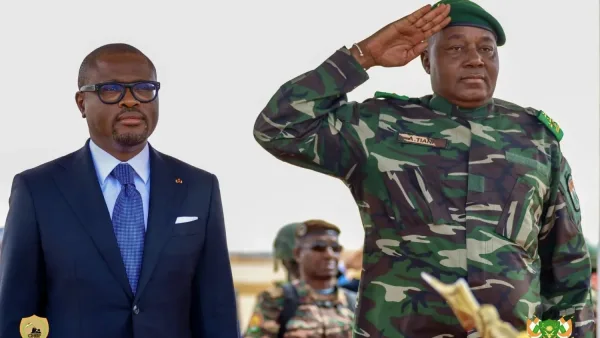
The reopening of the border between Benin and Niger now seems more likely. This is one of the main commitments outlined in the joint statement released on Tuesday, June 2, following the meeting between Beninese President Romuald Wadagni and his Nigerien counterpart, Army General Abdourahamane Tiani.
After several months of diplomatic tensions that affected exchanges between the two countries, the authorities in Cotonou and Niamey are showing their willingness to turn the page and fully relaunch their cooperation. The two heads of state agreed to strengthen bilateral relations in the political, economic, scientific, and cultural fields.
In the joint statement, the two leaders expressed their conviction about the “ need to strengthen cooperation ” between their countries and to “strengthen mutual exchanges at all levels.” They also expressed their desire to revitalize dialogue mechanisms, notably through the regular holding of the Niger-Benin joint cooperation commission.
However, the most awaited announcement undoubtedly concerns the issue of the border between the two countries. According to the official document, the presidents of Benin and Niger have committed to “work towards lifting all obstacles to strengthening cooperation between the two countries, particularly the reopening of the Benin-Niger border .”
To translate this political will into concrete actions, a committee of experts has been created. Its mission will be to identify the difficulties that still hinder the full restoration of exchanges between the two states and to propose solutions. The statement specifies that this committee has “ a deadline of fifteen days to submit its report to the two Heads of State.”
This measure underscores the desire of both governments to accelerate the normalization process. The closure of the border has had significant consequences on economic activities, particularly for traders, transporters, and populations living on either side of this strategic route.
Beyond the commercial stakes, the reopening of the border could also help strengthen security cooperation between the two countries. During their discussions, Romuald Wadagni and Abdourahamane Tiani reaffirmed their commitment to unite their efforts in facing security challenges affecting the Sahel and West Africa.
This diplomatic advance occurs within a context marked by a shared desire to restore trust between Cotonou and Niamey. The two leaders praised the historical ties that bind their peoples and expressed their ambition to elevate bilateral cooperation “to the level of their ambitions and the legitimate expectations of their respective peoples.”
While no date has yet been set for the actual reopening of the border, the establishment of the committee of experts serves as a strong signal. It hints at a gradual resumption of exchanges and a new chapter in the relations between Benin and Niger.
The Issues Behind a Closure that Paralyzed Exchanges
The issue of the border remains one of the main matters inherited from the diplomatic crisis that pitted the two countries against each other following the coup d’état on July 26, 2023, in Niger. Following the sanctions imposed by the Economic Community of West African States (ECOWAS) against the Nigerien military regime, Benin implemented community measures, including the closure of its border with its northern neighbor.
A few months later, the Beninese authorities announced the lifting of restrictions within their jurisdiction and reopened their side of the border. However, the Nigerien authorities maintained the closure on the Nigerien side, accusing Benin of harboring foreign military bases that could be used to destabilize Niger. These accusations have always been rejected by Cotonou.
This situation has severely impacted trade between the two countries. Niger, a landlocked country, traditionally uses the Autonomous Port of Cotonou as one of its main gateways to the sea. The closure of the border has also had repercussions on the activities of transporters, traders, and populations living in the border areas.
It is in this context that the commitment made in Niamey by Romuald Wadagni and Abdourahamane Tiani holds particular significance. By showing their willingness to “lift all obstacles” to bilateral cooperation and work towards the reopening of the border, the two leaders send a signal of de-escalation that could rekindle relations between the two countries.
Comments