
Libreville 2: Oligui Nguema facing the test of his campaign promises
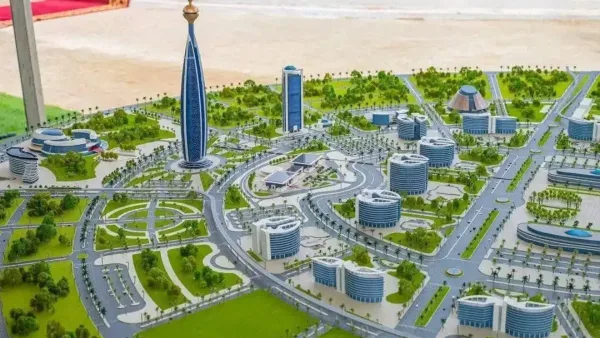
Launched with great fanfare on March 28, 2025, by Brice Clotaire Oligui Nguema, the Libreville 2 project was meant to mark Gabon’s entry into a new urban era. A new smart, modern, structured city, designed to ease congestion in the Gabonese capital and support the expansion of the Estuaire province. Nearly a year later, the dream remains intact, but the construction site still seems to be waiting for its true takeoff.

SUMMARY
The recent audience granted by the Minister of Housing, Habitat, Urbanism, and Cadastre, Mays Mouissi, to Senegalese architect and urban planner Pierre Goudiaby Atépa, brings the project back into the debate. Officially, the discussions focused on the design and planning of the future smart new city “Libreville 2”. But this meeting also raises a sensitive question: has the Gabonese government been too ambitious in announcing such a large-scale project before securing all the necessary technical, legal, and financial prerequisites?
Libreville 2 was born from a widely shared diagnosis. The Gabonese capital is saturated. Urbanization is progressing under demographic pressure, while access to land, decent housing, basic services, and infrastructure remains a major challenge. Greater Libreville concentrates a significant portion of the national population and crystallizes difficulties related to mobility, housing, urban planning, and the disordered expansion of neighborhoods.
It is in this context that Brice Clotaire Oligui Nguema presented Libreville 2 as a structuring response. The project, located in the Andem area, is supposed to cover nearly 30,000 hectares. It is meant to host residential neighborhoods, administrative zones, commercial spaces, school and hospital facilities, industrial areas, and green spaces. Meanwhile, the authorities have also mentioned the development of the new international airport in Andem, aimed at enhancing the country’s attractiveness and making this area a new growth pole.
In the official discourse, Libreville 2 is therefore not just a real estate operation. It is a land management project, a new urban center design to relieve Libreville, organize the capital’s expansion, and project a modernized image of Gabon.
The ambition is considerable. But it is precisely this ambition that raises questions today.
A groundbreaking ceremony, then the wait
The launch on March 28, 2025, was presented as the kickoff for the works. The ceremony brought together authorities, technical partners, and local populations. It gave a strong political visibility to the project, just weeks before the presidential election that was to see Brice Clotaire Oligui Nguema take the helm of the country.
But since that ceremony, visible signs of progress remain limited. Official communication does not yet reflect a construction site that has entered a massive construction phase. On the contrary, the latest available elements show that the project is still at the stage of design, studies, and institutional framing.
The meeting between Mays Mouissi and Pierre Goudiaby Atépa is revealing. According to the ministry’s communication, the Senegalese architect presented the initial technical guidelines related to the design and planning of the future urban site. He also requested the establishment of a secure legal framework through the signing of an agreement between his group and the Gabonese state to frame the project’s design phase.
This precision is important. It means that a year after the groundbreaking, the project has not yet fully entered its operational phase. It still needs to secure the studies, define the legal framework, coordinate the competent structures, and establish a precise schedule, outlined on a monthly and quarterly basis.
In other words, Libreville 2 seems to have been politically launched before being fully secured technically.
The funding challenge
The financial question is the other major unknown in the file. A new city of 30,000 hectares, equipped with modern infrastructure, housing, public facilities, economic zones, and a new airport, requires considerable resources. It also demands a robust financial arrangement, multi-year programming, credible investors, transparent governance, and high administrative execution capacity.
However, Gabon is operating in a constrained budgetary context. The country, still dependent on revenues from raw materials, faces tensions regarding its debt and significant funding needs. In March 2026, Libreville formally requested a program from the International Monetary Fund to stabilize its finances and enhance budget transparency.
This situation does not necessarily doom Libreville 2. But it makes the project more complex. In a context of sought budgetary discipline, every major project must now prove its viability, funding, economic return, and social utility. The promise of a smart city is not enough. It must specify who finances it, at what cost, according to what timeline, with what control mechanisms, and for which beneficiaries.
This is the area where the government is being awaited. A new city can be a powerful lever for development if it is conceived as an integrated project. It can also become a financial sinkhole if it relies more on the announcement effect than on realistic planning.
A real need for housing and urban planning
The idea of Libreville 2 does address a deep problem. Gabon has one of the highest urbanization rates in Africa. The World Bank estimates that the country is facing a significant housing deficit, with needs increasing each year. Access to titled land, affordable plots, basic infrastructure, and mortgage credit remains difficult for many households.
In this context, the Gabonese state needs a genuine urban policy. The saturation of Libreville, mobility issues, pressure on public services, under-equipped neighborhoods, and flooding risks require a structural response. On paper, Libreville 2 could therefore appear as a relevant response.
But the issue is less about the usefulness of the project than about its method. To succeed, a new city must not only be designed by architects or championed by political discourse. It must be connected to the real needs of the populations, articulated with existing cities, accessible to middle and lower classes, and supported by functional infrastructure.
The risk would be to build a showcase city, modern in its designs but inaccessible to a large portion of Gabonese people. Several African countries have already launched new city projects intended to embody modernity, but which then struggle to attract residents or meet the most urgent social needs.
Atépa, a symbolic and strategic choice
The choice of Pierre Goudiaby Atépa is not trivial. The Senegalese architect is known for his large-scale urban designs on the continent. His involvement gives the project a pan-African dimension and strengthens the discourse of a city conceived by African skills to address African challenges.
At the project launch, Brice Clotaire Oligui Nguema emphasized this idea, stating that Africa needs to be built by Africans. Libreville 2 is in line with this political logic: breaking away from urban improvisation, designing a modern city, and displaying architectural and strategic sovereignty.
But having a renowned architect is not enough to guarantee the success of a project. It must be accompanied by a clear governance framework. Who decides? Who finances? Who controls? What role for the state, local authorities, private investors, the populations of Andem, and future inhabitants? How to avoid land speculation? How to ensure that housing will not be reserved for the wealthiest categories?
These questions are central. They will determine whether Libreville 2 becomes a true tool for urban transformation or another emblematic project in the long list of grand African promises slowed down by administrative and financial realities.
An ambition to be adjusted?
The Gabonese government may not have been wrong to aim high. The saturation of Libreville calls for a long-term vision. The country needs to plan its urban development, anticipate population growth, and create new economic hubs. In this respect, Libreville 2 addresses a real necessity.
But ambition can become a handicap when it is too far ahead of preparation. The gap between the solemnity of the March 2025 launch and the current state of the project raises questions. If the design phase, legal framework, and timeline still need to be consolidated in 2026, it is because the groundbreaking was likely more of a political signal than a complete operational start.
The government must now clarify the trajectory. It needs to publish a realistic schedule, specify the financial arrangements, explain the steps of the project, involve the concerned populations, and define priorities. It might be more credible to start with a managed initial phase, featuring basic infrastructures, affordable housing, and essential public amenities, rather than maintaining the image of an immediately realizable smart megacity.
Libreville 2 remains a promising project. But its future will depend on the ability of Gabonese authorities to turn a spectacular promise into a concrete, funded, planned, and socially useful program. At this stage, the question is no longer just whether Gabon can build a new city. It is whether it can do so without repeating the mistakes of large projects announced too quickly, too loudly, and too soon.
Comments