
Chad: the discreet return of French officers reignites the debate on sovereignty
One year after the departure of the last French soldiers from Chad, military cooperation between N’Djamena and Paris appears to be resuming in a more discreet form. According to reports by Africa Intelligence, a handful of French officers returned to N’Djamena since mid-April to rekindle exchanges with the Chadian army. This limited return comes after Mahamat Idriss Déby’s visit to Paris in January 2026 and revives the debate on the sovereignty that was brandished during the rupture of defense agreements with France.

SUMMARY
One year after the departure of the last French soldiers from Chad, military cooperation between N’Djamena and Paris seems to be resuming in a more discreet form. According to reports by Africa Intelligence, a handful of French officers returned to N’Djamena in mid-April 2026 to revitalize cooperation with the Chadian army.
This discreet return occurs in a sensitive political context. On November 28, 2024, the Chadian authorities announced the denunciation of the military cooperation agreement signed with France in 1976. This decision led to the accelerated withdrawal of French forces from the country, the last major military foothold of Paris in the Sahel following the departures from Mali, Burkina Faso, and Niger.
At the end of January 2025, the last French soldiers had left the Adji-Kosseï base in N’Djamena. The Chadian government presented this departure as a major step in affirming national sovereignty. Mahamat Idriss Déby Itno hailed the end of a historical military presence and expressed his country’s desire to redefine its international partnerships based on mutual respect.
A Gradual Resumption After the Rupture
The current sequence thus marks a change of tone. After the spectacular rupture of 2024 and the political celebration of the departure of French troops, N’Djamena and Paris now appear to be engaged in a phase of controlled resumption of their security relations.
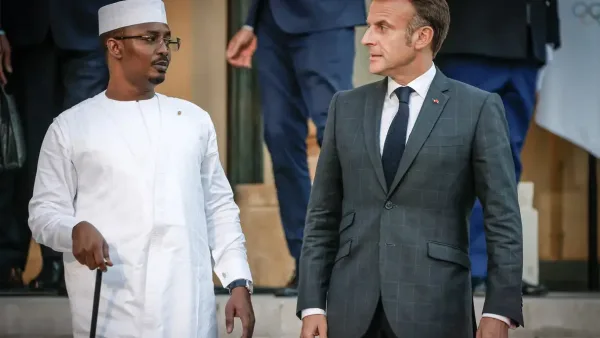
The visit of Mahamat Idriss Déby to the Élysée on January 29, 2026, had already paved the way for this rapprochement. In a joint statement, the two presidents expressed their desire to continue discussions to ensure the follow-up of the mutual commitments made between the two states. The text did not publicly detail the form that this new cooperation should take, but it confirmed the intention to maintain an open political channel between Paris and N’Djamena.
According to several media sources, Emmanuel Macron later stated that the Chadian president had requested to “rebuild a defense relationship” with France. This statement fueled questions about the true implications of the rupture announced by N’Djamena a year earlier.
The reported return of French officers does not mean, at this stage, the restoration of a military setup comparable to what existed before 2025. Rather, it would involve a reduced presence aimed at revitalizing cooperation, advising, training, or technical support. But symbolically, the message is strong: the Franco-Chadian security relationship, which many thought was definitively buried, has not completely disappeared.
A Fragile Security and Political Context
This resumption comes as Chad continues to face several security and political challenges. The country remains exposed to tensions in its regional environment, particularly along the borders with Sudan, Libya, Niger, Nigeria, and the Central African Republic. The situation in the Lake Chad basin is also marked by the threats posed by armed groups.
In addition to these external challenges, there are internal vulnerabilities. The government of Mahamat Idriss Déby, who took over the country after the death of his father Idriss Déby Itno in 2021, remains contested by some opposition and civil society groups. His election to the presidency in 2024 did not put an end to criticisms regarding governance, public freedoms, political arrests, economic difficulties, and allegations of corruption.
In this context, the resumption of military cooperation with France can be perceived in two ways. For the Chadian authorities, it may address concrete security needs and the necessity to diversify external support. For critics of the regime, however, it appears to be a retreat from the sovereignty discourse held during the departure of French forces.
The debate is all the more sensitive as the French military presence in Africa has been heavily questioned in recent years. Following its withdrawal from Mali, Burkina Faso, and Niger, Paris has sought to redefine its approach on the continent by favoring lighter, less visible formats that are more presented as partnerships at the request of the concerned states.
A Sovereignty Tested by Realities
In Chad, the central question remains the consistency between political discourse and strategic choices. In 2024 and 2025, the departure of French troops was presented as a major sovereign decision. In 2026, the resumption of security cooperation with Paris shows that N’Djamena does not intend to completely break away from its former military partner.
This evolution illustrates the limits of a rupture based mainly on symbolism. For a country facing multiple security pressures, sovereignty is not only measured by the absence of foreign troops on its territory. It is also measured by the state’s ability to ensure its own security, meet social expectations, and maintain trust between institutions and citizens.
The discreet return of French officers to N’Djamena will therefore not be enough to resolve the deep crises affecting the country. No external support can, on its own, restore political trust, reduce social tensions or address the frustrations of part of the population.
For Mahamat Idriss Déby, the challenge is now to convince that this new cooperation with Paris does not represent a step back, but a redefined relationship according to Chad’s interests. For his detractors, it confirms instead that the declared rupture with France was more a political moment than a true strategic change.
Comments