
Biometric identity card of ECOWAS: journalists raised awareness to better inform the populations
Beninese journalists and those from the subregion were made aware this Wednesday, June 3, 2026, in Cotonou, of the biometric national identity card of ECOWAS, designed to facilitate the free movement of West African citizens. Organized by IOM and the ECOWAS Commission, the workshop highlighted the stakes of regional integration and the essential role of the media in disseminating information to the populations.

SUMMARY
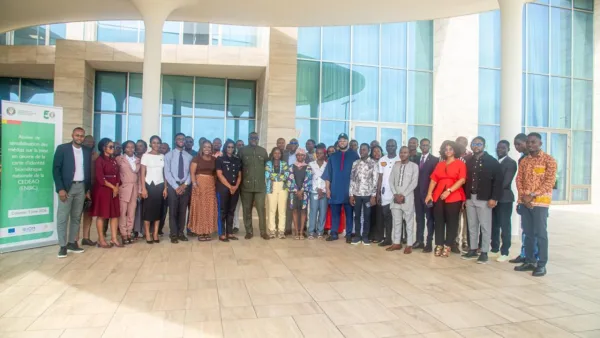
Gathered this Wednesday, June 3, at the Sofitel hotel in Cotonou, Beninese journalists and those from the subregion took part in an awareness workshop dedicated to the biometric national identity card of ECOWAS. Organized by the International Organization for Migration (IOM) and the ECOWAS Commission, the meeting aims to make the media key players in promoting this tool intended to facilitate the free movement of people within the community space.
For the organizers, the population’s acceptance of the biometric national identity card of ECOWAS primarily depends on reliable and widely disseminated information. Chimène Lougbegnon Bossa, Director of Emigration and Immigration of Benin, reminded that the country began issuing this document in 2020. “The ECOWAS biometric national identity card is available in Benin, it is indeed issued to citizens and facilitates travel within the community space,” she emphasized before the participants.
Adopted by the ECOWAS member states in 2014, this card complies with international standards set by the International Civil Aviation Organization (ICAO). It allows community nationals to travel more easily within the region while enhancing document security. For Seve Diomande, acting manager of the Program to Support the Free Movement of People and Migration, the stakes go beyond mere mobility. “The biometric national identity card is a major step in realizing the vision of a more integrated, safer, and more prosperous region,” he asserted.
The IOM representative also emphasized the benefits of legal identity for border populations and small cross-border traders, whose activities largely depend on the fluidity of movements. He reminded that reliable identification systems also contribute to the fight against identity fraud, illicit trafficking, and irregular migrations.
A Symbol of Regional Integration
Director of Free Movement of People, Migration, and Tourism of ECOWAS, Albert Siaw-Boateng placed the initiative within the context of the regional integration process that has been underway for several decades. “The biometric national identity card is not just a simple card. It is a symbol of belonging. It is an inclusion tool. And above all, it is a means to facilitate safe, secure, and efficient movements throughout our region,” he declared.
According to him, the biometric card harmonizes the identification systems of member states while enhancing cooperation in security and border management. However, its success will also depend on the population’s ownership of the system. “The success of this initiative does not solely depend on technology or political frameworks. It depends on people. It depends on trust. And it depends on information,” the community leader insisted.
Answers to Journalists’ Concerns
The discussions then clarified several questions regarding the operation of the system. The representatives of ECOWAS specified that each state remains responsible for producing and issuing its own cards, with the Commission merely defining common standards.
The organizers also reiterated the three fundamental principles of the free movement protocol adopted in 1979: the right to entry, the right to residence, and the right to establishment in member states. Regarding the use of the document, authorities clarified that the ECOWAS biometric card is a travel document valid only within the community space and does not replace the passport for travel outside the region.
The Media, An Essential Link in the System
At the end of the workshop, one message stood out as the common thread of all the interventions: the success of the project will largely depend on the information work conducted by the media. “You are the link between institutions and citizens. You shape public understanding, influence perception, and help build trust in initiatives such as the biometric national identity card,” Albert Siaw-Boateng reminded.
The organizers thus hope that journalists will help better promote the advantages of the ECOWAS biometric card to encourage its adoption and enhance mobility, security, and regional integration for the benefit of West African citizens.
Comments