
Benin: AES, Nigeria, Togo, Ivory Coast… Léandre Houngbédji details the Wadagni diplomacy
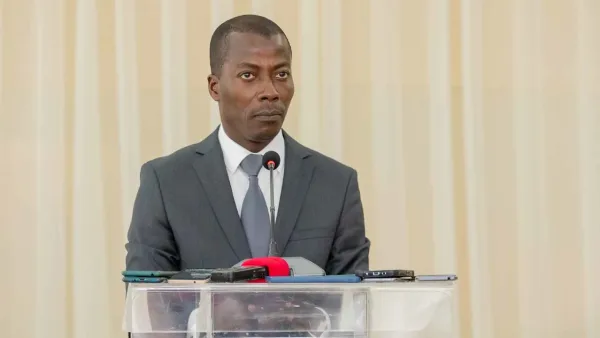
Wilfried Léandre Houngbédji delivered the official framing of Romuald Wadagni’s first diplomatic tour in the sub-region. The government spokesman confirmed five countries visited in one week and presented these trips as a means of peer presentation aimed at opening a new dynamic with Benin’s neighbors, particularly the countries of the AES.

SUMMARY
The government spokesperson, Wilfried Léandre Houngbédji, held a press conference on Friday, June 5, during which he assessed Romuald Wadagni’s first diplomatic tour and provided his official political framing. He confirmed that the head of state has visited five countries since his inauguration on May 24, namely Nigeria, Niger, Burkina Faso, Togo, and Côte d’Ivoire. He also added that further visits in the sub-region are planned “at the discretion of his schedule.”
When asked about the significance of the visits to the AES countries, Houngbédji rejected any notion of a break from Talon’s policy. “In the past, Benin has not remained closed off to the AES countries. Among the heads of state in the sub-region, President Talon was notably the one who visited Ouagadougou to speak with Captain Traoré. We have always been willing to discuss with our brothers from AES countries,” he stated.
The spokesperson also provided an explanation of the estrangement between Benin and the AES countries. “Due to our position as a loyal partner within ECOWAS, these countries became angry with us,” he indicated, before adding that Benin had worked “as a pioneer” to have ECOWAS sanctions against the AES countries lifted, and once these sanctions were dropped, “Benin consequently took the necessary measures” – without this being enough to dispel the suspicions from the other side.
“Condemned to Live Together”
Houngbédji explicitly invoked geography as the foundation for reconciliation. “It will not happen tomorrow, unless there is extraordinary tectonics, that Niger and Burkina separate from Benin, with whom they share borders.” The phrase – neighbors who “quarrel” but know they are “condemned to live together” – constitutes the official doctrine of the Wadagni government regarding relations with the AES according to Houngbédji’s explanations.
He characterized Wadagni’s tour in deliberately deferential terms. The head of state, “a newcomer in the class of heads of state,” took it upon himself to visit the “elders in office” to convey: “I just arrived, I am your new companion, I wish for a new dynamic to be implemented regarding relations between our countries.” This staging of protocol humility – the younger one paying respects to the elders – was clearly calculated to defuse the accumulated mistrust from the previous mandate.
The spokesperson expressed happiness about the reception of the message and “is pleased to note that on the other side as well, the leaders of these countries, the population itself, have been perfectly receptive to this approach.” He concluded by indicating that there are opponents to this rapprochement, before dismissing them with the phrase: “I don’t want to believe that you are the only marginal one who would complain about this new dynamic.”
Continuity as an Argument of Legitimacy
Houngbédji’s communicative posture is noteworthy. He does not present Wadagni’s tour as a break – which would implicitly criticize Talon – but as a continuity made possible by a change of context and face. Benin wanted to engage in dialogue for three years. The geopolitical situation and the arrival of a new head of state created the conditions for this dialogue to finally take place. The responsibility for the freeze is presented as belonging to the AES, not Benin.
This version of events is not neutral. It erases the most conflictual episodes of the 2023-2026 period – the accusations by Tiani against Talon in the Niamey airport affair, the arrests of Nigerien nationals regarding the pipeline, the mutual diplomatic expulsions – to retain only the image of a patient and loyal Benin whose peace efforts had not been rewarded. It is a narrative favorable to both the outgoing and incoming governments simultaneously, which aligns with a minister who has served under both.
Comments