
Sonko-Diomaye Break: Senegalese People Question the Future of the Sovereign Project
At the end of May 2026, the Senegalese political scene was marked by a significant reshuffling at the top of the state. The dismissal of Prime Minister Ousmane Sonko by President Bassirou Diomaye Faye ended a political sequence built around a duo that had long been presented as inseparable. The appointment of Ousmane Sonko to head the National Assembly then established a new institutional configuration, in which the two former allies now hold distinct positions within the state apparatus.

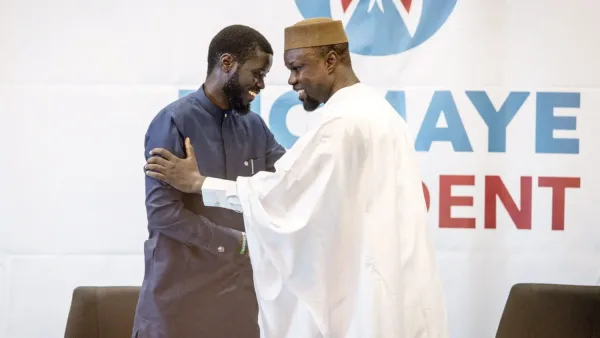
This development comes two years after the 2024 alternation, propelled by the slogan “Sonko mooy Diomaye”, which became one of the symbols of the presidential campaign. For some citizens, this phrase expressed the idea of political continuity between Ousmane Sonko, who was prevented from running for office, and Bassirou Diomaye Faye, who was ultimately elected president of the Republic. Today, the rift between the two men raises questions, concerns, and disappointments among some in the public opinion.
In the streets of Dakar, a street survey gathered several reactions from citizens regarding this new political situation. Some express their attachment to the sovereignist project advocated by Ousmane Sonko and question the reasons for the tensions that have emerged at the top of the state. One citizen stated, “the president of the National Assembly Ousmane Sonko, I see him as a president who really wants the functioning of Africa from Senegal, development, the sovereignty of Africans. This is what often creates a real problem between the two right now.”
Other respondents mention the idea of a political process disrupted by factors that are difficult to identify with certainty. Another participant suggested, “In this progress, at one point, there is a break. There would surely be influences on this process, in fact.” This perception reflects, for some citizens, the feeling that the separation between Bassirou Diomaye Faye and Ousmane Sonko is not merely due to internal disagreements, but could also be tied to broader political stakes.
For a portion of the electorate, the removal of Ousmane Sonko from the Prime Ministership marks a break with the expectations arising from the 2024 presidential election. Many citizens had placed great hopes in the tandem formed by the two men, seen at the time as bearers of a project for political, institutional, and economic change. The new power configuration is therefore met with caution by those who fear a weakening of this initial promise.
Additionally, one citizen summarized this disillusionment by saying, “The rise to power of the Diomaye and Sonko tandem sparked a lot of hope. Honestly, the Senegalese youth saw a duo or tandem that would really elevate the level of Senegal… But the reality of power is different.”
The rift between Bassirou Diomaye Faye and Ousmane Sonko thus goes beyond, in the eyes of several Senegalese interviewed, a simple disagreement between two political leaders. It raises deeper questions about the future of the project defended in 2024, particularly national sovereignty, a break with the practices of the old regime, and the capacity of the new power to meet social expectations.
In this context, the respective positions of the two men are now closely monitored. Bassirou Diomaye Faye, as president of the Republic, has the constitutional responsibility to lead the action of the state. Ousmane Sonko, now president of the National Assembly, retains significant political influence, especially among a substantial part of the militant base that supported the alternation.
The future will depend on how this new institutional configuration is managed. For some citizens, it could open a period of political clarification. For others, it risks further fueling divisions within the camp that brought the victory in 2024. In any case, the Sonko-Diomaye rift now raises a central question: what will remain of the sovereignist promise that mobilized a large part of the Senegalese youth?
Comments