
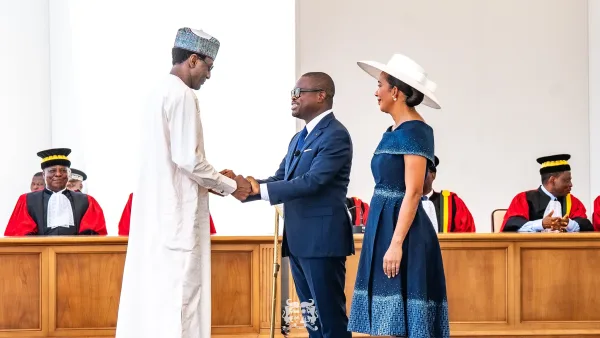
Romuald Wadagni announced in Niger this Tuesday, June 2.
According to several Nigerien sources, Romuald Wadagni will travel to Niamey for his first bilateral visit since his inauguration, amidst high expectations regarding the thawing of relations between Benin and Niger. In front of General Abdourahamane Tiani, the new Beninese president will need to address sensitive issues such as the closed border, the Niger-Benin pipeline, security cooperation, and the full restoration of diplomatic relations.

SUMMARY
On Tuesday, June 2, 2026, Beninese President Romuald Wadagni will undertake a working visit to Niamey, marking his first bilateral diplomatic outing of his term, just ten days after his inauguration on May 24. The agenda for talks with General Abdourahamane Tiani, President of the National Council for the Safeguarding of the Homeland (CNSP), will focus on five key issues: security cooperation, the reopening of the Nigerien land border, the operational status of the Niger-Benin oil export corridor, trade exchanges, and mechanisms for strengthening diplomatic relations, according to government sources.
This visit comes amid an unprecedented diplomatic context since July 2023. The rift between the two countries has never been deeper, and the conditions for rapprochement have never appeared more favorable at the same time. Relations between Benin and Niger have significantly deteriorated since the coup d’état in July 2023, with Niger now closing its land border with Benin and paralyzing a large part of the commercial exchanges between the two countries.
The crisis worsened in January 2026 with mutual expulsions of diplomats and the suspension of activities at the Beninese embassy in Niamey. Relations further deteriorated following the Islamic State’s attack on Niamey airport in March 2026, with Tiani directly accusing former President Talon, Emmanuel Macron, and Alassane Ouattara of having supported the assault.
However, the change in Beninese leadership alters the prospects for dialogue that two years of personalized tensions had rendered unlikely. During his campaign, Wadagni signaled his intention to rebuild trust with his troubled neighbors. In Niamey, the presence of Prime Minister Ali Mahamane Lamine Zeine at the inauguration on May 24 had already been interpreted as a conditional signal of openness from the CNSP.
The Pipeline, a Key Issue
The agreements signed on May 18, 2026, between Niamey and CNPC have revived the pipeline project and reopened the prospect of exports via the Sèmè-Kpodji terminal. For Niger, a landlocked country, the Beninese terminal remains the only viable Atlantic outlet in the short term, as it is quicker to mobilize than the redirection towards the Chad–Cameroon pipeline.
The 1,980-kilometer Niger-Benin pipeline connects the oil fields of Agadem to the maritime terminal of Sèmè, east of Cotonou. Operated by WAPCO, a subsidiary of CNPC, it had achieved a nominal capacity of 90,000 barrels per day at its inauguration in November 2023. Bilateral tensions and disputes over export conditions have prevented regular flow. The arrest in June 2024 of five Nigerien nationals at the Beninese terminal, three of whom were convicted by the CRIET, followed by the declaration of the first advisor of the Beninese embassy as persona non grata in January 2026, had successively jeopardized any resumption.
For Cotonou, restarting the pipeline represents transit revenue and the maintenance of the strategic role of the Sèmè port in the Sahelian logistics chain. For Niamey, oil exports via Benin condition a significant portion of projected short-term tax revenues, with oil accounting, according to projections from the transitional government, for up to 50% of tax revenues at full capacity.
A Narrow Diplomatic Window
Although Tiani has denied any involvement in the attempted coup on December 7, 2025, against Talon, the episode triggered mutual diplomatic expulsions at the beginning of 2026. The issue of French special forces stationed in Benin as part of counter-terrorism operations that France has officially acknowledged deploying remains a major point of irritation for Niamey, which has made it an implicit condition for any normalization.
As a recognized technocrat, Wadagni, not marked by the most contentious phases of the post-coup period, is well-positioned to exploit this opening. A regional mediation attempt had already been considered in 2025 through a tripartite commission involving both governments as well as former Beninese heads of state, without achieving a concrete result.
The visit on June 2 is the first face-to-face meeting between a Beninese president and General Tiani since the coup in August 2023. No joint statement has been announced in advance. Concrete outcomes (partial or total lifting of the border closure, protocol for the resumption of oil exports, restoration of full diplomatic relations) will determine whether the visit constitutes a breakthrough or a first exploratory exchange.
Comments