
Dasa: a $501 million mining project under surveillance in Niamey
General Abdourahamane Tiani met with Stephen G. Roman, CEO of Global Atomic, in Niamey to discuss the Dasa uranium project in the Agadez region. Presented as one of the most advanced high-grade deposits in the world, the site’s commissioning has been postponed to the end of 2027, mainly due to funding delays and logistical constraints related to the closure of the border with Benin.

SUMMARY
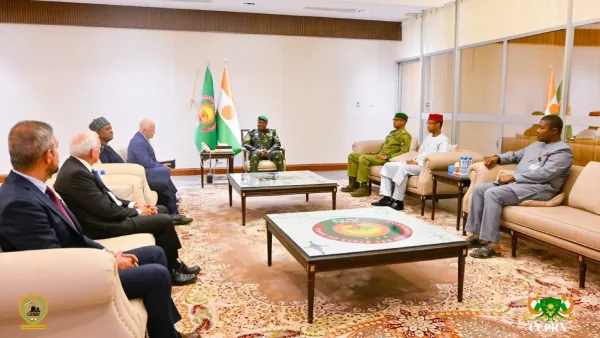
Niger’s head of state, Army General Abdourahamane Tiani, received Stephen G. Roman, president and CEO of the Canadian mining company Global Atomic Corporation, on Monday, May 18, for an update on the progress of the Dasa uranium deposit, according to a statement from the Nigerien presidency. Roman had just returned from a site visit located about 105 kilometers south of the mining town of Arlit in the Agadez region. Both parties confirmed the ongoing construction of the processing plant and their shared goal of maximizing benefits for the Nigerien population.
The Dasa project is operated by SOMIDA, a Nigerien mining company 80% owned by Global Atomic and 20% by the Nigerien state, of which 10% is free according to the mining code and 10% is purchased. According to Global Atomic’s first-quarter 2026 financial report published on May 13, the total project costs are now estimated at $501.3 million, of which $210.9 million has already been committed as of March 31, 2026. A remaining amount of $290.4 million still needs to be mobilized, contingent on securing external financing.
The commissioning of the processing plant is now scheduled for the fourth quarter of 2027, with the first yellowcake shipments expected in the first half of 2028, according to the first-quarter 2026 financial report. This schedule has been revised three times since the project began: initially set for the second quarter of 2026, it was pushed to the first quarter of 2027, then to the second half of 2027, before being moved to the fourth quarter of 2027. The main reason cited by the company is the delay in obtaining loan financing, compounded by the border closure with Benin, which had served until 2023 as the main corridor for importing equipment via the port of Cotonou.
During a visit to Niger in December 2025, followed by an interview on national television, Roman himself mentioned the possibility of the first uranium shipments being delayed to 2028, according to the company’s press release on December 11, 2025. The first quarter 2026 report confirms this projection for yellowcake.
U.S. financing, the crux of the project
The main variable affecting the production schedule remains the securing of a loan from a U.S. development bank. The company stated in December 2025 that the application had been reviewed by the bank’s credit committee and forwarded to the investment committee. In the first-quarter 2026 report, Global Atomic confirms that this process is still ongoing. The identity of the bank is not specified in the company’s official communications, but specialized publications cite the U.S. Development Finance Corporation (DFC), now chaired by Secretary of State Marco Rubio. At the same time, the company is exploring an alternative solution involving the sale of a minority stake in SOMIDA to an investment partner.
To finance its operations in the meantime, Global Atomic completed a stock issuance in February 2026 for gross proceeds of $72.6 million. In the first quarter of 2026, it invested $22.4 million in its Nigerien mining properties.
Dasa is presented by the company as the most advanced high-grade uranium deposit currently in development worldwide. The confirmed reserve stands at 4.1 million tons with a grade of 5,267 parts per million, equivalent to 47.2 million pounds of uranium, according to the revised feasibility study. The deposit is located in the sedimentary basin of Tim Mersoï, in the Agadez region, which is also home to deposits operated since the 1970s by Orano (formerly Areva) and other operators.
The company confirmed on Monday that the site currently employs more than 700 people, over 95% of whom are Nigerien nationals. Roman praised this commitment during the audience chaired by Tiani, which was attended by Commissioner Colonel Ousmane Abarchi, Minister of Mines, Dr. Soumana Boubacar, Minister and Government Spokesperson, and Abdoulrazakou Abdou Moumouni, mining and energy adviser to the head of state.
Global Atomic has entered into purchase agreements with three North American electric companies for 6.9 to 8.8 million pounds of uranium over the first six years of production, representing about 90% of the contracted volumes for this period. The spot price of uranium ranged between $82 and $101 per pound in the first quarter of 2026, and long-term prices remained around $90 per pound, according to Global Atomic’s quarterly report.
Comments