
Benin: the relocation of Dantokpa to Tokpa Yôyô caught up by the reality on the ground
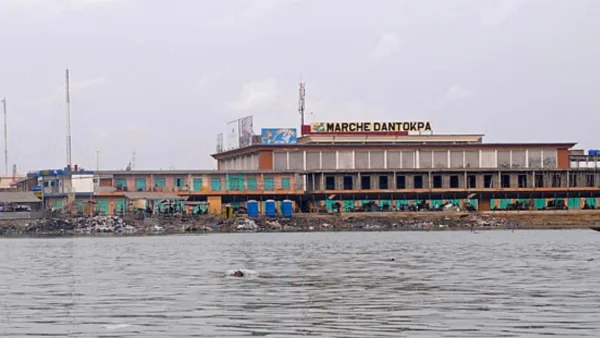
Launched in 20018, the relocation project from Dantokpa to Tokpa Yôyô now seems to reveal a major design flaw. According to the Director General of Anagem, 1,400 slots were planned while nearly 4,000 vendors are active in the relevant sectors. Between forgotten sub-tenants, successive delays, economic resistance, and spiritual attachment to the historic site, the extension announced by ANaGeM raises questions about the method chosen to modernize the largest market in Benin and its social as well as economic function. Dantokpa is not just a market. It is a living space for tens of thousands of families in the Cotonou region, and more broadly, a commercial hub for the entire sub-region.

SUMMARY
In June 2026, the Director General of the National Market Management Agency (ANaGeM), Eunice Loisel Kiniffo, announces on Matin Libre TV that an extension of the Tokpa Yôyô site “starts today.” Her phrasing is strikingly frank: the 1,400 constructed slots “could not accommodate the 4,000 vendors from Dantokpa who operate in this sector.” In other words, the delivered site does not match the real demand. This declaration is not a surprise for those who have been following this issue since 2018. It is the public admission of a design flaw that has been present in the project since its inception.
How did we get here? Why were 1,400 slots built for a market that required three times as many? And if the initial 1,400 slots took seven years to be completed, what should we expect for the additional 2,500 to 3,000 now needed? The history of this project offers some answers – and a call to moderate optimism.
Seven years of announcements before the first stakes
The relocation project for Dantokpa was born in 2018 from a program to modernize markets launched by President Patrice Talon, which planned the construction of 35 modern markets across the entire national territory. Dantokpa, presented as “the largest market in West Africa,” was its centerpiece.
On paper, the architecture was coherent. Two sites were to absorb the 33 activity sectors and the approximately 20,000 people who depend on the market. The Mathieu Kérékou Commercial Hub – renamed Tokpa Yôyô in March 2026 by the decision of the head of state – would host proximity non-food activities: textiles, leather goods, cosmetics, jewelry. Located on the esplanade of the Friendship Stadium in Kourounou, it was supposed to include 441 shops, 1,013 stands, and 70 restaurants. The Grand Nokoué Agro-Food Hub – renamed Tokpa Daho – was intended for food wholesalers on 168 hectares in Akassato, in the commune of Abomey-Calavi.
From 2018 to 2025, the program progressed. Fifteen retail markets were established in Cotonou, Porto Novo, Abomey, Glazoué, Pahou, and Natitingou. Others followed, bringing the number of completed infrastructures to 21 out of the 35 expected by March 2026. But the Dantokpa aspect – the most complex, the most symbolic, and the most politically exposed – lagged behind. It was only on September 8, 2025, that ANaGeM published a detailed timeline: starting January 5, 2026, over ten days, all Dantokpa vendors would move. All sectors combined.
The mechanics of delays
The date of January 5, 2026, arrives. A journalist from Kori Actu descends the Martin Luther King bridge, observes the currency exchange agents at their posts, the usual traffic jams, and the vendors at work. Dantokpa operates as usual. ANaGeM does not communicate about this failure. The schedule discreetly disappears. Two months later, a new press conference sets new dates: relocation from April 13 to May 2, opening of Tokpa Yôyô on May 9. In the meantime, DG Kiniffo in February lets slip a phrase that reveals much about the state of the dossier: “The head of state told us to let the ladies sell calmly during this festive period and afterward, they will move slowly.”
On March 28, 2026, the provisional list of pre-selected vendors for Tokpa Yôyô is posted. It contains around 2,000 names – those of the tenants recorded in the SOGEMA books, the former market management company. The site’s capacity stands at 1,300 to 1,400 slots. The math does not add up.
This imbalance between the 2,000 official tenants and the ground reality is explained by a structural gap: sub-tenants – those who rent their space not from the state but from a primary tenant – are invisible in SOGEMA’s records. Yet they number in the thousands, mostly women, working daily at Dantokpa without a direct contractual link to the agency. They are the ones who bring the actual market population to 4,000 people in the four sectors concerned by Tokpa Yôyô, and to 20,000 across the entire market.
On April 1, ANaGeM announces a new delay, citing a “readjustment of the system” without further details. The real reason has been circulating on social media for weeks: hundreds of female traders have not found a spot and are making it known. The agency urgently launches a census of sub-tenants from April 2 to 6. This census should have preceded the setting of the accommodation capacity. It arrives afterwards.
What the opponents were right to point out
The project faced resistance from the outset, which the government sought to keep at bay rather than engage with substantively. The most well-known figure of this opposition is Célestine Zanou, former Chief of Staff to General Mathieu Kérékou and former Minister of Planning. In an article published in June 2024, she describes the project as “disastrous” and raises the fundamental question: “Dantokpa must remain where it is.” Her argument is not conservatism. It is the absence of demonstration that relocation is preferable to in-situ modernization. “There are rulers who confuse development with the satisfaction of personal desires, with the realization of one person’s wishes at the expense of considering the Human being in his entirety and the people in their sincere and realistic aspirations,” she writes. She compares the destruction of Dantokpa to the demolition of the former residence of General Kérékou, razed to make way for a garden – the same logic of total erasure, the same absence of public debate.
Zanou’s critique resonates all the more strongly in 2026 as the relocation commercial hub was named after General Kérékou himself until March. The memorial dimension added to the economic dimension: moving Dantokpa also erases a geography of Dahomey memory.
To this political resistance, there is also a spiritual resistance that ANaGeM’s consultations have partially overlooked. Dantokpa means in Fon “the great market of Dan” – Dan being the serpent god of the Vodun pantheon, reputed to protect the commercial space and ensure the prosperity of its vendors. Leaving Dantokpa is, for many, to leave this protection. ANaGeM’s strategy has been to play on symbols by choosing evocative names – Tokpa Yôyô, Tokpa Daho – to recall the spirit of the old market. It has not addressed the attachment to the place itself, irreplaceable in its spiritual and memorial significance.
The unresolved legacy
What DG Kiniffo announced in June 2026 – an ongoing extension whose new operating dates will be communicated “in the coming days” – resonates like an echo of previous announcements. In January 2026: the relocation will begin “in the coming days.” In March 2026: new dates will be known “soon.” In April 2026: the resumption will be communicated “in the coming days.” The vocabulary of floating deadlines does not change. What changes is the scale of the problem remaining to be solved.
If the construction of 1,400 slots, as part of a national program of 35 simultaneous sites, took seven years to complete, what timeline should we anticipate for an additional 2,500 to 3,000 slots? ANaGeM has not communicated any specific timeline, budget, or contractor. The phrase “will not last over time” engages morally, but not contractually.
The Tokpa Yôyô case does not invalidate the entire market modernization program. Twenty-one modern markets have been delivered, a large wholesale infrastructure of 168 hectares exists in Akassato, and a unified management architecture has been established. These achievements are real. However, Dantokpa, as the centerpiece and showcase of the project, has been approached with the same method as any modest-sized market, without taking into account what makes its uniqueness: the massive informality of its occupants, the longevity of its solidarity networks, and its function that far exceeds the economic to touch on social, cultural, and spiritual aspects.
Building 1,400 slots to relocate 4,000 vendors without first having surveyed the sub-tenants is akin to having wanted to write history before having read the previous chapter. The announced extension may be the chance to correct this flaw. It will only be that if the method changes along with it.
Comments