
Benin: the government explains the delay in the reconstruction of the Djonou bridge
Announced two years ago, the reconstruction of the Djonou bridge in Abomey-Calavi has still not started. In response to questions raised by this delay, the government has assured that the project has been scaled up after its integration into an urban mobility program funded by the World Bank. A revision that, according to the authorities, is meant to meet new objectives, particularly the development of river transport.

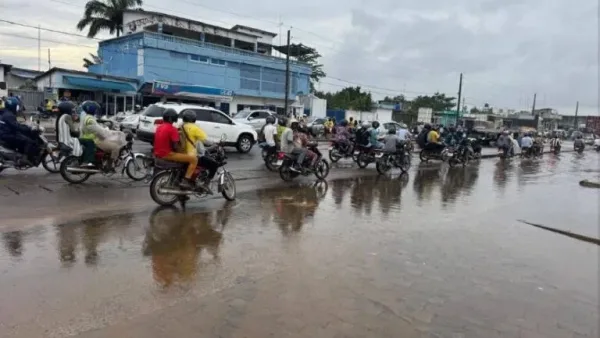
The Beninese government has provided details on the reasons for the observed delay in the reconstruction of the Djonou bridge, located in the municipality of Abomey-Calavi. Invited to the program Sous l’arbre à palabres, the government spokesperson, Wilfried Léandre Houngbédji, stated that the project had changed in scope after its integration into a World Bank-supported program.
“We entered into a program with the World Bank, a program called urban mobility, in which the Djonou bridge, like that of Cotonou, has been integrated,” he explained.
According to him, this new direction led the authorities to completely revise the technical studies. “In the meantime, we have seen things on a larger scale, more modern and more futuristic,” declared the former Deputy Secretary General of the government.
Beyond the reconstruction of the structure, the government intends to develop river transport between Porto-Novo, Cotonou, and Abomey-Calavi. “Ultimately, we want to promote river transport from Porto-Novo to Calavi via Cotonou and put our water plan into operation. For this, a certain dimension was necessary,” emphasized Wilfried Léandre Houngbédji.
The government spokesperson also indicated that the head of state has asked the Minister of Living Environment and Transport to seek solutions to speed up the project’s realization. The goal is to prevent the difficulties recently observed at this site from recurring.
While waiting for the work to start, temporary measures have been taken. “The Minister of Living Environment and Transport has made arrangements to ensure that such an amphibious intervention occurs to further drain the waters and prevent their stagnation up to overflowing,” stated the minister.
According to the government, once the technical studies are finalized, the reconstruction of the bridge should require between two and three years of work. The authorities estimate that the future structure will provide better water circulation and safer travel conditions for users.
These explanations come after heavy rains on June 30 caused the overflow of waters at the Djonou bridge (Houédonou) in Godomey, cutting off this strategic section of the RNIE2 connecting Calavi to Cotonou for several days — detours via Kpota, Bidossessi, IITA, Hêvié, or the bridges of Cocotomey and Womey.
Traffic was fully restored in both directions on the bridge on Saturday, July 4, around 8 PM, after drainage work by the Beninese Agency for Civil Protection (ABPC), which removed the standing water using amphibious excavators and motor pumps.
Comments