
Benin – Mali: Wadagni receives a message from Assimi Goïta two days after his inauguration.
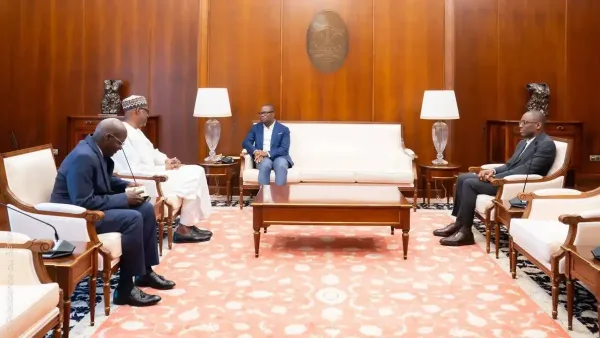
Romuald Wadagni received the Malian Minister of Foreign Affairs, Abdoulaye Diop, in Cotonou, bearer of a message from General Assimi Goïta two days after his inauguration. This audience, following the presence of AES delegations at the ceremony on May 24, confirms the opening of a dialogue between the new Beninese government and the Sahelian capitals, set against issues of security, economy, and diplomacy.

SUMMARY
Beninese President Romuald Wadagni received Abdoulaye Diop, Mali’s Minister of Foreign Affairs and International Cooperation, on Monday, May 26, at the Marina Palace, two days after his inauguration. Diop brought a message from General Assimi Goïta, the head of state of Mali, and conveyed the official congratulations of Bamako as well as his wishes for success for the Beninese people.
The discussions focused on bilateral relations between Cotonou and Bamako, regional cooperation, security stability, and economic prospects between the two states, according to information released after the meeting. Wadagni expressed his satisfaction with Mali’s presence at his inauguration. Minister Diop reiterated his country’s readiness to develop cooperation based, in his words, on “the respect of the sovereignty of states, strategic choices, and the interests of the populations.”
Diop had already represented Goïta at the inauguration ceremony on Sunday, May 24, at the Cotonou Congress Palace, alongside his Burkinabe counterpart Karamoko Jean-Marie Traoré and Nigerien Prime Minister Ali Mahaman Lamine Zeine. This is the first time in several years that the three countries of the Sahel States Alliance (AES) have sent high-ranking representatives to an official Beninese ceremony.
A Context of Accumulated Tensions with the AES
The Sahelian presence in Cotonou comes after a series of deep tensions between Benin and the AES countries, particularly Niger. Since the coup that overthrew President Mohamed Bazoum in July 2023, Benin had supported ECOWAS’s position in favor of a military intervention to restore constitutional order. In response, Niamey closed its land border with Benin — still closed in May 2026 — and made repeated accusations against Cotonou, alleging that Beninese territory was being used as a base for destabilizing actions, claims denied by Beninese authorities.
The oil issue has aggravated the bilateral relationship. The Niger-Benin pipeline, over 2,000 kilometers long, connecting the Agadem fields to the Sèmè port, has never reached its nominal capacity of 200,000 barrels per day. In June 2024, the arrest of five Nigerien nationals on the platform of the pipeline in Benin, three of whom were sentenced to eighteen months of suspended prison by CRIET for using fake badges, further strained relations. In January 2026, Niamey declared the first counselor of the Beninese embassy persona non grata. On December 7, 2025, an attempted coup against President Patrice Talon intensified the mutual accusations between the two capitals. France has since acknowledged the deployment of special forces in support of Benin’s anti-terrorism efforts.
Security at the Forefront for Wadagni
In his inauguration speech on May 24, Wadagni emphasized the need for strengthened regional cooperation and expressed Benin’s solidarity with Mali in its fight against terrorism. Without naming the AES, he spoke of stability, dialogue, and mutual respect as common priorities with neighboring countries.
For Cotonou, the stakes of rapprochement with the AES are both security and economic. Northern Benin has faced a rise in jihadist violence for several years, partly fueled by the lack of effective cross-border cooperation with Burkina Faso and Niger. The autonomous port of Cotonou, which derives a significant part of its activity from transit to the Sahel hinterland, has seen its volumes slow since the closure of the Nigerien border.
An agreement signed on May 18, 2026, between Niamey and the China National Petroleum Corporation (CNPC) has revived the Niger-Benin pipeline issue, signaling a possible resumption of oil exports and opening a window for the resumption of bilateral contacts, according to analysts from the Institute for Security Studies (ISS). The date of a potential reopening of the Nigerien border and the commitments Wadagni is willing to make regarding French forces in Beninese territory will determine, according to these same analysts, the concrete scope of the rapprochement initiated.
Comments