
Senegal: from the perch, Ousmane Sonko reveals the true reasons for his separation from Diomaye Faye.
Since his election as president of the National Assembly, Ousmane Sonko has been trying to give a political and moral depth to his break with Bassirou Diomaye Faye. Amid disagreements over political funds, criticism of governance, economic divergences, and references to Mamadou Dia, the former Prime Minister presents his dismissal as a symptom of a broader conflict over the ethics of power and the direction of the Pastef project.

SUMMARY
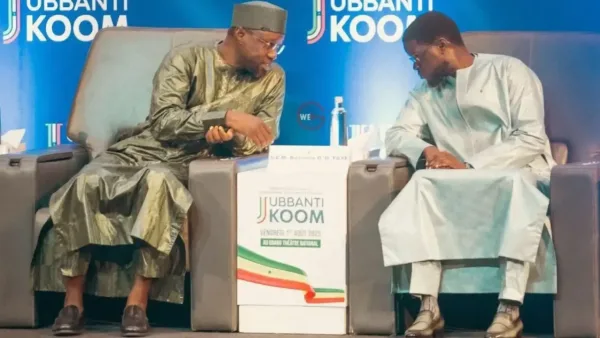
In his inaugural speech as president of the National Assembly on Tuesday, May 26, Ousmane Sonko presented his break with President Bassirou Diomaye Faye through two distinct registers: first, a series of concrete grievances formulated on May 22 before the same deputies, just hours before his dismissal, and then a philosophical framing on the day of his election to the perch, invoking Aristotle and the first Prime Minister of the independent Senegal Mamadou Dia to anchor the disagreement in the realm of public ethics.
The immediate trigger for the dismissal was identified by several Senegalese media. During the question-and-answer session on May 22, Sonko had displayed a frontal disagreement with the head of state on the issue of political funds, relating to the financial envelopes that the presidency and the prime minister’s office have, which escape parliamentary control. “The President made a mistake regarding political funds and I hope he returns to reason. I do not agree with him on this issue,” he stated. He added that “Since 2019, we have raised this debate on political funds. No one imposed it on us; we believed all funds should be transparent.” Clarifying that he had never demanded the elimination of these funds but their regulation “as in countries like France,” he also revealed that at the Prime Minister’s office, his services had 1 billion 770 million CFA francs in this regard. In the same session, he stated that “I am not a Prime Minister who blindly obeys and agrees with everything.” The decree No. 2026-1128 of revocation was read on national television a few hours later. According to a source close to the power, it is a “general attitude” that displeased Faye and not just the issue of political funds.
The day after the election, during his inaugural speech at the perch, Sonko shifted the debate to a philosophical register. He asserted that “what is at stake goes beyond individuals” and that “it is the relationship between morality and politics.” Drawing on Aristotle’s thought, where politics is “the supreme art” when it aims for the common good, he developed the theme of “moral fatigue” in societies whose institutions cease to serve citizens and become instruments of personal comfort. He called on the figure of Mamadou Dia, the first head of government of independent Senegal, as an example of a leader who warned, in the early years after independence, against the confusion between the state and the private interests of leaders, defending the idea that sovereignty could not be merely political but must also be moral, economic, and social. Without naming President Faye explicitly, Sonko suggested that the differences leading to his dismissal stemmed from a fundamental disagreement over governance and the ethical principles of exercising power.
Two years of accumulated tensions
The speech on May 22 was not a sudden break. Tensions between the two men had accumulated since the autumn of 2025. In early March 2026, Sonko had publicly mentioned the possibility of returning to the opposition and talked about “soft cohabitation.” On May 2, 2026, Faye crossed a new threshold by publicly stating that he could dismiss his Prime Minister if he no longer trusted him, and by defending the maintenance of political funds. “Political funds are expenses that cannot be detailed to the general public,” he said. From then on, according to SenePlus, observers and political sources agreed on a single word: divorce.
The announcement of his candidacy for the presidential election of 2029, publicly made by Sonko in December 2025, four years before the deadline, while Faye was in office, placed the two men in direct competition for the leadership of the camp resulting from the March 2024 presidential election. At the same time, Faye gradually restructured his own coalition “Diomaye Président“, providing it with founding texts and appointing former Prime Minister Aminata Touré as general supervisor, in order to make it a political force distinct from Pastef. In this sequence, the appointment of Al Aminou Lô, a former BCEAO executive whose profile contrasts with the sovereignist discourse of Pastef, has been interpreted by some in the movement, including deputy Guy Marius Sagna, as a strategic repositioning of the presidency.
The Senghor-Dia comparison invoked by analysts
The invocation of Mamadou Dia by Sonko is not coincidental. It fits into a historical parallel that several Senegalese analysts have drawn in recent days. Professor Moritié Camara, in an article published on Afrik Soir, compares the Senghor-Dia (1960-1962) and Faye-Sonko (2024-2026) pairs as two configurations of bipartite power marked by similar tensions between institutional legitimacy, that of the president, and popular legitimacy, that of the Prime Minister. In both cases, he notes, the break crystallized in Parliament: on December 17, 1962, with the motion of censure against Dia, and on May 22, 2026, with Sonko’s speech before the deputies. As for the conclusions, they differ. After his overthrow, Dia was arrested and imprisoned for twelve years without a fair trial. Sonko, however, was dismissed and found himself four days later at the head of the institution where he had challenged his chief.
Sonko’s reaction to the announcement of his dismissal, posted on his Facebook page in a few lines, “Alhamdoulillah. Tonight I will sleep with a light heart at the Keur Gorgui city” — surprised as much as it spoke. Pastef holds 130 of the 165 seats in the National Assembly, compared to 16 for Takku Wallu Sénégal and 7 for Jàmm ak Njariñ. The loyalty of this majority to Sonko or Faye now constitutes the main unknown in the political sequence that is opening up.
Comments