
Senegal: elected president, Ousmane Sonko promises an “assertive yet responsible” Assembly.
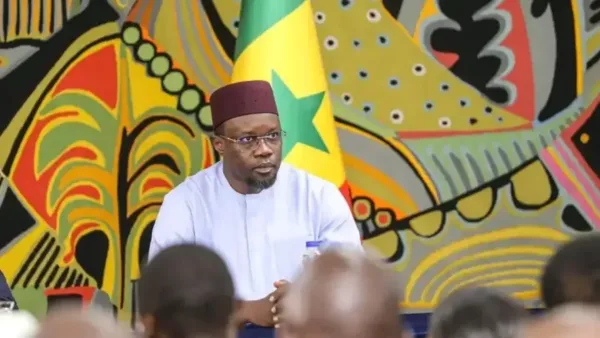
Ousmane Sonko was elected on Tuesday, May 26, as the President of the National Assembly of Senegal with 132 favorable votes out of 133 voters, meaning one abstention and no votes against. The vote took place after the opposition deputies boycotted the session, leaving the room at the beginning of the meeting to protest what they believe to be a violation of the internal regulations. The session, supervised by the first vice-president of the institution, Ismaïla Diallo, began at 9:23 AM in the form of a secret ballot.

SUMMARY
Prior to this, Sonko had been reinstated in his role as a deputy, amid applause from the Pastef elected officials present in the hemicycle. His substitute, Ismaïla Wone, had relinquished the mandate to make way for him. The constitutional majority required for the election to the chair was set at 67 votes. The meeting followed the resignation of El Malick Ndiaye from the presidency of the Assembly on May 24, and Sonko’s dismissal from the Prime Ministry by President Bassirou Diomaye Faye on May 22. In his first speech from the podium, Sonko stated that the National Assembly “will firmly but responsibly use all levers of power.”
Out of the 165 seats in the Assembly, the 32 deputies belonging to the opposition groups did not participate in the vote. Pastef holds 130 seats and was joined by elected officials from allied groups, bringing the total number of voters to 133. The figure of 132 votes out of 133 voters contrasts with the 165 seats in the chamber, illustrating the effective extent of the boycott.
A Persistent Constitutional Controversy
The opposition’s boycott is based on an unresolved legal controversy. Sonko had led the national list of Pastef in the legislative elections of November 2024 while he was the serving Prime Minister. According to his detractors, including Thierno Alassane Sall, an independent deputy, his election as a deputy in this situation of incompatibility definitively deprived him of his parliamentary mandate. Sall had described the procedure as an attempt to provoke “a major institutional crisis.” The parliamentary opposition has used the terms “robbery” and “constitutional coup” in its reactions reported by several Senegalese media outlets.
Two legal experts, Cheikhou Oumar Sy and Théodore Chérif Monteil, former elected officials, supported in a column published on SenePlus that Sonko’s case falls under articles 123 and 132 of the internal regulations — applicable to citizens entering Parliament while already holding government positions — and not under article 124, which organizes a temporary replacement for deputies appointed as ministers. According to them, the break from the mandate was “definitive” and not temporary, as article 56 of the Constitution allowing a return to the seat does not apply to this configuration.
President Faye had referred the matter regarding Sonko’s reintegration to the Constitutional Council before the session. The conclusions of this referral had not been made public at the time of the vote.
An Unprecedented Institutional Configuration Since 2024
Sonko’s election to the chair places, for the first time since the beginning of Faye’s term, both founding figures of Pastef at the head of two distinct institutions: Prime Minister Ahmadou Al Aminou Lô — appointed on Monday by Faye to succeed Sonko as Prime Minister — represents the executive pole chosen by the presidency, while Sonko now leads the legislative power.
Faye cannot dissolve the National Assembly before November 2026, two years after the start of the 15th legislature. The loyalty of the 130 Pastef elected officials — whether to Faye or Sonko — thus becomes one of the central parameters of the political sequence that is now unfolding. In his inaugural speech, Sonko praised the work of the new Prime Minister Al Aminou Lô while asserting the Assembly’s willingness to fully exercise its oversight prerogatives.
Comments