
In Senegal, the new revision of the Constitution is at the heart of a fratricidal duel.
In Senegal, the constitutional reform led by Pastef opens up much more than a legal debate. Behind the announced overhaul of institutions lies a power struggle between Bassirou Diomaye Faye and Ousmane Sonko, former allies who have become rival poles within the same regime. With a weakened presidency, a conquering Parliament, and the horizon of 2029 already lurking, the country is entering a high-risk institutional phase.

SUMMARY
In Senegal, the proposed constitutional reform put forward by the Pastef parliamentary group goes far beyond a simple institutional project. Behind the stated desire to strengthen the separation of powers, the rule of law, and democratic governance, the text highlights a deep political crisis between President Bassirou Diomaye Faye and his former Prime Minister Ousmane Sonko, who is now the President of the National Assembly.
Filed under number 17/2026, the bill aims for a substantial revision of the Senegalese Constitution. It addresses the functioning of the Executive, the role of Parliament, the powers of the Prime Minister, political incompatibilities, oversight during the electoral period, and the structure of constitutional justice. Officially, it aims to rebuild institutions based on the recommendations from the National Assizes, the National Commission for Institutional Reform, the Justice Assizes, and the National Dialogue.
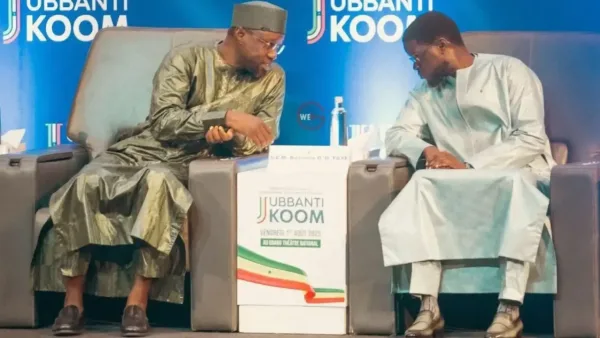
However, in the current context, this reform takes on a much more political dimension. It comes after several months of tensions between Bassirou Diomaye Faye and Ousmane Sonko, two figures who together rose to power in March 2024, supported by the same movement, the same electorate, and the same political slogan. Two years later, one embodies presidential authority; the other controls the ruling party and the National Assembly.
A Reform Presented as an Institutional Reconstruction
The text put forward by the Pastef deputies is part of a logic of rebalancing power. It notably proposes to strengthen the role of the National Assembly by obligating the Executive to inform Parliament of any investment agreement related to natural resources. It also plans to broaden the prerogatives of parliamentary inquiry commissions, which could hear a wider range of actors, including judges.
The reform also includes a reconfiguration of executive power. The President of the Republic would continue to determine the nation’s policy, but now in consultation with the Prime Minister. The latter would see his responsibilities strengthened, especially in terms of regulatory power and appointments to certain civil positions. He could also chair the Council of Ministers by delegation from the Head of State.
Another major point is the transformation of the Constitutional Council into a Constitutional Court. This new jurisdiction would become the highest authority in constitutional matters. The text provides for a more balanced distribution in the appointment of its members between the President of the Republic and the President of the National Assembly.
The proposal also introduces a constitutional definition of marriage as the union between a man and a woman. This provision responds to a demand from a segment of Pastef’s conservative base.
The Sensitive Point: The President’s Powers Regulated
Beyond these institutional aspects, some provisions have immediately been read as measures aimed directly at Bassirou Diomaye Faye. The most sensitive concerns the prohibition placed on the President of the Republic from leading a political party or coalition. The Head of State could only maintain an honorary role in a political formation.
This measure comes as Bassirou Diomaye Faye tries to consolidate his own coalition, “Diomaye President,” after distancing himself from Pastef. For the presidential camp, such a provision could limit his ability to structure an autonomous political base. Conversely, for the parliamentary majority, it aims to clearly separate the state from the party and to avoid a partisan concentration around the presidential function.
Another point of tension concerns the right to dissolve the National Assembly. In committee, deputies introduced a limitation on this right to one dissolution per presidential term. This provision is politically significant as it reduces the president’s maneuvering space against an Assembly dominated by Pastef. In the current configuration, it effectively protects the parliamentary majority led by Ousmane Sonko.
The reform also tightens the conditions surrounding motions of censure. Again, the text participates in a redefinition of the power dynamics between the Executive and Parliament.
An Open Battle in Committee
The Law Committee of the National Assembly, which met on June 24, 2026, confirmed the depth of the disagreement between the presidential camp and the parliamentary majority. The Keeper of the Seals, Me Moussa Sarr, representing the Executive, came to defend several government amendments.
One of the most important amendments aimed to remove the incompatibility between the presidential function and the leadership of a party or coalition. This request was rejected by the Pastef majority. Other government amendments were also dismissed.
At the end of this sequence, the Executive called for broader consultation with political actors and civil society. The government believes that a reform of such magnitude should not be undertaken hastily. However, the National Assembly maintained its schedule, with a vote planned in plenary session on June 29, 2026.
This parliamentary sequence has thus established a clear line of fracture, with on one side, a president who seeks to preserve his political margins; on the other, a parliamentary majority that intends to impose its interpretation of institutional reconstruction.
From Political Alliance to Institutional Confrontation
The current crisis has its roots in the recent history of Senegalese power. In March 2024, Bassirou Diomaye Faye and Ousmane Sonko appeared as two faces of the same political project. Prevented from running for president, Sonko supported Diomaye Faye’s candidacy. Their victory was interpreted as that of a united duo, backed by Pastef and a strong expectation of breaking with the old system.
However, the first cracks began to appear gradually. The management of the presidential coalition, disagreements over economic directions, relations with financial partners, and the issue of internal leadership fueled tensions.
The reform of the electoral code, adopted in the spring of 2026, was a key moment. This text notably lifted some obstacles to a possible candidacy of Ousmane Sonko for the presidential election of 2029. Bassirou Diomaye Faye criticized the procedure, calling it questionable. This public disagreement was seen as a breaking point.
The crisis accelerated on May 22, 2026, when President Faye terminated Ousmane Sonko’s functions as Prime Minister and dissolved the government. A few days later, Sonko bounced back in the National Assembly, where he was elected to the presidency of the institution. The center of gravity of power then shifted: Diomaye Faye retains the presidency of the Republic, but Sonko controls the ruling party and the Parliament.
Sonko at the Helm, Pastef in a Strong Position
Ousmane Sonko’s election as President of the National Assembly altered the institutional balance. With a very comfortable majority, Pastef has the means to influence the government and impose its legislative agenda. This position of strength was confirmed during the party’s congress in Diamniadio in June 2026, during which Sonko was re-elected at the head of Pastef. The political message is clear: the former Prime Minister remains the leader of the party, retains authority over the militant apparatus, and intends to influence the country’s direction from Parliament.
Against him, Bassirou Diomaye Faye is trying to build an autonomous presidential base around his coalition. However, this strategy faces the parliamentary power of Pastef and Sonko’s militant groundwork.
The constitutional reform thus appears as an institutional extension of this political battle. It does not simply amend articles of the Constitution; it redefines the power relations between the two former allies. The plenary session on June 29, 2026, promises to be decisive. With its parliamentary majority, Pastef theoretically has the votes needed to pass the text in the National Assembly. But the President of the Republic still holds an important card: the possibility of submitting the reform to a referendum.
If Bassirou Diomaye Faye chooses this option, the institutional battle could turn into a direct confrontation before the people. The referendum would then become a political test between the President of the Republic and the leader of the ruling party.
In this scenario, each camp would seek to present its reading of the crisis. For Sonko and Pastef, it would be about defending a reform aimed at limiting presidential powers and strengthening democratic control. For Diomaye Faye, the challenge would be to denounce a rushed reform, tailored to the context of political rivalry.
The 2029 Presidential Election Already in the Background
This confrontation occurs within a delicate economic context. Senegal faces significant budgetary constraints, difficult discussions with the IMF, and ongoing social pressure. In such a climate, institutional paralysis could come at a high cost.
The new Prime Minister, Ahmadou Al Aminou Mohamed Lo, appointed after Sonko’s dismissal, inherits a complex situation. He must govern with an Assembly dominated by his predecessor’s party, while Pastef can censure the government at any moment. This configuration places the Head of State in a fragile position, at least until he can potentially use the weapon of dissolution under the conditions provided by the Constitution.
Senegal finds itself in an unprecedented political situation: an elected president under the banner of a movement whose leader now controls the National Assembly, a government contested by part of the ruling party, and a constitutional reform that could sustainably redistribute powers.
Behind the legal debate, another deadline looms: the presidential election of 2029. The constitutional reform, the modification of the electoral code, and the reshaping of political forces seem to be preparing for this upcoming battle. Ousmane Sonko, now eligible again according to recent changes to the electoral code, appears as a central actor in this perspective. By controlling Pastef and the National Assembly, he is building a position of strength. Bassirou Diomaye Faye, for his part, seeks to exist politically outside the shadow of his former mentor.
The promise of an inseparable duo has given way to an open competition for control of power. What is at stake around the constitutional reform thus exceeds the text itself. It is the future of the regime resulting from the 2024 victory that is now in question.
Comments