
Tofa and Vodun Days 2026 in Benin: between the Fa prophecy and a global cultural showcase
Between spiritual revelation and popular fervor, Ouidah pulsed to the rhythm of the Tofa and Vodun Days 2026. Carried by the sign Losso Sa, herald of stability and prosperity, this edition confirmed Benin’s ambition to make Vodoun a cultural, spiritual, and tourist pillar open to the world.

SUMMARY

Every January, Benin becomes the epicenter of a unique gathering where ancestral spirituality, living culture, and tourism ambitions meet. The 2026 edition of the Vodun Days, organized from January 8 to 10 in Ouidah, has once again confirmed this dynamic, driven by the long-awaited revelation of the Tofa 2026, the annual sign arising from the Fa consultation.
The solemn Fa consultation, held on January 9, 2026 in Ouidah, delivered the sign Losso Sa as the spiritual orientation of the year. The official announcement was made by Mahugnon Kakpo, president of the Vodun Rites Committee of Benin, in front of a gathering of dignitaries, bokonon and national and international observers.
According to the interpretation provided, Losso Sa is a decidedly positive sign, associated with resilience, stability, and a prosperity built on mastery and discipline. The symbolic image of “the bird that must forge a metal beak to face the stinging glass” illustrates Benin’s ability to overcome trials through preparation, rigor, and lucidity.
Thus the Fa announces governance aimed at consolidating abundance while remaining vigilant against covetousness, particularly around resources and territories. According to the Fa, any attempt at destabilization or injustice exposes its authors to inevitable consequences. In return, respect for authority, social cohesion, and the performance of the prescribed rituals appear as essential conditions for peace and collective progress.
Vodun Days 2026: Ouidah at the Heart of a Planetary Celebration
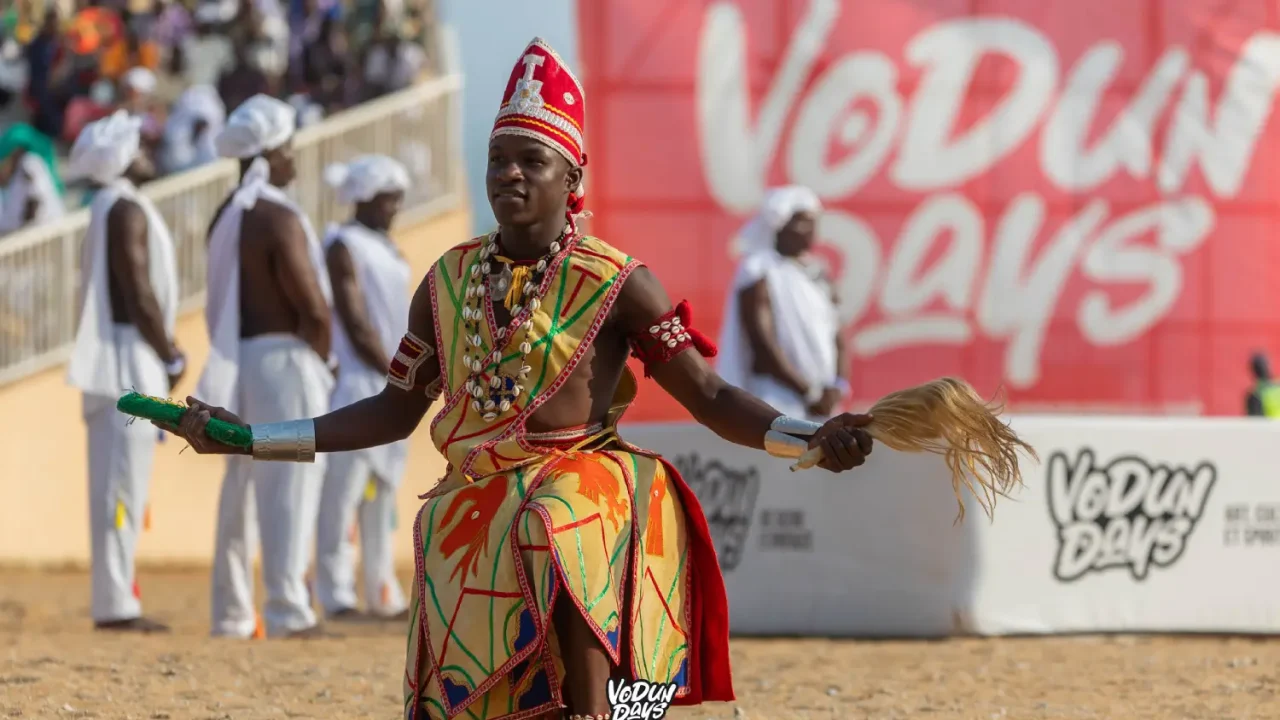
Beyond the spiritual dimension of the Tofa, the Vodun Days 2026 have transformed Ouidah into a vast open-air cultural stage. Heirs of the National Vodoun Festival celebrated every January 10, these three days have, in less than three years, established themselves as a major international event dedicated to art, culture, and Vodoun spirituality.
Streets, public squares, beaches and sacred sites welcomed an exceptional turnout, marked by the massive presence of the Afro-descendant diaspora from the Caribbean, the Americas and Europe, seeking memorial and spiritual reconnection. Ritual parades, spectacular appearances of Zangbeto and Egungun, ceremonies dedicated to the divinities, sacred dances, and artistic performances paced these holidays, days off with pay.
At the heart of this celebration, Vodoun was presented in all its complexity and depth, far from reductive clichés of sorcery or fetishism. A religion founded on dialogue between the visible and the invisible, Vodoun rests on rites, chants, dances and a divination system – the Fa – that guides individuals and communities toward balance and fulfillment.
Supported by the Beninese government, the Vodun Days are part of a policy to valorize cultural heritage and develop tourism. The official launch of the festivities in the presence of President Patrice Talon illustrated the strategic importance attached to this event, which has become a pillar of the country’s cultural outreach program.
Giant concerts on the beach, with internationally renowned artists such as Angélique Kidjo, Davido or Meiway, a cultural village dedicated to crafts and gastronomy, immersive circuits in the temples and sacred forests; everything was designed to offer a complete experience, respectful of the sacred and accessible to the public.
Major Economic and Symbolic Impacts
With more than two million visitors and participants expected according to organizers, the Vodun Days generate substantial economic returns for Ouidah and the entire Benin. Hotels, restaurants, transportation, crafts and tourism services experience, over a few days, a level of activity equivalent to several months of operation.
Beyond the numbers, the impact is also symbolic, because, long stigmatized, the Vodoun religion is now proudly claimed by many Beninese, while the country positions itself as a global hub of Vodoun, open to intercultural dialogue and faithful to the authenticity of its traditions.
Comments