
Benin: here’s how public hospitals will have to handle vital emergencies
A few days after the government’s announcement of the systematic coverage of vital emergencies in public health facilities, the Ministry of Health issued a memo outlining the implementation modalities of this measure. Signed on June 9, 2026, by Minister Benjamin Hounkpatin, the document sets forth the obligations of health centers and public hospitals to ensure a rapid response for patients whose lives are at risk.


SUMMARY
The Ministry of Health is moving to the operational phase of the reform concerning the management of vital emergencies. In a memo dated June 9, 2026, the Minister of Health, Benjamin Hounkpatin, defined the implementation modalities for this measure announced by the government during the Council of Ministers on June 3, 2026.
The stated goal is to ensure that any patient in a vital emergency situation is immediately treated in public health facilities, without financial or administrative considerations delaying care.
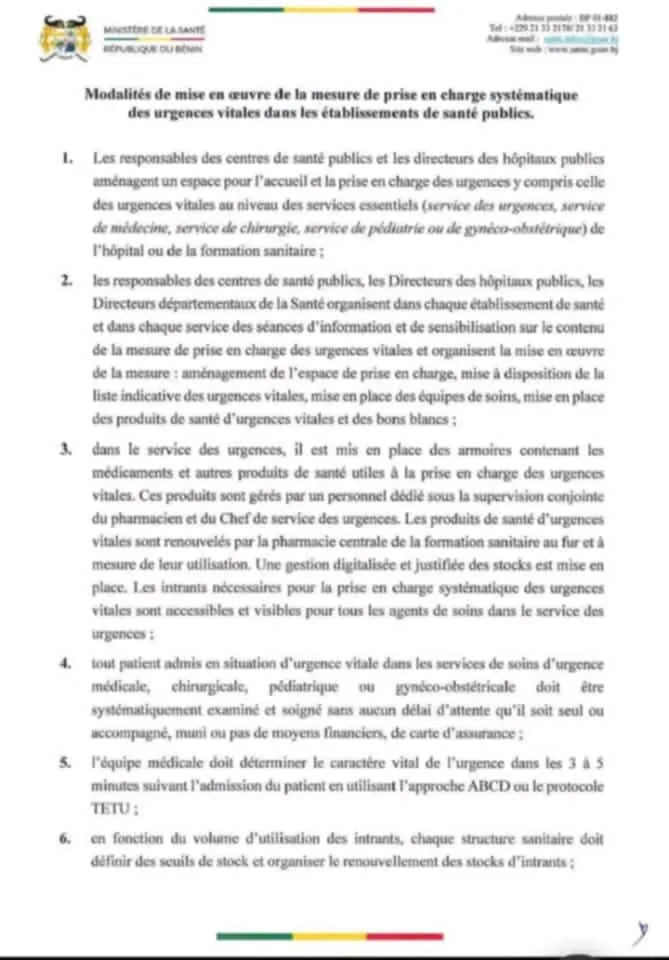
According to the ministerial document, each public health center and hospital must set up a dedicated space for the reception and management of emergencies. Heads of health facilities are also required to organize information and awareness sessions for staff to ensure uniform application of the measure across the national territory.
To make interventions more effective, cabinets containing the necessary medications and health products for managing vital emergencies must be installed in the relevant departments. These supplies will be the responsibility of dedicated staff charged with ensuring their constant availability and stock replenishment.
The memo reminds that “every patient admitted in a vital emergency situation must be systematically examined and treated without any waiting time,” whether accompanied or not and regardless of financial means or health insurance. The medical team must determine the vital nature of the emergency within three to five minutes after the patient’s admission.
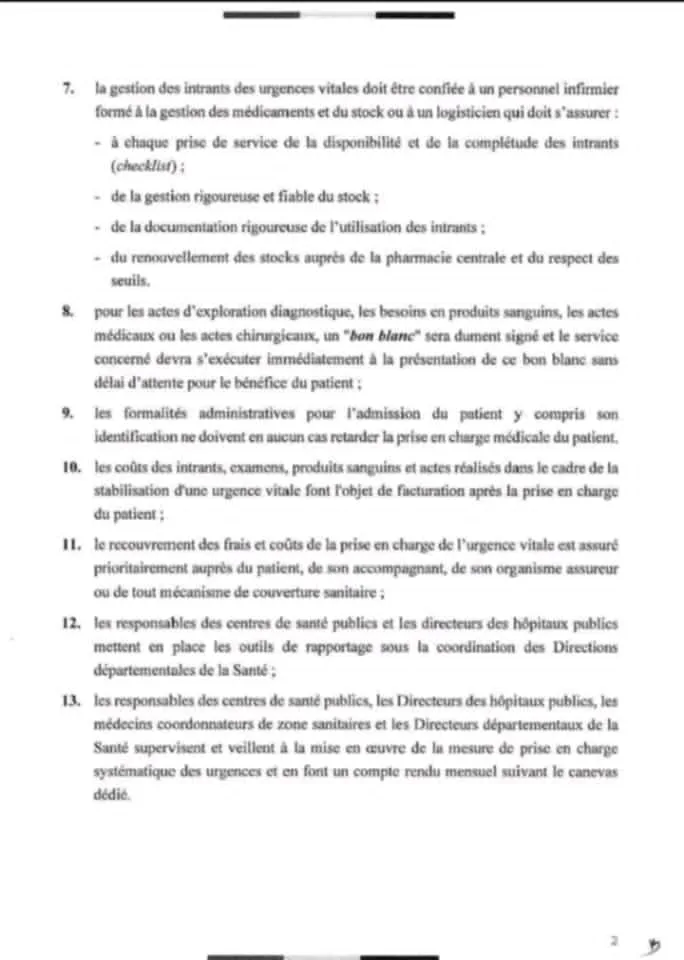
The ministry also emphasizes the urgency of executing necessary medical acts to stabilize the patient. Thus, diagnostic exams, blood transfusions, and urgent surgical interventions must be performed immediately upon presentation of a “blank form” signed by authorized personnel.
Another important clarification: “administrative formalities for the admission of the patient must in no way delay medical care.” Therefore, identification or registration procedures for the patient must occur concurrently with treatment or after stabilizing their condition.
Contrary to some interpretations, the measure does not imply total free care. The document specifies that costs related to exams, medications, blood products, and other medical acts performed in the context of a vital emergency will be billed after the patient has been taken care of. Recovery may be made from the patient, their companion, their insurer, or any other health coverage mechanism.
To monitor the reform, hospital directors, health center managers, sanitary zone coordinating physicians, and departmental health directors are tasked with overseeing its implementation. Reporting tools will be established, and monthly reports must be submitted to health authorities.
Through these new provisions, the Beninese government aims to end situations where patients in medical distress are denied or delayed care due to lack of immediate payment. The priority, according to authorities, is now to save the patient’s life before any other administrative or financial considerations.
The Full Communiqué
Comments