
Senegal: behind the Pastef congress, Ousmane Sonko’s new strategy
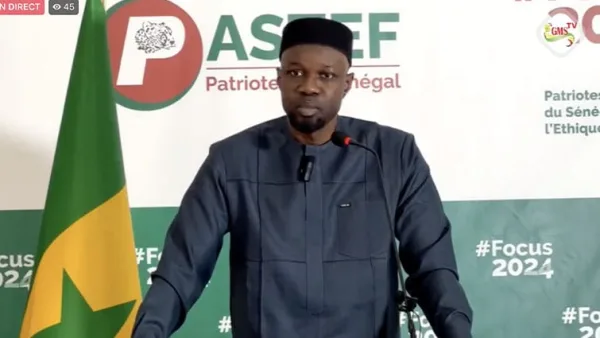
In just a few days before the first national congress of Pastef, scheduled for June 6, 2026, in Dakar, Ousmane Sonko is looking to position his party in a new political phase. In a text published on X under the theme “From movement to organization,” the leader of Pastef emphasizes internal structuring, militant discipline, and doctrinal consolidation for a formation now faced with the demands of power.

SUMMARY
Ousmane Sonko wants to open a new chapter in the history of Pastef. As the first national congress of the party approaches, set for June 6, 2026, in Dakar, the former Prime Minister and president of Pastef has chosen to address his supporters in a text published on X titled “From movement to organization.” The message comes in a particular political context, marked by the reorganization of the ruling party and the institutional repositioning of its leader.
Founded twelve years ago, Pastef has long established itself as a force of dissent, driven by a discourse of rupture, sovereignty, and denunciation of the practices of the old regime. Its ascent to power, following the victory of Bassirou Diomaye Faye in the 2024 presidential election and the party’s breakthrough in the legislative elections, has profoundly changed the nature of its responsibilities. The militant movement must now take on the constraints of a governing party.
This change of status is what Sonko seeks to formalize. In his text, he does not primarily focus on the current institutional power dynamics. Instead, he chooses to place Pastef in a long trajectory, from its years of political struggle to its current phase of institutionalization. The message conveyed is that the party must no longer just mobilize, it must organize, train, supervise, and produce a sustainable political line.
A Founding Congress for Pastef
The congress on June 6 is presented as an important moment in the internal life of the party. It is expected to allow the election of the president of Pastef, the adoption of major political orientations for the next six years, and the validation of internal texts, including the statutes, internal regulations, and electoral charter. These projects aim to provide a more solid architecture for a formation that has rapidly grown, driven by strong popular dynamics.
A High Authority for the party’s regulation is overseeing the internal process, while preparatory commissions are working on the doctrinal, organizational, and logistical aspects of the congress. The stated goal is to transform militant energy into a structured political apparatus capable of supporting public action and preparing for the upcoming electoral deadlines.
At this stage, Ousmane Sonko’s candidacy for the presidency of the party appears to be the central element of this meeting. As a historical figure of Pastef, he remains the main political and ideological reference of the formation. His likely reappointment as the head of the party should therefore not come as a surprise. The real issue lies more in the formalization of his leadership and in the congress’s capacity to organize the leadership, internal rules, and decision-making mechanisms.
From Dissent to Responsibility
The phrase “From movement to organization” encapsulates the challenge facing Pastef. For years, the party has established itself as an opposition force, mobilizing against corruption, authoritarian drift, and economic imbalances. This culture of struggle has greatly contributed to its popular grounding, particularly among the youth and part of civil society.
But exercising power imposes other demands. A party in government can no longer just denounce. It must arbitrate, manage, explain its choices, and account for its results. This transformation requires Pastef to move from a logic of permanent mobilization to a logic of sustainable organization. It is on this ground that Sonko now wants to place the debate.
In his text, the leader of Pastef emphasizes the necessity of preserving the militant spirit while strengthening discipline and internal structures. The approach aims to prevent the accession to power from diluting the party’s identity or turning its project into mere administrative management. For Sonko, the institutionalization of Pastef should allow for the continuation of political struggle, but within a more orderly framework.
A Political Message in a Sensitive Context
The timing gives this statement a particular significance. Ousmane Sonko left the Prime Minister’s Office before being elected president of the National Assembly. This institutional shift has placed him in another strategic position within the state while reigniting discussions about the balance of power within the presidential camp.
In this context, his text on Pastef can be read as an intention to regain political initiative. Rather than focusing his speech on his departure from the government or on the supposed tensions at the top of the state, Sonko chooses to talk about organization, doctrine, and militant memory. This thus shifts the debate from his personal trajectory to the future of the party.
This choice is not neutral. By presenting himself as the architect of Pastef’s transformation, Sonko reminds everyone that he remains the main political driver of the formation. His authority does not rest solely on a governmental or parliamentary position but on his role as a founder, theorist, and mobilizer. Through this text, he seeks to demonstrate that his influence extends beyond the posts he occupies.
Pastef Facing the Challenge of a Governing Party
The first national congress of Pastef must also address a fundamental question: how to transform a combat party into a state party without losing its identity? Since coming to power, Pastef has had to reconcile its promises of rupture with the constraints of administration, the economy, and social expectations. This tension is at the heart of the new phase opened by Sonko.
The structuring of the party should allow for better supervision of the militants, training of leaders, harmonization of the political discourse, and avoidance of improvisations. It should also reinforce Pastef’s territorial anchorage, especially in areas where the party wants to strengthen its presence ahead of the upcoming local and national elections.
The revision of internal texts and the establishment of regulatory bodies respond to this logic. Pastef wants to establish clearer rules that can manage internal competition, individual ambitions, and strategic divergences. For a party that has come to power after a rapid ascent, this formalization is a delicate but necessary step.
A Line Between Militant Loyalty and Political Effectiveness
The challenge for Sonko now consists of maintaining the militant momentum that has propelled Pastef while instilling a culture of governance. The party must remain true to its rupture discourse, but it must also produce concrete results. Expectations remain high regarding the cost of living, employment, governance, social justice, and economic sovereignty.
In this regard, the congress on June 6 will not only be an internal meeting. It will also serve as a political test. It must show whether Pastef can transform its popularity into a sustainable organization capable of withstanding the tensions of power and the impatience of public opinion.
Through his text, Ousmane Sonko is therefore attempting to set a direction. He wants to position Pastef in the long term, beyond electoral sequences and institutional reshufflings. For him, the challenge is no longer just to gain power but to build an organization capable of carrying it, framing it, and translating it into public action.
The congress on June 6 will reveal how far Pastef is willing to go in this transformation. Balancing loyalty to its dissenting DNA with the necessity of becoming a fully structured party, Ousmane Sonko’s formation is entering a decisive phase in its political history.
Comments