
From now on, call me Kodjovi Claudy Siar, from the Zossoungbo family.
On May 22, 2026, Claudy Siar experienced a highly symbolic moment in Ouidah by officially discovering his Beninese roots within the Zossoungbo lineage. Through a ceremony blending memory, vodoun spirituality, and national recognition, the former Guadeloupean RFI presenter is part of the movement of return for Afro-descendants encouraged by the new Beninese nationality law.

SUMMARY
He crossed the threshold in reverse. That morning in Ouidah, Claudy Siar stepped where millions of men and women last placed their feet. The Door of No Return, this concrete and bronze monument inaugurated in 1995 on the beach at the end of the Slave Road, has symbolized for thirty years the departure point for over a million Africans deported to the Americas. For the Guadeloupean RFI host, it became, that day, a door of return.
The man could not hold back his tears. There was no question of holding them in either. After decades carrying the identity of an Afro-descendant, Claudy Siar learns that he is also, and now officially, an African from Ouidah. A DNA test revealed what family history had kept silent for generations. He belongs to the Zossoungbo lineage, the founding family of this memory-laden city. Born on a Monday, he receives the name Kodjovi during the ceremony, in accordance with the Fon tradition that names each child based on the day of their birth.
When Ancestors Speak Again
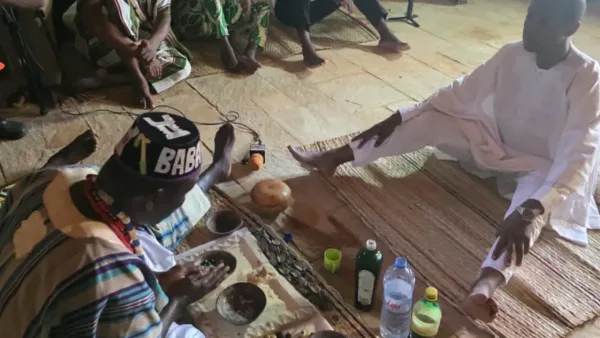
Two ceremonies marked this day. The first, the Fâ, a divinatory oracle at the heart of vodoun spirituality, remained secret, reserved for this intimate dialogue between a man and his ancestors. The second, more open, was a collective and personal reconciliation. Claudy Siar laid down his pains, his defeats, and the weight of months he describes as unjust. The customary dignitaries of Ouidah intervened. Something was lifted.
This moment fits into a larger movement than just him. In September 2024, Benin enacted law 2024-31 allowing Afro-descendants from the diaspora to obtain Beninese nationality. The process, coordinated via the digital platform My Afro Origins, requires proof of sub-Saharan African ancestry, whether genealogical or certified by an approved DNA test. The application fee amounts to one hundred dollars. Since the launch of the program, Beninese authorities have been receiving about a hundred new applications each day, and several thousand applications are under review. American singer Ciara was among the first recipients of this historic law in July 2025.
A Nationality, a Date, a Symbol
For Claudy Siar, the date is not insignificant. It is on May 22 that he officially receives his Beninese nationality certificate and passport at six PM, Cotonou time. May 22 is precisely the day the decree to abolish slavery in Martinique came into effect in 1848. The coincidence is dizzying. The presenter who, since March 13, 1995, has hosted “Couleurs Tropicales” weekly on RFI and built his entire career around the “conscious generation” and pan-Africanism, closes a loop of which he may not have even grasped the full extent.
On that day in May 2026, Claudy Siar is no longer just the child of Guadeloupe born in Paris, the founder of Tropiques FM, the voice of Afro music on the global airwaves. He is also, for the first time, at home in Benin, in Ouidah, the land of his ancestors.
Comments