
Benin elections: significant delays at the start of polling, whose fault is it?
The conduct of the municipal and legislative elections on January 11, 2026 in Benin highlighted a marked contrast between, on the one hand, the reassuring official rhetoric and the visible participation of many personalities, and, on the other hand, significant delays observed in the opening of several polling stations. While, in many localities, the vote did indeed begin calmly, the malfunctions observed in certain areas, notably in Abomey-Calavi, raise questions about the operational capacity of the electoral setup in a novel context of coupled general elections.

SUMMARY

On the ground, the observations are mixed. In several municipalities and urban centers, notably in Cotonou, Parakou, Abomey or Kandi, polling stations opened at the regulatory time of 7 a.m. or with delays deemed marginal. The authorities, including the President of the Republic, Patrice Talon, the Minister of the Interior, and several prefects, publicly praised the overall smooth conduct of the poll and urged voters to come out in large numbers to vote calmly. These official statements stressed the country’s democratic maturity and the security measures taken to ensure a peaceful vote.
However, in other areas, notably in certain communes of Atlantique and around Abomey-Calavi, the situation was more problematic. Polling stations remained closed for several hours after the official opening time, due to the absence or insufficiency of electoral materials, the late setup of the ballot boxes, or logistical difficulties related to the delivery of voting kits. In some cases reported by political actors, local elected officials and media correspondents, voters waited for long hours without being able to cast their suffrage, before going home discouraged.
These delays raise major issues. First, that of equality before suffrage. A voter who presents themselves at 7 a.m. and can vote only at 2 p.m. or 3 p.m., or not at all, is not placed in the same conditions as another who voted without difficulty. Next, the question of the sincerity of the ballot: when voting operations spill well into the day, or threaten to extend to the following day, the question of the legal and political validity of the results inevitably arises. Several analysts argue that a ballot intended to be held on a single day cannot, without consequences, become a process spanning two dates.
A more bitter assessment in the Calavi commune
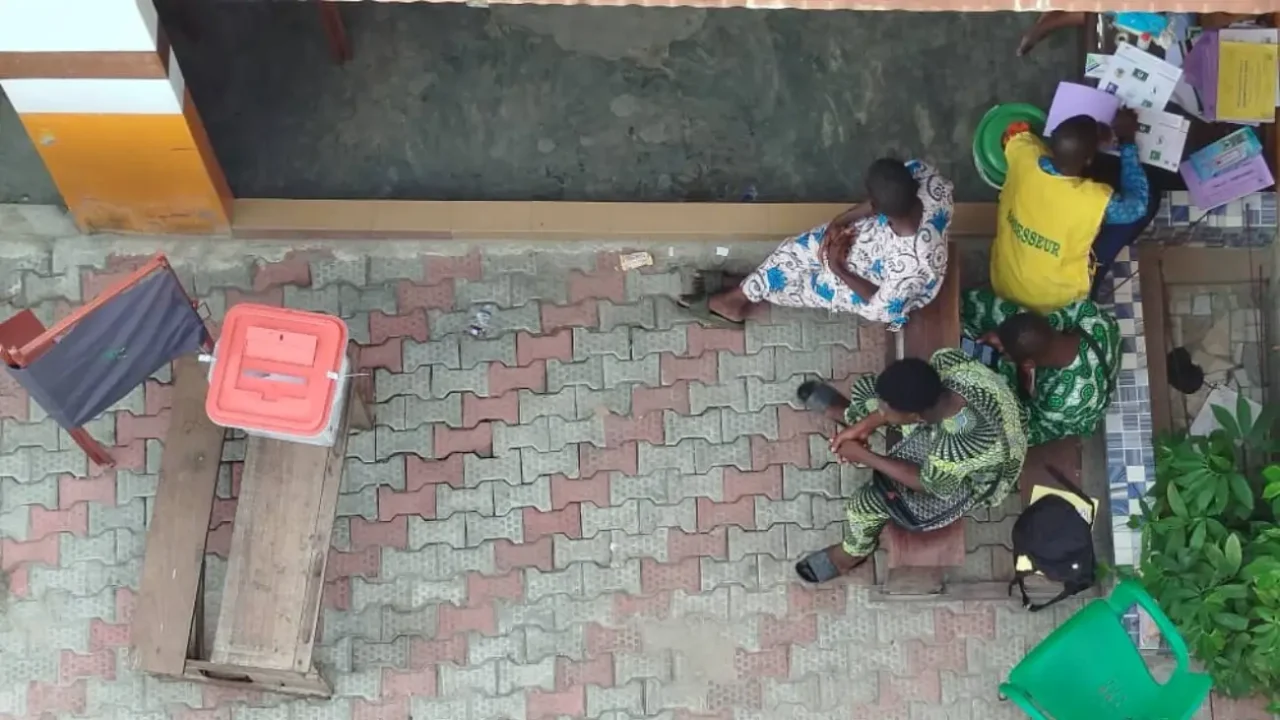
In the commune of Abomey-Calavi, delays were particularly visible in the Akassato district. At the Domè-Zèkanmey Public Primary School, out of five polling posts installed, only four opened with a slight delay, between 7:55 and 8:24, while a fifth did not actually start until 9:04. According to the president of this polling station questioned by l’Investigateur, this delay was due to difficulties in transporting the electoral materials and the absence of the initially assigned agents. He said he found himself alone during the withdrawal of the materials in the arrondissement, before being assigned a polling assistant late.
Facing this situation, the zone coordinator took an exceptional measure: recruit on-site three young voters with a high school diploma to complete the polling station team. They were trained on the spot, in a rush, to enable the effective launch of the vote. A move that, while it helped unblock the situation, nonetheless raises questions about anticipation, training, and the availability of electoral agents in a commune located in the immediate vicinity of the major national institutions.
Similar observations were made in other centers of the commune, notably at the Glo-Tokpa Public Primary School, where the offices also opened from 8 a.m., beyond the official 7 a.m. hour. In the Togba arrondissement, the Drabo and Ouega centers likewise recorded comparable delays. Added to these malfunctions was a low turnout in the early hours of the day, citizens arriving gradually, sometimes in dribs and drabs, which reinforced the impression of a laborious start to the vote.
Who pays the price?
These delays, though localized, take on a particular dimension in the context of the ongoing political reforms. The 2026 elections represent Benin’s first experience of general elections held on the same day, combining municipal and legislative elections. They are also conducted within a more demanding legal framework, marked by a tightened party system and increased competition for proximity issues: mayors, municipal councils, and seats in the National Assembly. In such an environment, any obstacle to the expression of the vote, even temporary, is perceived as a risk to citizens’ equality before suffrage.
Beyond the technical aspects, the stakes are also psychological and political. A voter who shows up early in the morning and cannot vote because no polling place is open may become discouraged and give up on returning. Each delay thus becomes a potential factor of abstention, likely to influence overall participation and, by extension, the legitimacy of the results. In a democracy that claims more than thirty years of electoral practice, these situations are difficult to accept for a portion of public opinion.
Facing these criticisms, some observers call for nuance in the analysis. They remind that no electoral process, even in older democracies, is completely free of unforeseen events. The essential, according to them, lies in the ability of the National Autonomous Electoral Commission and other competent institutions to recognize the malfunctions, to clearly explain their causes, and to take, where appropriate, appropriate corrective measures, including partial reruns of voting where the rights of voters have not been fully guaranteed.
That said, these delays remain a warning signal. In a country that has built a reputation for electoral stability and democratic maturity, the material organization of the ballot remains a central element of citizen trust. The 2026 municipal and legislative elections, set to mark an institutional turning point, will be judged not only by their political outcome but also by how the authorities have managed these malfunctions and preserved the integrity of the electoral process.
Comments