
Benin: a cohort of female leaders trained in political leadership and feminist action in West Africa
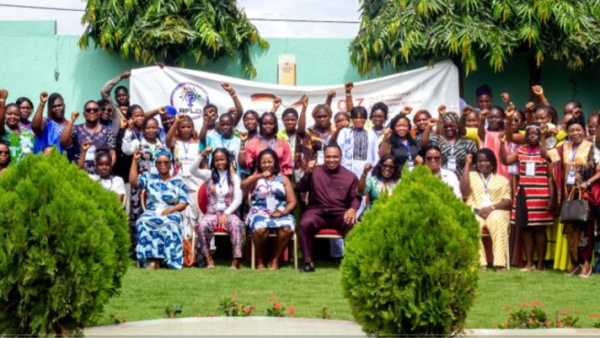
In Porto-Novo, about fifty women from various backgrounds participated in an intensive training session focused on political leadership, afrofeminism, and women’s rights, as part of a regional initiative led by the Network of Women Leaders for Development (RFLD), with support from BMZ and GIZ. Over two days, participants were equipped with knowledge about power mechanisms, African legal frameworks, and feminist mobilization strategies, aiming to enhance their engagement in governance and social transformation in Francophone West Africa.

SUMMARY
In a context where women’s political participation remains a major issue in Francophone West Africa, the Network of Women Leaders for Development (RFLD) launched this Wednesday, at the Les Oliviers hotel in Porto-Novo, an intensive training session gathering around fifty participants from diverse backgrounds. This initiative is part of the regional AIHRDFWA program, supported by BMZ and GIZ.
Over the two days, this cohort was immersed in a structured course combining leadership, legal rights, feminist mobilization, and political innovation. The stated goal is to empower a new generation of women capable of influencing public policies and asserting themselves in decision-making spaces.
A regional architecture and a bold afrofeminist program
According to John Gbénagnon, regional director in charge of development and strategy at RFLD, this initiative fits into a structured continental dynamic. “(…) RFLD is a regional organization present in several countries. Its headquarters is registered in Senegal as an international organization. We also have a regional office in Accra, Ghana, as well as an office near the African Commission on Human and Peoples’ Rights in Gambia. We are also represented in Porto-Novo, with an office based in Igolo. The national headquarters in Benin is located in Hounsa.”
He further emphasized the program’s philosophy: “This program follows an afrofeminist approach, based on an essential principle: allowing African organizations and movements to define their own priorities and actions.” And on its concrete impact; “We have a regional program called the Francophone Women’s Fund of West Africa. During the first cohort held in January, more than 40 organizations received funding ranging from $15,000 to $50,000.”
The program is being implemented simultaneously in several cities, including Dakar, Porto-Novo, and soon Lomé, as part of a regional dynamic. The main objective is to strengthen the participants’ capacities so that they can become agents of change in their communities. The system also includes post-training support and networking with public institutions, added the official who stressed the importance of advocacy and collaboration with state actors to promote local development and inclusive governance.
Deconstructing power mechanisms
The first day featured modules raising awareness about forms of power and mechanisms of exclusion. Lawyer and gender specialist Ginette Bonou introduced a critical analysis framework that became central to the discussions. “We identified three forms of power: visible power, hidden power, and invisible power (…) Visible power refers to institutions, laws, and public policies. Hidden power, on the other hand, manifests through influence games. We also discussed invisible power, linked to self-esteem and self-censorship.” She added a strong observation: “Every woman must learn to value herself, not to underestimate herself, and to work on her visibility as well.”
Transformational leadership and afrofeminism
In a second module, Charlotte Ezebada emphasized the need for a paradigm shift in the exercise of female leadership. “We have understood that traditional leadership is no longer sufficient to sustainably transform our societies. We now need transformational and feminist leadership.” She placed the discussion in a historical and cultural perspective: “African feminism is not an imported idea but is rooted in our social and cultural realities.”
The law as a lever for empowerment
Another key moment was the intervention of Kembo Paulette Annie on the Maputo Protocol. She highlighted the importance of the legal text: “The Maputo Protocol is a major legal instrument binding on African states, adopted in 2003. To date, 46 African countries have ratified it.” She also underscored national advances: “Today, medical and safe abortion is authorized within a precise legal framework to better protect women. One can say that fear has changed sides.”
Feminist mobilization and historical legacies
According to Sintondji Blandine, the strength of feminist movements lies in their historical roots and real political impact. “It is thanks to feminist movements that we celebrate International Women’s Rights Day today,” recalled the national coordinator of the ‘Country Security for Women’ region within the ECOWAS space, section of Benin. She also emphasized their legislative role:
“In Benin, these movements have played a decisive role in the adoption of the Persons and Family Code, the law on reproductive health, and the 2021 law on gender-based discrimination.”
Participants engaged and aware of the issues
From the beneficiaries’ side, testimonies reflect a strong appropriation of the contents. Deputy Bankolé Martine states: “Today, we no longer have the right to remain on the sidelines of our own development. This training is a real opportunity, and personally, I feel fulfilled.” She continues: “To assert oneself does not mean to take power by force. It is simply about having our skills and value recognized.”
The same sentiment is echoed by Perpétue Aidophie, entrepreneur and association president: “By participating in this training, I realized that as women, we have immense potential.” She adds: “By taking part today in this afrofeminist initiative… I have joined a true movement of collective action.”
Finally, Dossou Olympiade summarizes the impact of the program: “It has been very useful for me, as it allowed me to obtain clarifications on many subjects.” She concludes: “With this support… we will be able to assert ourselves more and, why not, participate fully in leading our nation.”
A cohort for lasting change
At the end of these two days, RFLD aims to transform this training into an active network for advocacy and political action. The challenge goes beyond the training room: it is now about fostering a generation of women capable of sustainably occupying power spaces in West Africa.
Comments