
The Les Démocrates party — already the end? The torch falters…
The fate of Benin’s main opposition party, Les Démocrates, increasingly resembles a long political agony.

SUMMARY
The rift took shape with the confiscation of sponsorship by MP Michel Sodjinou, who shattered the party’s presidential dream by refusing to sponsor the party’s candidate duo. He not only broke the party’s dream but also, symbolically, its internal cohesion.
This sequence was followed by the rejection of files for the municipal elections, and the persistent uncertainty over the legislative elections. Just hours before the deadline for submitting candidacies for the legislative elections, Boni Yayi’s party moves forward as a formation struggling to exist in a political field predetermined in advance.
This gesture, presented at the time as a “free and thoughtful” decision, had the effect of an earthquake. Sodjinou, in an almost prophetic stance, had urged his comrades to focus on the legislative elections, as if he already knew the party would go neither to the presidential nor the municipal elections. What was then thought to be a simple warning became, as the deadlines followed one another, an unyielding reality.
The leadership crisis: the internal poison
Since this break by MP Michel Sodjinou, Boni Yayi’s political formation has lived to the rhythm of departures and disillusions. Sodjinou opened the way, others followed. Among them, Chantal Adjovi, whose statement resonated like a slap to political idealism. She justifies her break with Les Démocrates by her desire to preserve her place in the next term of the national assembly.
A confession of disarming frankness, but revealing of a constant in Beninese politics: convictions never weigh heavily against the fear of disappearing from the electoral radar.
The discourse of loyalty fades as soon as the prospects of nomination diminish. This brutal, almost cynical realism illustrates the fragility of party structures built not around ideals but around private interests.
A party facing the 20% test
And even if, by administrative miracle, Les Démocrates managed to present lists for the legislative elections, another obstacle would arise: the 20% threshold of votes cast in all electoral constituencies.
A technical requirement, but politically formidable. In a context of isolation, with demobilized cadres and an electoral base undermined by discouragement, reaching this threshold would be a challenge.
In the best case, the party could obtain a handful of symbolic seats, without real political weight, just enough not to disappear completely but too few to truly exist. In any case, with the constitutional revision introducing the senate, even if Les Démocrates managed to have elected officials, the revised Constitution forbids them from obstructing the ongoing policy…
Parliamentary isolation would then be the logical consequence of a weakening orchestrated as much from outside as from within.
The torch of hope flickers, will it go out?
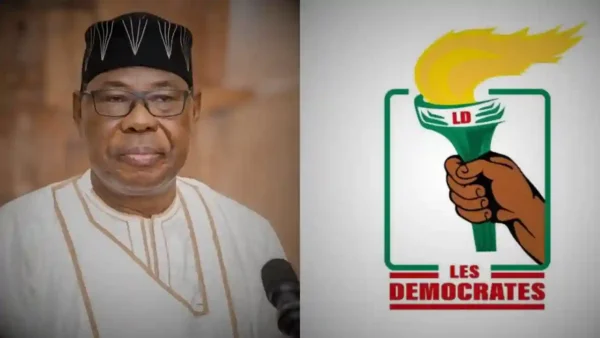
Les Démocrates had chosen a flame, a torch of hope, as their emblem. Cruel irony: it is precisely this flame that seems to flicker today. As departures multiply, hopes dwindle, and certainties collapse, the flame loses its brightness.
The party, once seen as the last bastion of political resistance, sinks into militant melancholy, between disillusionment and resignation.
The most tragic thing is that this extinction owes nothing to chance. It results from an unrelenting political strategy, certainly, but also from collective moral fatigue.
In Benin, politics is no longer a commitment, it is a career. Elected officials do not cling to ideals, they cling to seats.
A predictable realignment
At this rate, it would be hardly surprising if new defections emerged toward the presidential movement. The famous “Wadagni wave,” seen as the new horizon of power, already attracts those who know that balances are decided long before the polls.
Beninese political play thus seems to follow a circular logic: the disappointed from the opposition join the power they criticized yesterday, while the loyal burn out waiting for an election that may never come.
At heart, the drama of Boni Yayi’s party goes beyond its own story.
It reveals the fatigue of a locked political system, where the opposition breathes only by permission, and where loyalty is measured by the scale of future benefits.
When a party’s flame goes out, it is not just a logo that disappears.
It is the very idea of alternation that burns out.
Comments