
Right to sexual and reproductive health: women with disabilities struggle to access family planning in Benin
In Benin, many women living with disabilities struggle to access family planning services with dignity and safety. Between inadequate health infrastructures, social prejudices and lack of staff training, their sexual and reproductive health rights remain fragile, despite the existence of protective laws and government efforts.

SUMMARY
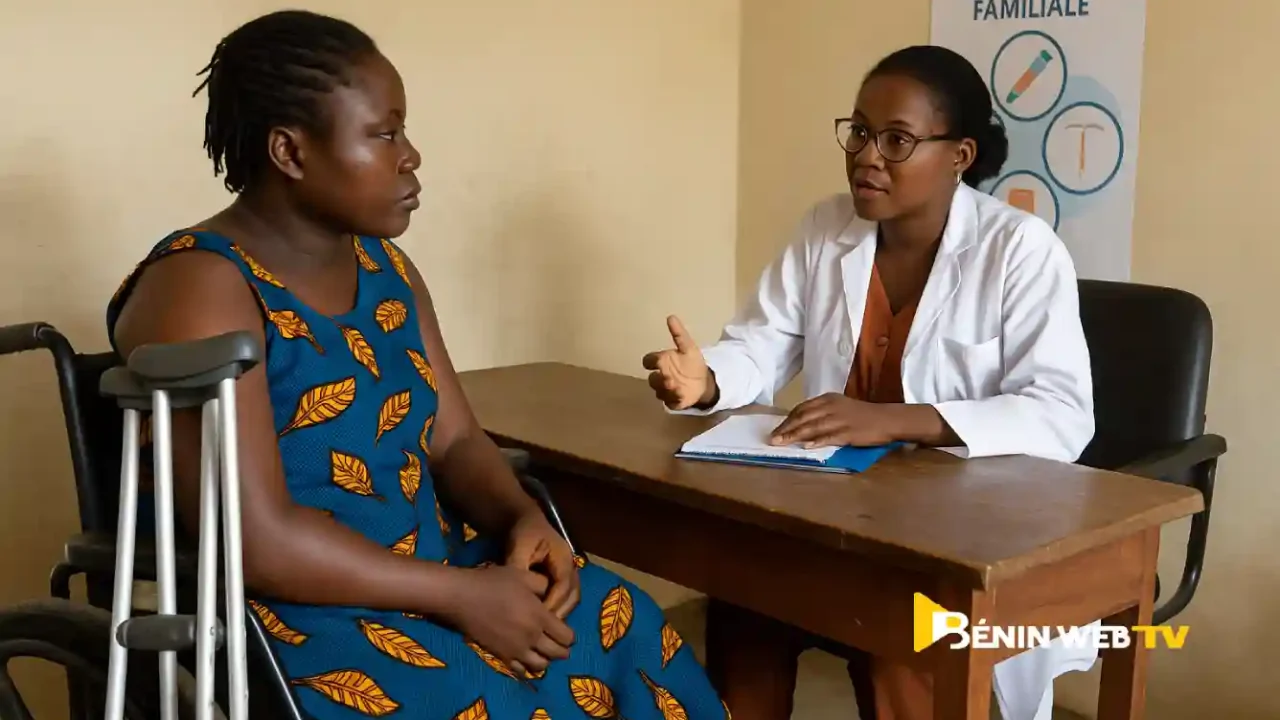
“When a disabled woman comes to talk about reproductive health, people look at her as if she doesn’t need these services. It’s as if we aren’t counted among those who should benefit from family planning. You can hear, ‘she does that too?’”, these are, among other things, the prejudices denounced by Ms. Ameyo Ahouansou, a woman with a motor disability.
For her, reception doesn’t make things easier for women with disabilities. “When you walk in, all eyes are on you. If you’re not mentally strong, the tension rises even before the consultation.”
Prejudice, inaccessibility and lack of training: a triple burden for women with disabilities
To these material obstacles is added the inaccessibility of the premises. “You arrive with your crutches and you find yourself facing steps. They carry you like a package. It’s humiliating.” For visually impaired or deaf women, there is no signage, no sign language interpreter. “The doctor doesn’t understand, nor does the patient. How can she explain her problem?”.
For her, with these difficulties, these prejudices, these accusing looks, which woman with a disability would still go humiliate herself to ask for family planning advice. “We can’t always blame the caregivers, they haven’t been trained. The state must sensitize them, equip them so they know how to care for us. Accessibility, reception, communication—if we fix these, we will ease our burdens and finally open family planning to women with disabilities.”
“Our sexual and reproductive health rights are not a favor. Treat us like everyone else, and sometimes a bit more, because our path is heavier. I expect a system that welcomes us, listens to us and respects us, not a place where illness is coupled with shame.”
Ameto Ahouansou
Like Ameyo, other women also experience this exclusion, such as Prudence Dakè, an administrative assistant and a woman with a disability.
Prudence Dakè, an administrative assistant, also sought information on family planning. “I consulted, but I was disappointed. They didn’t give me convincing information. The staff told me that, given my condition, it was better to avoid family planning at the risk of later lacking children. I didn’t take it as discrimination, rather a ‘warning’,” she said.
Today, Prudence Dakè, administrative assistant, a person with a physical disability, uses the condom “Simple, available and inexpensive.”. But she maintains that “the (health) staff (editor’s note) are not sufficiently trained to give us clear and adapted information.” That is why she advocates, for her sisters with disabilities, for subsidized contraceptives, accessible centers and genuine listening.
Laws exist, implementation stalls
A journalist specializing in disability and human rights, Marcel Candide Hinvi is secretary general of the departmental network of associations of persons with disabilities (Littoral) and communications officer of the Federation of Persons with Disabilities of Benin. “Women with disabilities have the same rights as everyone else to family planning: it’s a matter of equal opportunity and well-being,” he reminded.
According to him, despite progress, obstacles persist, notably inaccessibility, prejudice and mockery. “People still ask whether a woman with a disability can have children or sexual relations. Work remains to be done: train, raise awareness, communicate so that a person with a disability is no longer a subject of discrimination”
“Our sisters with disabilities must be taken into account in their sexual and reproductive rights; they are called, like all women, to start a family, to have children and to raise them.”, Marcel Candide Hinvi argued. Faced with these realities, what does Beninese law say and what protections exist for these women?
A legal framework awaiting implementation ?
There is no specific national law on the sexual and reproductive health rights of persons with disabilities in Benin. But Benin has equipped itself with legal tools intended to guarantee these rights. Law No. 2017-06 of 29 September 2017 on the protection and promotion of the rights of persons with disabilities enshrines access to health care through “reasonable accommodations”.
Moreover, the Convention on the Rights of Persons with Disabilities (CRPD), ratified by Benin, guarantees the right to health, including sexual and reproductive health. Article 21 of the Beninese law emphasizes equal access to health services, while the CRPD prohibits any violation of privacy and private life.
But the texts struggle to take effect. “The law exists, but the absence of implementing decrees hinders its implementation”, Candide Hinvi laments. He mentions the lack of training of health personnel, the persistence of prejudices and inadequate infrastructures that continue to limit the effective enjoyment of these rights.
Faced with these challenges, the Beninese government, through the Ministry of Social Affairs, nevertheless multiplies awareness-raising and advocacy actions for inclusion. The adoption of the 2017 law represents an important step, but associations of persons with disabilities are calling to accelerate the concrete implementation of the measures provided.
An effort welcomed, but still judged insufficient by the associations, which remind that “the sexual and reproductive rights of women with disabilities are not a favor, but a requirement of equality and dignity”.
Because, as Ameyo Ahouansou wished, “our sexual and reproductive health rights are not a favor. Treat us like everyone else, and sometimes a little more, because our journey is heavier.”
Comments