
Ghana: A third bounced check exposes you to a 20% penalty and 3 years of prohibition
The Bank of Ghana has renewed its sanctions regime against bounced checks: a third incident within one year can lead to a 20% penalty, a ban on issuing checks for at least three years, and a freeze on access to new credit for one year.

SUMMARY
The Bank of Ghana reiterated on Monday, 7 September 2026, its strengthened regime against bounced checks. A customer who issues a third bounced check within one year of the first incident faces a penalty equivalent to 20% of the check’s value, a ban on issuing checks for at least three years, and an inability to obtain new bank credit for one year.
The system provides for a gradual increase in sanctions. At the first incident, the bank or deposit institution concerned must deduct 10% of the check’s value, issue a warning to the customer, and report the case to credit reference bureaus as well as to the Bank of Ghana. The customer is also placed under monitoring for at least one year.
If a second bounced check is issued within the year following the first, the penalty rises to 15% of the face amount. The bank must again warn the customer and forward the information to credit agencies and the central bank.
At the third incident within the same reference period, the penalty reaches 20%. The Bank of Ghana may then prohibit the customer from issuing checks in the country for at least three years. However, the individual can continue to receive checks or funds into the affected account and use electronic payment methods.
An already effective system
These sanctions are set out in Bank of Ghana notice BG/GOV/SEC/2026/12, dated 24 June 2026 and effective immediately. The document replaces earlier directives from 2021 and 2025. The central bank renewed its public communication on this regime on 7 September through a new financial awareness campaign.
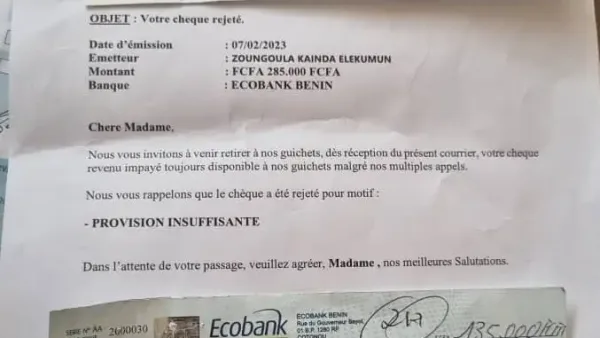
The Bank of Ghana defines a bounced check as any check drawn on a bank or deposit institution when the customer’s account does not have sufficient funds to cover the indicated amount. The institution also reminds that this practice constitutes an offense under the Criminal Offences Act and may result in a fine and/or imprisonment for up to five years.
When a prohibition is imposed after a third incident, the customer’s bank must inform them within five working days, recall all unused checkbooks, and no longer issue any until the sanction is lifted.
If the customer does not return unused checkbooks within ten working days following notification, the Bank of Ghana may go further by prohibiting them from operating a current account. Their name may also be listed in the high-risk check issuers directory used by the central bank and the banking sector.
Banks and deposit institutions must also continue to report these incidents to credit reference bureaus and submit their data monthly to the Bank of Ghana. The monetary authority justifies the tightening of monitoring by the persistence of bounced checks and their effects on public confidence in this payment method.
Comments