
Spain: what the calls to cross the Ceuta border on August 15 are hiding
An investigation by RFI reveals that a call to massively join Ceuta on August 15, 2026, was widely shared on Instagram, Facebook, and WhatsApp following the migration crisis on July 30 and 31. The rumor, based in part on the false idea of an exceptional opening of the Spanish border, was reportedly artificially amplified by about ten suspicious accounts.

SUMMARY
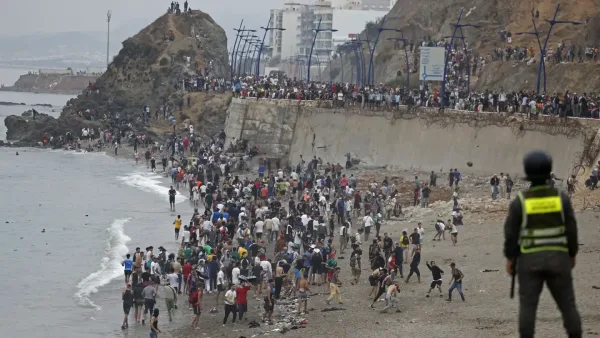
On July 30 and 31, more than 70,000 people are said to have crossed illegally into Ceuta from Morocco in 48 hours, according to information reported by RFI. Moroccan NGOs also report more than 141 deaths during this sequence, a toll that has not been independently confirmed with the available evidence.
From the very beginning of this crisis, posts began to announce a new collective attempt for August 15. These messages claimed that the Ceuta border post would be exceptionally open due to a public holiday in Spain. This information is false: Spanish and Moroccan authorities have, on the contrary, tightened controls around the two Spanish enclaves.
In a message posted on Instagram on August 11, the Guardia Civil reminded that the border remained closed and that new security barriers had been installed. They also warned potential crossers that they could be turned away.
Recently Created Accounts to Spread the Rumor
The RFI investigation did not definitively identify the origin of the call on August 15. However, it highlighted about ten Instagram accounts exhibiting common characteristics: recent creation, low follower count, dubious identity, and impersonal biographies.
Some of these profiles had changed names and pseudonyms several times. Their posts were almost exclusively dedicated to the date of August 15, with videos sometimes amassing several million views. RFI believes that several accounts may have been created specifically to give visibility to this campaign.
The sudden surge in some videos could also be explained by the purchase of views, although this hypothesis does not clarify who would have financed or organized the operation. Open-source research has not determined whether it was a single actor or several networks.
Other anomalies appear in the publications. Some videos associated with the call use captions in Japanese, with no link to Morocco, Spain, or migration. These texts come from a publication by Vogue dedicated to the Vogue World 2025 event, which had exceeded 11 million views and received 766,000 likes. Users are reported to have re-shared and translated this content in an attempt to benefit from the algorithmic recommendation related to its initial popularity.
According to RFI, all these practices correspond to the mechanisms of “astroturfing,” a technique that aims to give the appearance of a spontaneous and popular movement to an organized or artificially amplified campaign. The repeated use of keywords like “haraga” and “Spanish” has contributed to reinforcing this impression of massive mobilization.
A Real Audience Well Below the Millions of Views
After the initial dissemination by dubious accounts, the call was picked up by authentic profiles, some of which have more than 100,000 followers. A young Moroccan videographer notably offered his audience free bus transport to the Spanish border. It has not been possible to determine whether he was paid to relay this message.
On WhatsApp, several private groups presented as linked to the movement also circulated on social networks. The largest one reported by RFI had nearly 800 members, although it was not possible to verify the authenticity of all profiles. This audience seems very distant from the more than 20 million views accumulated by the content associated with August 15, primarily on Instagram.
The exchanges observed in these groups often discussed topics unrelated to crossing the border. Most identified members were Moroccan men also using these spaces to offer or seek services. Several participants interviewed on condition of anonymity explained that they joined the groups out of curiosity, without any intention of going to Ceuta or Melilla.
Other messages, however, discussed the possibility of a crossing and spread unfounded information about a supposed opening of the border. Moroccan authorities stated they had detected anonymous publications calling for collective and illegal attempts to cross into Ceuta and Melilla. They also announced the arrest of a group of individuals who were allegedly linked to these calls.
Unemployment and Lack of Prospects as Underlying Factors
According to Mehdi Alioua, a sociologist and associate professor at the International University of Rabat, the virality of these messages is driven by a deeper social malaise. The term “harraga,” often used to refer to migrants who illegally cross borders, reflects the desire of young Moroccans to escape a situation they perceive as hopeless economically and socially.
Morocco recorded a growth of 4.9% in 2025, according to the High Commission for Planning. However, this macroeconomic performance does not necessarily translate to improved prospects for a portion of the youth, who face unemployment, low wages, and limited access to social protections.
Mohamed Ali Lahlou, a migration expert and member of the Moroccan Association for Migration Studies and Research, refers to an underutilization rate of labor close to 45% among youth. This indicator includes situations of underemployment and discouragement, beyond just the officially recorded unemployment.
For both specialists, social networks are not the primary cause of mobilizations. They serve rather as an accelerator for a pre-existing desire to leave, providing a date, a narrative, and sometimes a mode of organization. Lahlou recalls that the crisis of 2021 in Ceuta, during which about 10,000 people crossed the border, was also preceded by the circulation of messages on social networks.
The tightening of security measures on both sides made a new crossing of the scale announced for August 15 unlikely. However, the spread of the rumor shows that calls of this type can continue to resonate, even when the information they convey is clearly false. Experts interviewed by RFI believe that the migration issue cannot be addressed solely through border control and call for the development of legal migration pathways as well as social policies that offer more prospects for youth.
Comments