
Cheetahs in Benin: an internal crisis that worries
With just a few months to go before the start of the qualifiers for the CAN 2027, the national team of Benin is going through a period of strong turbulence. The suspension of Olivier Verdon, concerning recent results, and persistent difficulties in stabilizing some dual-national players reignite the debate on sports governance surrounding the Cheetahs.

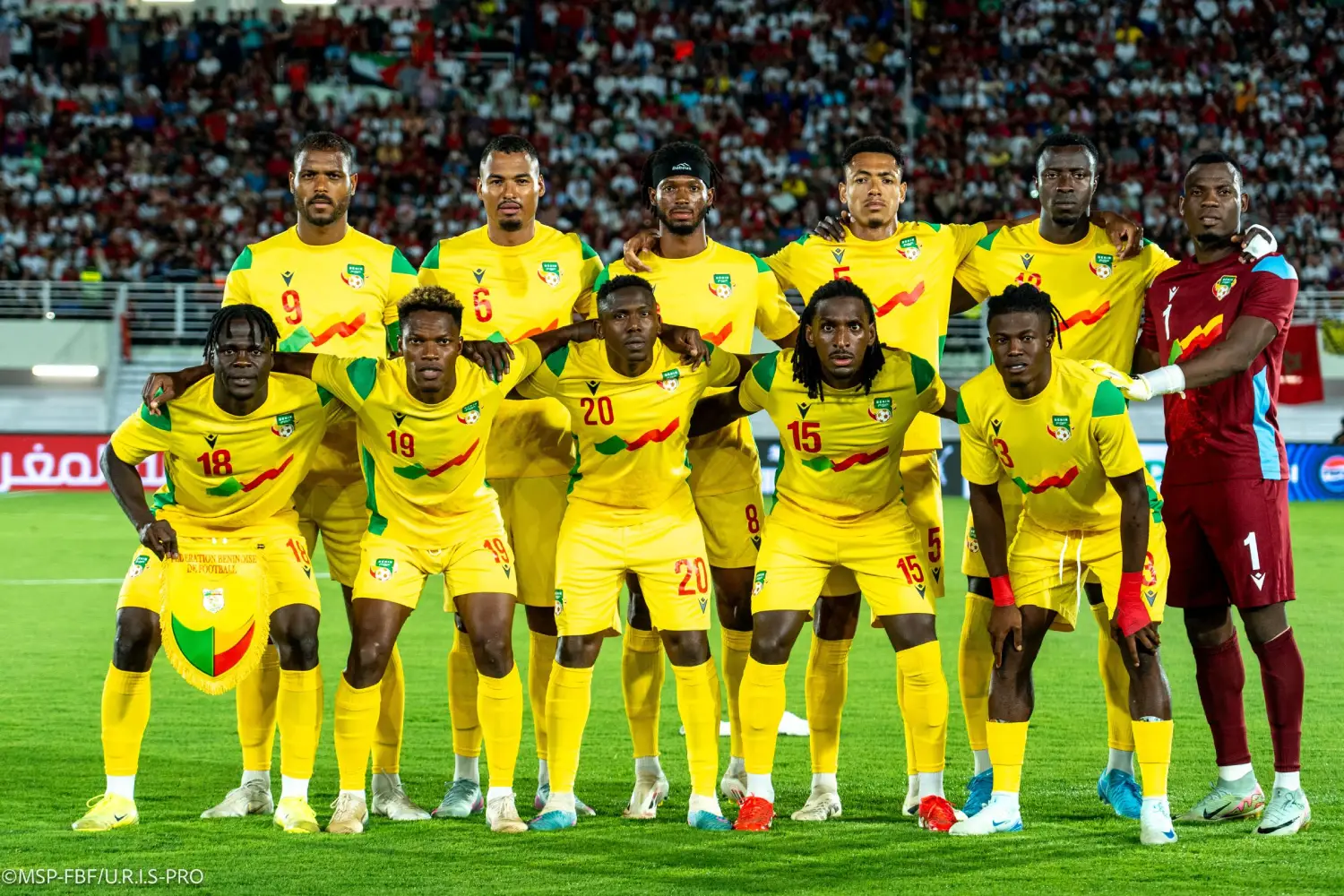
SUMMARY
The national A team of Benin is experiencing a time of deep turmoil. With humiliating defeats, disaffection from dual nationals, and a crisis of internal governance, the Cheetahs approach the upcoming qualifiers for the Africa Cup of Nations 2027 with a state of widespread concern.
On June 18, 2026, the Beninese Football Federation (FBF) issued a suspension of six months without parole, with an additional six months suspended, against central defender and international Olivier Verdon. The statement, signed by Secretary General Claude Paqui, cites “multiple breaches of rules of discipline, internal functioning, respect for the coaches’ instructions, and obligations of collective life.” The FBF chose not to disclose the exact circumstances that led to this decision, stating that it “will not communicate further.”
This is not, however, a surprise. As early as March 2025, during the qualifiers for World Cup 2026, Gernot Rohr had already publicly sidelined Verdon for “issues of communication and mutual respect” – the player having been accused of lying to the technical staff about the true reasons for his absence. The defender had since been kept away from gatherings in November 2024 and March 2025. The formal sanction of June 2026 thus marks the conclusion of a long tug-of-war but also reopens, in the public opinion of Benin, a much larger wound: the deep malaise between the technical management and the team leaders.
The Dual-National Phenomenon
Verdon’s situation is just the latest episode in a series that raises questions. Several dual nationals who have contributed to the rise of the Cheetahs have gradually turned their backs on the national team.
Rudy Gestede, a legend of the Beninese attack (11 caps, 3 goals), announced his international retirement as early as April 2017 citing “personal reasons,” amidst tensions with the Beninese public who accused him of a lack of involvement. His premature departure deprived Benin of a Championship-level striker at his peak.
Cebio Soukou, on the other hand, left in a much more resounding manner. Not retained by Gernot Rohr upon his arrival, the attacking midfielder stated on Facebook in March 2024: “I will always wear our jersey with pride and honor, but not with the current coach”. Despite being the all-time leading assist provider for the national team, Soukou has been regularly ignored by Rohr, who justified his absences with “technical insufficiencies,” a reason deemed insufficient by many observers given his consistent performances at club level. To this day, Soukou remains out of the selection.
Andréas Hountondji represents the most recent and concerning case. The FC St. Pauli (Bundesliga) forward declined his call-up for the CAN 2025 due to injury, even though he was starting for his club the same day against Mainz. In March 2026, he again turned down Gernot Rohr’s call, citing “personal reasons.” This double defection shocked supporters, especially since the player, who scored 4 goals in 16 appearances this season, is considered one of the most talented forwards of the selection.
Olivier Verdon now completes this blacklist, he who was still captain during the disastrous Benin-Togo (1-5) match on June 9, 2026, before his official suspension nine days later.
The Central Question
However, the FBF is not lacking in expressed ambition. In April 2026, the Federation and the Ministry of Sports organized an official detection day in Pantin (France) to recruit dual nationals playing in Europe ( France, Belgium, Germany, Canada). Vincent Rautureau, the technical director, rightly stated that “we are increasingly being approached by dual nationals. This shows that Benin is attracting and interesting more and more players”.
But this discourse of attractiveness clashes with the reality on the ground. Several contacted players do not even respond to the requests. In 2023, Gernot Rohr revealed that right-back Colin Dagba (trained at PSG) had “never responded” to their multiple messages. The coach himself stated that “we are not going to chase after a player. We want enthusiastic players who are excited to join us”, a stance that is understandable in principle but masks a structural problem: the sports project and the human environment of the den are no longer convincing.
The public criticisms of the coach towards his own players also feed this malaise. After the 3-0 defeat against Burkina Faso in November 2025, Rohr publicly stated about Jordan Lawson and Adam Akimey that he “did not yet see the quality” they could bring, a habit of “pointing fingers” in public that, according to sources close to the group, discourages potential players. In an environment where human management has become the most visible weak point of Rohr, it is difficult to sell the Beninese project to dual nationals established in major European leagues.
Worrying Numbers
In terms of results, alarm signals are accumulating. During the FIFA window in June 2026, the Cheetahs were first held to a 1-1 draw by Niger, before falling to the Sparrowhawks of Togo by a score of 5-1, the heaviest defeat of the Rohr era. The team was missing 8 key players (Steve Mounié, David Kiki, Rachid Moumini, Yohan Roche, Tosin Aiyegun, Tamimou Ouorou, Sessi d’Almeida, Junior Olaitan), but the exposed flaws (defensive disorganization, expulsion of Samadou Attidjikou in the 51st minute, goals conceded from corners and counter-attacks) reveal an insufficient depth on the bench and a concerning collective fragility.
From their last 10 outings, the national record shows a meager 3 victories, 2 draws, 5 defeats, marked by chronic defensive fragility. The 4-0 defeat to Nigeria in October 2025, during the last match of the World Cup 2026 qualifiers, remains in memory. It ended Benin’s dream of a first participation in a World Cup.
At the CAN 2025 in Morocco, Benin did reach the round of 16, a second qualification to the knockout stage in its history, but succumbed to Egypt (3-1 a.e.t.) after losing to DR Congo (0-1) and Senegal (0-3).
The CAN 2027 Project
The draw for the CAN 2027 qualifiers (Kenya-Uganda-Tanzania), held in Cairo on May 19, 2026, placed Benin in Group F alongside Burkina Faso (top seed), Mauritania, and the Central African Republic. Only the top two teams in the group will qualify.
The qualifiers’ schedule is tight: the first window runs from September 21 to October 6, 2026, the second from November 9 to 17, 2026, and the third from March 22 to 30, 2027. It is precisely in this September window that Olivier Verdon’s suspension will have a significant impact. The central defender, a cornerstone of the defensive setup, will be absent from the first and possibly the second window.
Without Verdon, without Soukou, with Hountondji’s availability still uncertain, and facing a still formidable Burkina Faso, the qualification mission appears complex, if not perilous.
The Need for a Governance Reform
Beyond individual cases, a systemic management problem is emerging. The FBF did hold, in April 2025, an emergency meeting with Gernot Rohr to discuss disappointing performances and recommend “the rejuvenation of the squad.” But recommending and acting are two different things. Two years after this meeting, the same tensions resurface, the same faces disappear, and the same questions remain unanswered in public.
The model for recruiting dual nationals, which has been the backbone of the national team for a decade, requires a clear moral contract: welcoming conditions, transparent communication, respectful human management, and, above all, a coherent and credible sports project. Without this, the seduction efforts in Pantin will remain mere window dressing.
An extraordinary general assembly of the FBF, bringing together leaders, technical staff, key players, and representatives of supporters, is essential as a necessary prerequisite, not to designate culprits but to rebuild a trust contract around the national selection, before the September qualifiers turn the latent crisis into a sports disaster.
Comments