
Benin general elections: an appeal against the sample single-ballot paper rejected by the Court.
The Constitutional Court has validated the specimen of the single ballot paper retained by the National Autonomous Electoral Commission for the legislative and municipal elections scheduled for 2026.

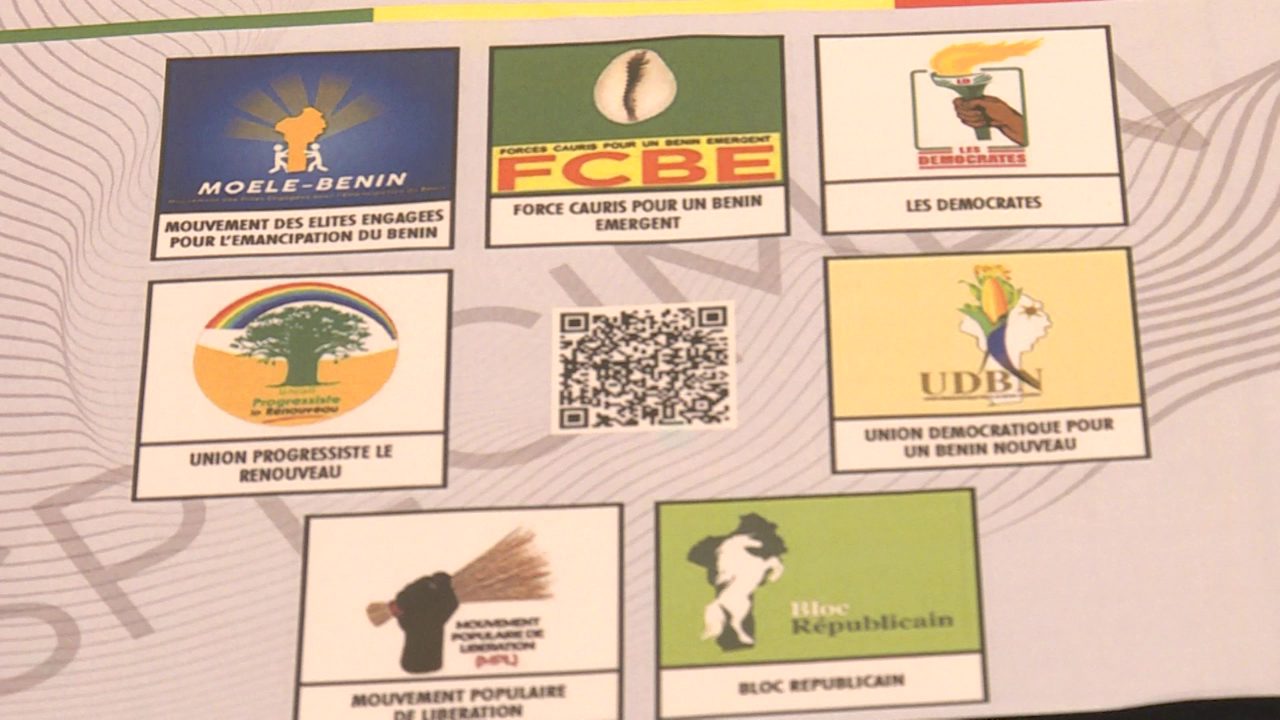

The decision follows an appeal challenging the graphical presentation of the ballot, notably regarding the visibility of certain political party logos.
For the CENA, the chosen approach is based on a color scheme designed to clearly distinguish the two elections held simultaneously. White is retained for the legislative elections, while gray is used for the municipal elections. This differentiation, applied uniformly to all political parties, is presented as an electoral readability measure aimed at facilitating voters’ choices.
In handling the dispute, the Constitutional Court was notably asked to rule on a request to modify the substance of the ballot, to enlarge the Les Démocrates party’s logo, or to adopt a specimen similar to the one used in the 2023 legislative elections. The high court rejected these claims, relying on a strict interpretation of the principle of equality before the law.
In its decision, the Court recalls that equality does not require a perfect identity of visual rendering between parties, but the application of identical rules to comparable situations.
The examination of the contested specimen showed that the Les Démocrates party’s logo respects its usual symbols and colors, remains legible and identifiable, and has been integrated according to the same technical standards as those of the other parties, notably in terms of dimensions, scale, and positioning.
The Court further notes that the perception differences cited by the applicant pertain more to the graphic design of each logo than to discriminatory treatment attributable to the electoral institution. The technical criteria having been applied uniformly to all political formations, no violation of the principle of equality nor of the integrity of the vote was established.
Consequently, the Constitutional Court concludes that there is no violation of the electoral code and confirms the validity of the specimen of the single ballot as adopted by the CENA. This decision thus reinforces the technical framework established for organizing the 2026 elections and closes the dispute concerning the presentation of the ballot paper.
Comments