
The committee of experts is concluding their work in Cotonou on the reopening of the Benin-Niger border.
The Beninese and Nigerien expert committees concluded their joint work on the conditions for reopening the common border on Sunday, June 21, 2026, in Cotonou. The conclusions will be submitted to Presidents Romuald Wadagni and Abdourahamane Tiani, while Niamey has set two security preconditions deemed essential before any effective resumption of border traffic.

SUMMARY
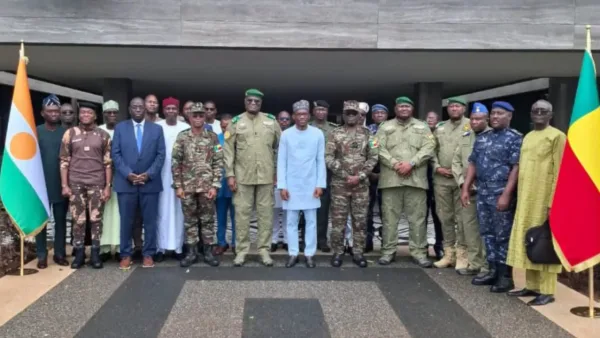
The Beninese and Nigerien expert committees tasked with examining the conditions for reopening the common border completed their joint work on Sunday, June 21, early in the afternoon in Cotonou, after two days of meetings presided over by Major General Mohamed Toumba, Nigerien Minister of State for Interior and Public Security, and by the Beninese Minister of African Integration, Olushegun Adjadi Bakari. The two delegations agreed on several points, according to elements communicated after the meeting. The conclusions will be submitted to Presidents Romuald Wadagni and Abdourahamane Tiani for validation.
The two heads of delegation praised the spirit that guided the discussions. However, the Nigerien delegation formally notified two security preconditions that Niamey considers non-negotiable for any effective reopening. The first pertains to the signing of a bilateral defense and security agreement based on the principle of non-aggression, prohibiting the use of the territory of either state to conduct hostile or destabilizing actions against the other. The second demands transparency regarding foreign military deployments stationed near Nigerien borders, along with the creation of a joint intelligence unit aimed at sharing strategic information in the face of threats from armed groups.
These two demands relate to the dispute that has pitted the two countries against each other since the coup d’état of July 26, 2023. Niger accuses Benin of hosting foreign military bases on its territory that could be used for destabilization operations, a claim Cotonou has consistently denied. The joint intelligence unit would address a shared threat: armed groups operating in the border areas of northern Benin and southwestern Niger ignore borders and strike from both sides.
The mission of General Toumba in Cotonou, the first Nigerien initiative of this level on Beninese soil since the crisis, marks a step in the process. This member of the National Council for the Safeguarding of the Homeland, the Nigerien transitional body, left Niamey on June 19 following a framing meeting at the office of Prime Minister Ali Mahamane Lamine Zeine, according to Niger’s radio and television.
A Three-Step Process
The rapprochement began on June 2, when President Wadagni, inaugurated nine days earlier, made an official visit to Niamey, the first visit by a Beninese head of state to Niger since the coup. The two presidents then adopted a joint statement in nine points and established an expert committee with a mandate of fifteen days to propose methods to lift the obstacles to reopening. The Nigerien Prime Minister had set up this committee on June 5.
On June 16, a joint statement signed by Ministers Adjadi Bakari and Bakary Yaou Sangaré, Nigerien Minister of Foreign Affairs, confirmed the conclusion of the first cycle of work conducted separately by each delegation. Both parties expressed satisfaction with the results, deemed fruitful, and announced a joint meeting before the end of the week to consolidate the conclusions. This meeting, taking place on June 20 and 21 in Cotonou, has just concluded.
The Issue of the Pipeline and Transit
The border between the two countries, approximately 280 kilometers long, has remained closed for nearly three years. After the coup against Mohamed Bazoum, Benin applied sanctions from ECOWAS. Even after lifting these measures, Niamey maintained the closure. The dispute had escalated around the pipeline linking the Agadem oil fields to the Sèmè-Kpodji terminal on the Beninese coast. Stretching about 2,000 kilometers, this infrastructure, with an estimated investment of six billion dollars, is the main export route for Nigerien crude oil.
None of the official statements published since June 2 explicitly mention the pipeline, but the oil issue and the revival of transit through the Port of Cotonou are at the heart of both parties’ economic interests. The reopening of the border is also a prerequisite for resuming cross-border trade, which is essential for the populations in the border areas, especially along the Malanville-Gaya axis.
No reopening date has been announced. The next step depends on the decision of the two heads of state, to whom the final report will be submitted. The reopening remains contingent on the response that Cotonou will provide to the two conditions set by Niamey.
Comments