
Boni Yayi – Adrien Houngbédji: Simple exchanges or the beginning of a political pact?
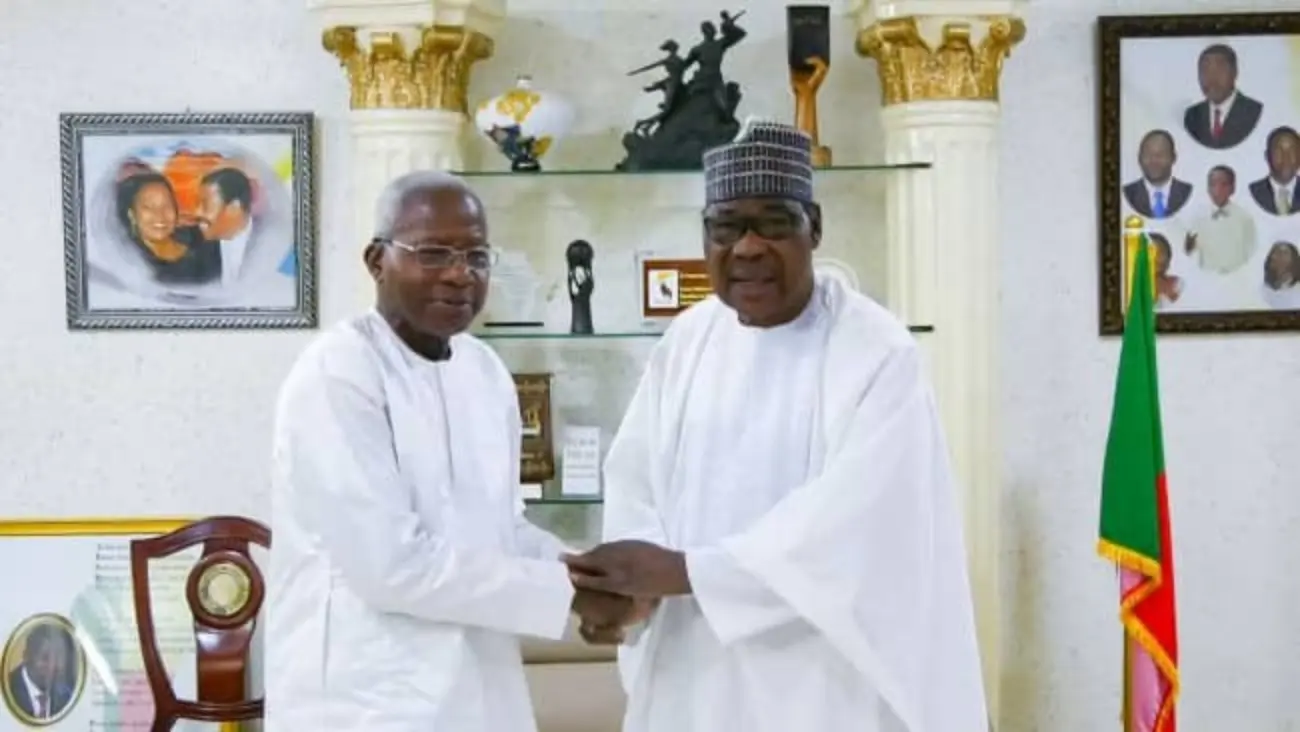
Since the beginning of 2025, the meetings between Boni Yayi and Adrien Houngbédji, two major figures of the Beninese political class, have been intriguing observers and analysts.

SUMMARY
If the first was qualified as a “courtesy visit”, the following ones, recurring and increasingly close, seem to follow another logic. In a pre-election context and less than a year away from the 2026 presidential election, these exchanges fuel a central question: are these just reunions of former adversaries or the preparation for an unprecedented electoral alliance?
The weight of the past and the realignments of tomorrow
Long opposed, particularly during the 2011 presidential election, Adrien Houngbédji and Boni Yayi have experienced parallel political trajectories, marked by rivalries, then by contrasting alliance choices. While Houngbédji joined Patrice Talon in 2016, becoming a tutelary figure of the presidential movement, Boni Yayi has remained a pillar of the opposition, now leading the party Les Démocrates.
However, the increasingly blunt criticisms formulated by Houngbédji against the current government, added to the crisis shaking up the Union Progressiste le Renouveau (UPR), feed the idea of a gradual shift of the PRD leader towards a more independent posture, even a rapprochement with Les Démocrates. Furthermore, in the city of Porto-Novo, the historic stronghold of the PRD, frustrations are growing within a militant base that feels betrayed by the UP–PRD merger, seen as hasty and unbalanced.
A PRD–Les Démocrates alliance? Not that simple…
But legally, such a hypothesis faces several major obstacles. According to the government’s official position, the merger between the Union Progressiste and the PRD has not only been enacted but validated by the Constitutional Court. This means, in legal terms, that the PRD no longer exists as an autonomous political entity.
Under these conditions, the PRD cannot engage in any political agreement with another party, in this case Les Démocrates, as suggested in some circles. Indeed, the new charter of political parties, adopted as part of the reforms of the partisan system, does not allow “political alliances” as such. There are now mechanisms for absorption or disappearance that apply, implying the end of the legal existence of one of the parties or of a political governance agreement. But in this case, the legal existence of the PRD is subject to debate. The party of Mr. Adrien Houngbédji, unless he wins a legal battle, does not have much room for maneuver, it is now prisoner of its rapprochement with the UP.
Thus, if some militants or nostalgic PRD executives still claim this training, they no longer have, in law, a separate party base from the UPR.
Variable-geometry political realignment
In the face of this reality, any attempt at agreement or rapprochement could only be carried by individual political figures, and not in the name of the PRD as a structure. This makes the interpretation of the meetings between Boni Yayi and Adrien Houngbédji even more sensitive. Are they the prelude to a personal repositioning of Houngbédji in the opposition? Or simply a power play to reposition his base inside the presidential movement itself?
The answer is yet to come. But these repeated appointments clearly signal an ongoing reconfiguration, behind the scenes, in a political landscape where the boundary between alliances and confrontations remains fluid.
2026 in the crosshairs
With the anticipated end of President Patrice Talon’s term, the major maneuvers are intensifying. Behind the facade smiles and calculated silences, the Beninese political class is being reshaped, between readjusted loyalties and relaunched ambitions.
And if the Yayi–Houngbédji meetings do not herald a common front… they might well draw the new lines of fracture of a Beninese politics in full mutation.
Comments