
At the end of his mission in Benin, American Ambassador Brian Shukan takes stock of his tenure and bids farewell.
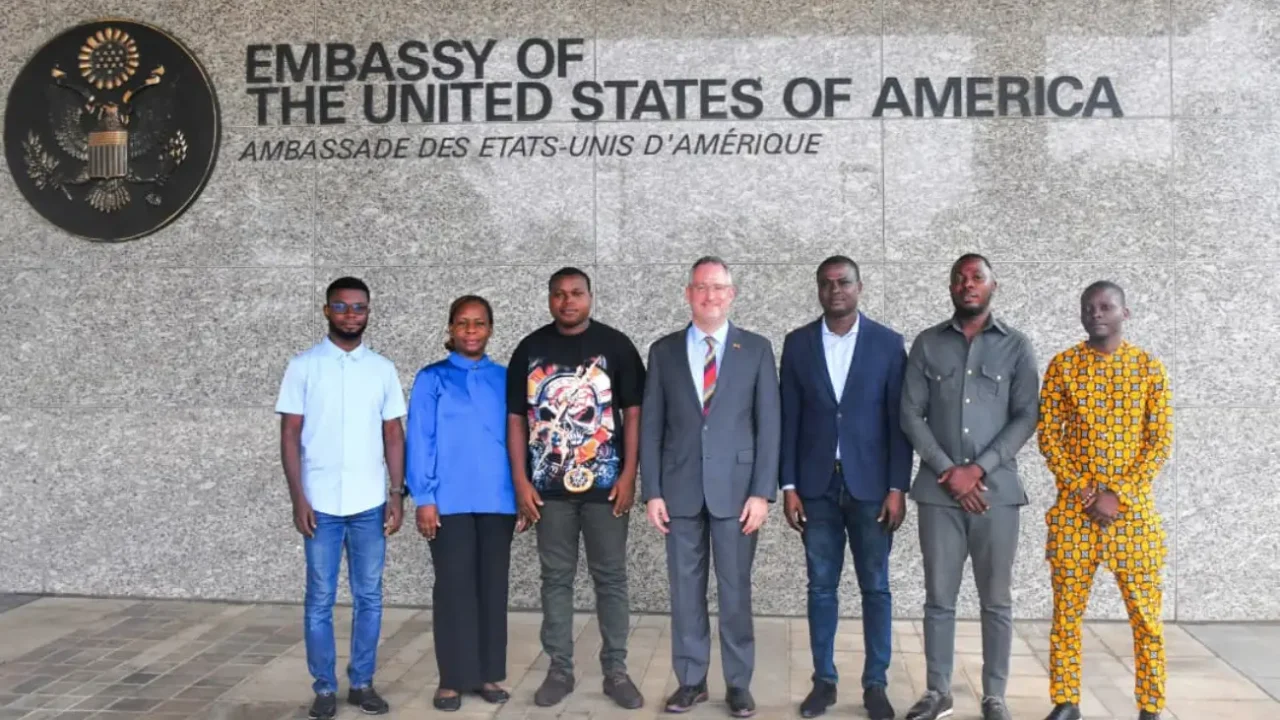
At the end of his term after nearly four years at the helm of the U.S. representation in Cotonou, the United States Ambassador to Benin, Brian Shukan, met with the press on February 10, 2026. The occasion for the diplomat to provide a detailed assessment of bilateral cooperation, to analyze Benin’s transformations over three decades, and to outline the prospects for relations between Washington and Cotonou.

SUMMARY
Arrived in May 2022, Brian Shukan says he has overseen a significant intensification of the security partnership between the two countries. According to him, more than $30 million in assistance has been mobilized for the Beninese defense and security forces.
These funds enabled the donation of military and police equipment, as well as the implementation of training programs for the Beninese Armed Forces, the Republican Police, the Penitentiary Administration, and the Ministry of Justice. A police training center was notably completed during his tenure.
The ambassador emphasizes a central point: “It is Benin that leads this fight. It is not up to a foreign country to do it.” For him, American support is primarily aimed at strengthening national capacities in a spirit of sovereignty and partnership.
Institutionally, the cooperation has taken a step forward with the establishment of a military cooperation office directly at the United States Embassy in Cotonou, now led by an American officer. Previously, oversight of these matters was handled by the U.S. Embassy in Accra, Ghana. A person dedicated to coordinating counterterrorism programs is also based in Cotonou.
In the face of the threat from extremist groups in the subregion, Brian Shukan advocates for a regional and integrated approach. “This is not a problem that can be solved with arms alone,” he notes, highlighting the need to address social vulnerabilities, particularly in the marginalized northern areas of the country.
Health, Infrastructure, and Economic Development
Beyond security, the American mission has continued its engagement in social and economic sectors. More than 3,000 community health workers are now supported through American programs in health, notably for vaccination, maternal health, and malaria control.
Despite the closure of the local USAID mission as part of a reorganization decided in Washington, the ambassador says that more than $50 million in health programs continue to be implemented in Benin.
Cooperation also extends to infrastructure. The Millennium Challenge Corporation (MCC) contributed to improving Benin’s electrical grid through a previous compact focused on energy. A new regional program focused on transport includes plans to rehabilitate the Bohicon–Dassa corridor, as well as reforms aimed at strengthening road safety.
The Peace Corps remains active, with 32 volunteers currently deployed in the sectors of agriculture, education, and health. Since 1968, nearly 2,500 American volunteers have served in Benin.
A privileged witness’s perspective
The peculiarity of Brian Shukan lies in his long-standing knowledge of the country. A diplomat in Benin in 1996, he witnessed the presidential election of that year, a few years after the National Conference. “Being a witness to the beginnings of a new democracy deeply moved me,” he confides.
Thirty years later, he notes a notable structural transformation. Benin, once mainly an exporter of raw products, is now oriented toward local processing and value-added creation. He cites, in particular, the Glo-Djigbé Industrial Zone (GDIZ) and progress in the cotton and textile sectors.
For the diplomat, this strategic orientation toward industrialization and processing is a key lever for job creation and the consolidation of growth.
Commerce, visas et dialogue politique
Economically, Brian Shukan calls for deepening trade between the two countries. “There is a lot more we can do to open trade,” he says.
Asked about visa restrictions and the new American immigration policies, the ambassador recalls that each state has the sovereign right to protect its borders. He mentions high overstay rates for certain types of visas — more than 12% for tourist visas and more than 36% for student visas — justifying, in his view, the ongoing adjustments. A dialogue is underway with Beninese authorities to strengthen cooperation on migration.
Politically, Brian Shukan reaffirms the United States’ commitment to democratic principles, notably freedom of expression and the press, while underscoring respect for Benin’s sovereignty. “We remain available to accompany the Government of Benin in a spirit of partnership, mutual respect and constructive cooperation,” he concludes.
A personal attachment to Benin
Beyond the numbers and programs, the ambassador leaves Cotonou with a personal attachment to the country. An avid cyclist, he says he has traveled thousands of kilometers across the territory. He also welcomes the progress of the Benin Cycling Federation, whose athletes competed in the United States for the first time during his tenure.
“Benin is a very special country for my family and me,” he confides. Aware of the security and socio-economic challenges to address, Brian Shukan assures that he will remain “a steadfast supporter of Benin” after his departure.
Comments