
Talon’s media appearance: the final round before the epilogue of a duel that’s gone on too long
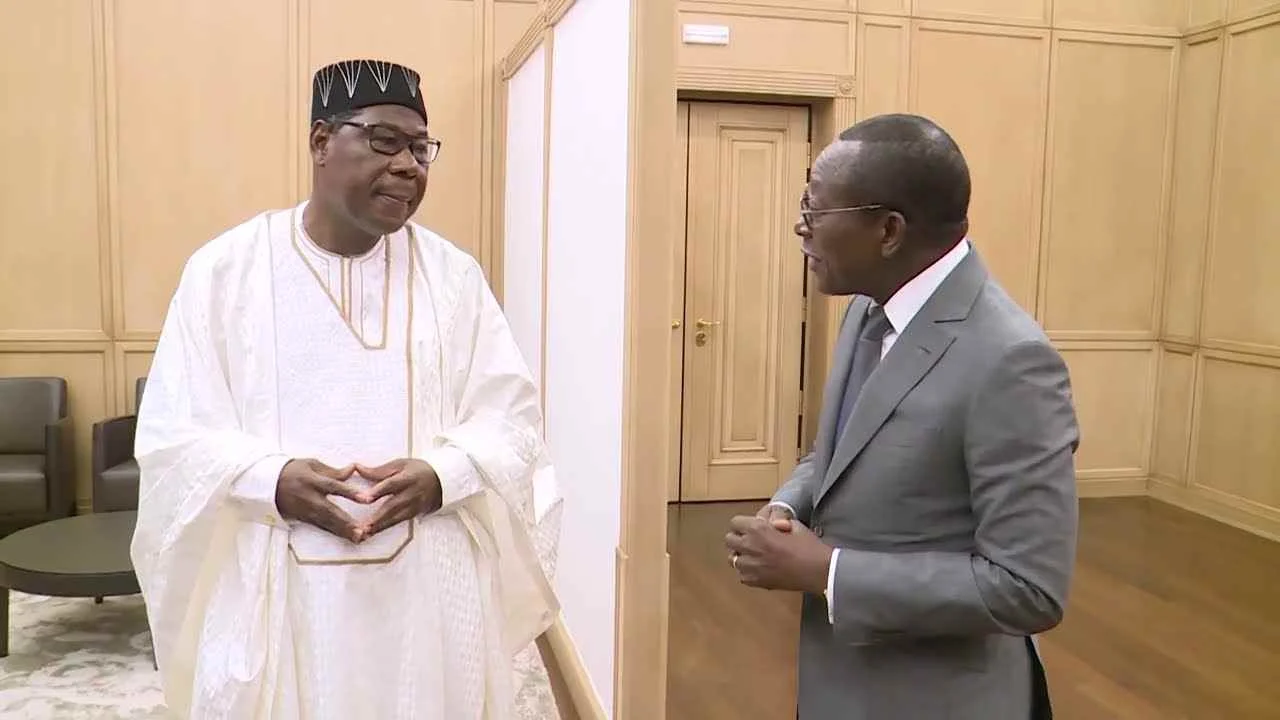
Announced by the press and awaited by public opinion, Patrice Talon agreed on Tuesday evening to an exercise he himself dislikes: the televised interview. But this much-anticipated meeting neither eased tensions nor shed light on the current political uncertainties. The head of state, whom many expected to address the major national issues, seemed mainly to have come to settle scores with an opponent whose specter continues to haunt his governance: Boni Yayi.

SUMMARY

Over 45 minutes, Patrice Talon revealed a constant preoccupation: his predecessor. Every argument, every justification, every jab seemed to revolve around this man whom he accuses, again and again, of wanting to sabotage his reforms. As if to remind everyone that Beninese politics remains captive to this unfinished rivalry between two men, two egos, two irreconcilable visions of power.
The public, for its part, could only see it less as a head-of-state speech than as a long personal plea, an attempt to regain control of a duel that, clearly, never ends.
Indeed, from this media show one sentence sums up the general feeling: “If I didn’t triumph, it’s Yayi.” This implicit cry, behind diplomatic phrases and rhetorical detours, makes the presidential appearance look like a delayed settling of scores.
The tone was unusual. The cold, controlled assurance of a born competitor gave way to a hesitant, almost defensive voice. The man who once claimed to need no one now seems to be asking for everyone’s pity. His language became less cutting, his stance less triumphant.
This is not a communication error, it’s a confession of a state of mind. President Talon, who long cultivated the image of an unshakeable man, today gives the impression of fearing what the future holds for him once the trappings of power are laid down. It’s a political fear, but also an existential one: the fear of reverting to the status of an ordinary man in a country where the memory of power is rarely kind.
The confession beneath the veneer of the speech
Behind the words about reforms, the Senate or institutions, hides a subliminal message: the difficulty of owning up to unpopularity and the desire to shift responsibility onto someone else. By naming Yayi as the ultimate obstacle, Talon offloads part of the weight of his own record. But in doing so, he overturns his own narrative: that of the strongman who wanted to “take responsibility alone” for the harshness of the reforms.
The contradiction is clear. You can’t at once claim political courage and look for scapegoats. You can’t call yourself the architect of renewal and blame the building’s cracks on the shadow of your predecessor.
Fear of what comes after
What comes through in this communication is an after-power anxiety. The head of state no longer seems to fear his current opponents, but what they might become again tomorrow. The repeated denunciation of Boni Yayi’s supposed actions reflects less a political disagreement than a personal unease: that of a man who senses that power is slipping from him and that the story he will leave behind is no longer entirely under his control.
This psychological dimension of the presidential appearance is all the more striking because it is staged unusually: an interview longer than it was deep, where the real questions slid under the rug, notably that of constitutional revision. This silence, as deafening as it was calculated, reinforced the impression of a speech more turned toward the past than toward the Nation.
The context of President Patrice Talon’s media outing also invites reflection. Everything seems to confirm that this interview followed two consecutive statements by former president Boni Yayi. In the first, the LD party president accuses his successor of wanting to stifle Benin’s democracy by eliminating the opposition. That statement was followed by another in which he denounces the anti-democratic nature of the Senate in the making and asserts that his shadow will not appear in that body.
A posture that no doubt struck the head of state, who sees in this move a fresh opposition to his institutional reform, one of the last of his term. All of which gave his media outing the appearance of a settling of scores.
The defense of an unwieldy Senate
In his remarks, the head of state seemed to justify the constitutional reform promoted by his camp as a response to political adversity, notably the one between him and his predecessor.
But this Senate that he tries to present as a guarantee of stability, many see as yet another political stronghold.
Behind the institutional theory, the political backdrop asserts itself: former presidents, ex officio members of the future Senate, would sit there with the possibility to influence, even to correct, their successors’ choices.
In other words, the shadow of the past would settle in the very heart of legislative power, with the assurance that nothing essential disappears entirely. The risk is clear: to turn this chamber into a space for muffled revenge, where old grudges are cloaked in the garments of state wisdom.
The eternal return of the duel
This endless face-off between Talon and Yayi, two former allies turned adversaries, wears on the Republic. Seeing them in the same Senate as conceived in the Aké-Assan bill does little to reassure.
Unfortunately, each of these statesmen, in his own way, refuses to fall silent and withdraw from the country’s political life.
Beninese political life seems to boil down to this circular tension where the same faces, the same quarrels, return to haunt the institutions.
The country, for its part, expects something else: prospects, a new breath, a new generation freed from succession squabbles and score-settling.
Putting these two rivals in the same Senate would be to prolong a duel that the people of Benin no longer want to witness. This project, meant to consolidate democracy, risks becoming its caricature: an upper chamber where yesterday’s debts are settled under the guise of institutional wisdom.
Benin deserves better than this staging. The country would benefit from granting Patrice Talon and Boni Yayi the luxury of political rest, the kind that allows a nation to finally breathe, away from the passions of men who oppose everything and yet always bring each other back together.
History, sometimes, moves forward better when its protagonists know how to step aside.
Time for political rest
It must be said without passion: Benin has lived long enough to the rhythm of this Yayi-Talon duel. The two men have given the Republic what they could offer. But today, each embodies less a program than reflexes.
Because keeping these two figures in the same arena, even under the roof of a Senate, is to condemn the country to replay the same play indefinitely.
The Republic deserves a new breath, new faces and fresh ideas. The rest is no longer politics, it’s theater. History, sometimes, advances better when its protagonists know how to step away.
Comments