
Migrants vs Billions: Rabat’s ‘blackmail’ of Europe?
Recent Moroccan remarks and fresh EU funding plans revive the old question of whether migration pressure is being used as a bargaining tool.

SUMMARY
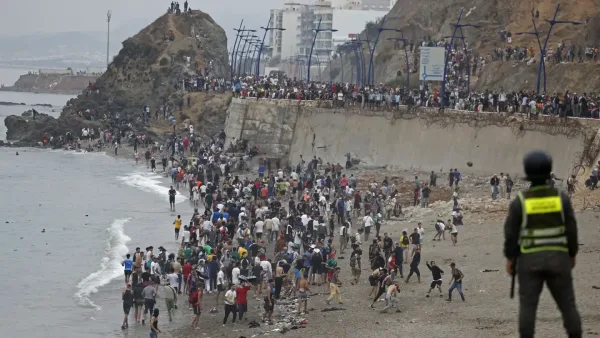
Less than a month after the massive arrival of tens of thousands of migrants in Ceuta, new Moroccan statements about the Spanish enclaves have reignited tensions with Madrid. At the same time, the European Union is considering boosting its financial support for Morocco’s border management. A sequence of events that puts back at the center of the debate an accusation already raised during the 2021 crisis: that migration pressure may have been used as a diplomatic bargaining tool.
The scene unfolded on August 24, 2026 at the Royal Palace in Rabat. During a religious ceremony presided over by King Mohammed VI, Moroccan Minister of Habous and Islamic Affairs Ahmed Toufiq spoke of the “sacred struggle” being waged to “liberate the occupied cities.” His remarks, which referred to Ceuta and Melilla through the history of several religious figures from Ceuta, immediately drew attention in Spain.
The political significance of the episode lies as much in the words used as in the setting in which they were delivered. Ahmed Toufiq was speaking before Mohammed VI, Crown Prince Moulay Hassan and Prime Minister Aziz Akhannouch. Even so, his speech did not amount to the announcement of a new diplomatic doctrine: the Foreign Ministry has communicated no formal change in Morocco’s position on the two territories.
Madrid quickly restated its line. “Ceuta and Melilla are Spanish,” government spokeswoman Elma Saiz said. The Spanish government considers the two cities an integral part of its territory and of the European Union, a position also officially conveyed to Rabat through diplomatic channels after several recent Moroccan statements.
Those positions come as Ceuta is still struggling to absorb the consequences of the migration crisis of July 30. Around 72,000 people crossed the border illegally from Morocco that day, according to Spanish estimates cited by several European sources. The human toll was later revised to at least 82 dead on the Spanish side and 14 in Morocco, while several thousand migrants were still in the enclave weeks later.
The 2021 precedent fuels the suspicions
The July crisis inevitably recalls the one in May 2021. At the time, around 8,000 people entered Ceuta in two days after an apparent easing of Moroccan controls. The episode broke out in the middle of a diplomatic crisis triggered by Spain’s reception of Brahim Ghali, the Polisario Front leader, who had come there for medical treatment.
The link between the two events was then suggested by a member of the Moroccan government. Mustapha Ramid, state minister in charge of human rights, said Morocco had the right to ease its efforts after the welcome given to Brahim Ghali and argued that Madrid should understand that “underestimating Morocco is costly.”
Spanish Defense Minister Margarita Robles responded by directly accusing Rabat of “blackmail.” She criticized the Moroccan authorities for allowing thousands of people, including minors, to try to reach Ceuta by swimming or by crossing the border fence. “We will not accept any blackmail,” she said on Spanish public radio RNE.
Five years later, the comparison has its limits. No public evidence currently shows that Moroccan authorities organized or deliberately triggered the influx of July 30, 2026. On the ground, Moroccan forces used water cannons, riot-control equipment and reinforcements to try to contain the crossings. After the crisis, Rabat also strengthened its deployments near Ceuta and made arrests when new calls to cross the border circulated on social media.
Morocco also explicitly rejects the idea of instrumentalization. A source in the Moroccan foreign ministry said in early August that the kingdom was acting “neither under pressure, nor blackmail, nor in exchange for anything.” Rabat says it warned Madrid before the crisis about the consequences of a Spanish court ruling that limited the immediate return of migrants intercepted at sea. According to Moroccan authorities, that development weakened the deterrent effect of the border system and was exploited by smuggling networks.
Hundreds of millions of euros at the heart of migration cooperation
The questions are now shifting to Brussels. For several years, Morocco has benefited from significant European funding for migration management, border surveillance, the fight against smuggling networks and return policies.
According to figures provided by the European Commission to Euronews, 222 million euros were committed between 2021 and 2024 for migration cooperation with Rabat. Brussels is also planning a further 190 million euros by the end of the current budget framework in 2027, bringing the total to more than 400 million euros over the period under review.
Cooperation is not limited to surveillance equipment. In 2023, the European Union launched a 152 million-euro budget program dedicated to migration management in Morocco, as part of a broader package of cooperation that also covers economic reforms and the green transition.
The Ceuta crisis comes as Brussels and Rabat negotiate a new strategic and global partnership, expected before the end of the year. According to several European officials interviewed by Euronews, the July events are now prompting the EU to strengthen the migration, security and border-control chapters of the future agreement.
Ursula von der Leyen herself has spoken of the need to improve border management, early-warning mechanisms and the “technical and financial” support provided to Morocco. For his part, the EU commissioner for home affairs and migration, Magnus Brunner, said the Union must use all its levers to secure lasting cooperation from Rabat, stressing the vulnerability created by Europe’s dependence on neighboring countries in migration matters.
An interdependence that gives Rabat considerable weight
The issue therefore goes beyond the July 30 crisis alone. Geography places Morocco in a special position: it controls a major part of the land and sea routes leading to Spain and, by extension, to the European Union.
For Brussels and Madrid, cooperation with Rabat is therefore a central element in controlling irregular arrivals. For Morocco, that situation mechanically increases its weight in negotiations not only on migration, but also on trade, investment and political cooperation.
This relationship of interdependence feeds suspicions every time a crisis erupts. After the July events, the president of Ceuta, Juan Jesús Vivas, accused the Moroccan authorities of having “encouraged and allowed” the influx, while Rabat firmly rejected those accusations. The European Commission stopped short of directly blaming the Moroccan government.
Madrid’s stance has also remained cautious. During his visit to Ceuta on July 31, Pedro Sánchez spoke of a “violation” and an “attack on Spain’s territorial integrity” without accusing Morocco. Instead, he highlighted the cooperation of the Moroccan authorities in organizing returns and attributed the trigger for the crisis to how a Spanish court decision was interpreted by migrant-trafficking networks.
The timeline remains politically sensitive. An unprecedented migration crisis hits Ceuta, Brussels then considers boosting its financial and security support to Morocco, and several Moroccan officials publicly bring sovereignty over Ceuta and Melilla back into the debate.
Those elements do not prove the existence of a mechanism coordinated by Rabat to win European concessions. They do, however, explain why the accusation of “migration blackmail”, formally voiced by Madrid in 2021, is resurfacing in the European debate.
For the European Union, the challenge now is to maintain indispensable cooperation with Morocco without creating a relationship in which migration control becomes a disproportionate bargaining lever. For Rabat, the reverse challenge is to keep presenting itself as a strategic partner without reinforcing the idea that the stability of the European border depends on political or financial concessions.
Comments