
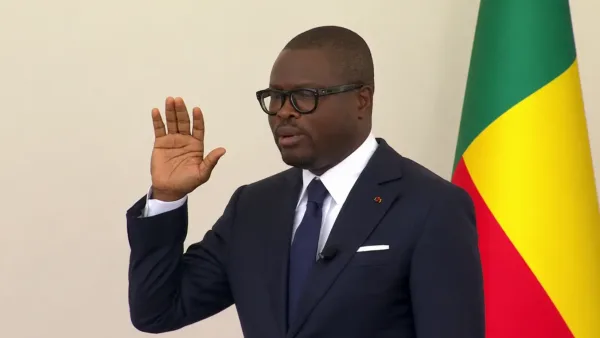
Benin: invested as President of the Republic, Romuald Wadagni outlines his priorities
In his first presidential speech, Romuald Wadagni promised to make economic growth a concrete lever for improving the daily lives of Beninoise people. The new head of state notably announced an agricultural social protection, while showing a firm stance against security threats and a desire for regional cooperation in a tense sub-regional context.

SUMMARY
The new Beninese president Romuald Wadagni set Sunday, May 24, 2026, in his inaugural speech at the Cotonou Congress Palace, as the first priority of his term translating economic growth into tangible benefits for each Beninese family. “Our economy has progressed, that’s a reality. But we all know that national growth only makes sense when it becomes visible in the everyday lives of the people,” he stated in front of representatives of institutions, the diplomatic corps, and attending heads of state and government.
Wadagni articulated his promise around four categories of the population. To the youth, he promised local opportunities. To women, he announced enhanced access to financing, ownership, social protection, and responsibilities. To farmers, he detailed improved access to mechanization, adapted seeds, funding, and processing equipment — accompanied by an unprecedented announcement: “We will build agricultural social protection, because a nation that respects those who feed it is a nation that respects itself.” To the diaspora, finally, he reaffirmed that “the country we are building is also yours,” with a message explicitly addressed to the descendants of the slave trade: “Benin will always be the house of return, our door remains open and our memory faithful.”
The new head of state paid a strong tribute to his predecessor Patrice Talon, praising “the courage of difficult decisions, the constancy of builders, and the rare ability to think of Benin in the long term.” He also cited his predecessors since the democratic renewal of 1990 — Nicéphore Soglo, Mathieu Kérékou, and Boni Yayi — positioning himself as a continuer of a “tradition of peace” that he intends to perpetuate.
A Firm Stance on Security and National Unity
On the security issue, Wadagni adopted an unambiguous tone. In the face of the growing terrorist threat in the sub-region, affecting northern Benin since 2022, he stated: “Benin will not yield to fear or relaxation. The state will be firm against anything that threatens our cohesion and our security.” He announced continued investments in defense and security forces but emphasized the social dimension of the response: development of basic services, provision of local economic opportunities, and “effective presence of the state throughout the territory.”
Regarding the neighbors of the sub-region — several heads of state attended the ceremony — Wadagni expressed his conviction that “in a sub-region facing terrorist perils, we are condemned to work together,” reiterating Benin’s willingness to act in concert. This formulation, without explicitly naming the member countries of the Sahel States Alliance — Mali, Burkina Faso, and Niger — extends a hand in a context of strained diplomatic relations between Benin and its landlocked neighbors due to successive coups.
On the international front, Wadagni affirmed that Benin would remain “faithful to its commitments” and committed to partnerships based on “mutual respect, trust, and shared interests,” adding that the country “will remain open to the world without ever distancing itself from itself.”
A Seven-Year Mandate Under Security and Budgetary Constraints
Wadagni takes the helm of a state whose growth was evaluated at 6.4% in 2025 by the World Bank, but which faces persistent security pressures in the north of the country and a structural budget deficit after a decade of sustained investment spending. His speech, deliberately sober in rhetoric, avoided numerical announcements and timeline commitments — except for agricultural social protection, presented as a mandate project.
The constitutional revision of November 2025 extended the presidential term from five to seven years, meaning Wadagni will govern until 2033. He concluded his speech with a personal commitment: “I will serve Benin with integrity, with courage, and with constancy. I will serve with the permanent awareness that power is never a personal privilege.”
Comments